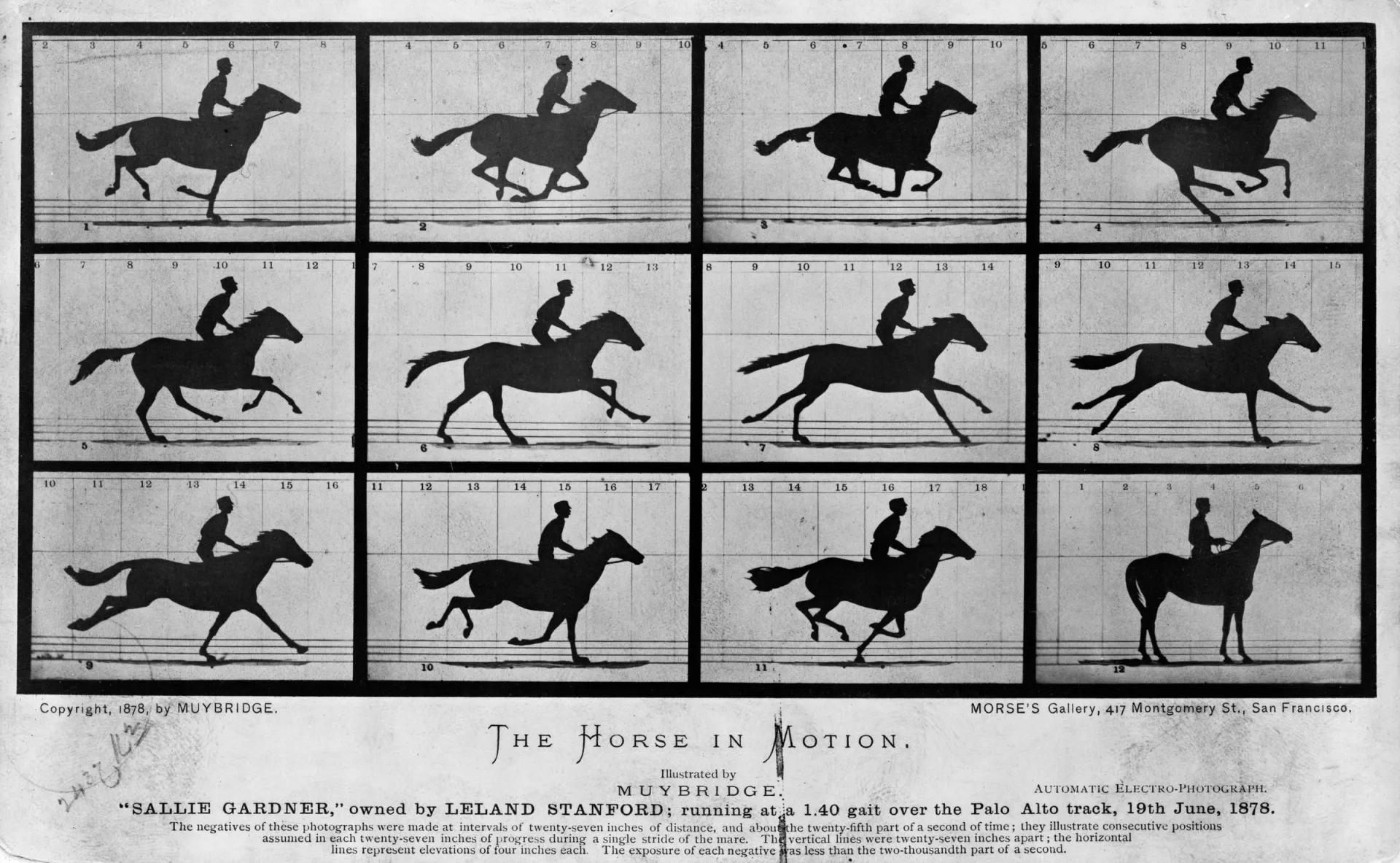
Muybridge separated movement into successive images, making a fleeting running posture available for inspection.
Article
Does a running horse ever lift all four feet from the ground? The moment is difficult to follow by eye. Eadweard Muybridge divided the action into successive photographs to make it visible.
In experiments during the 1870s, he placed several cameras along the running course. This differed from a modern camera taking a burst of images. Arranged in sequence, the exposures showed how the legs moved from one position to the next.
The photographs showed the horse airborne with its legs gathered underneath, rather than stretched far out in front and behind. A still frame caught what was easy to miss by eye: both the feet clear of the ground and the position of the legs.
Muybridge later photographed a broad range of human and animal motion at the University of Pennsylvania. Walking, climbing steps and carrying objects became subjects. Animal Locomotion, published in 1887, assembled images from multiple viewpoints.
He also worked on presenting successive images as movement. His zoopraxiscope projected images transferred to a rotating disc, rather than running the original photographic film through a projector. Scenes separated for inspection could be joined into apparent motion again.
Sources and editorial notes
archives.upenn.edu · 머이브리지 연속사진 자료 1
archives.upenn.edu · 머이브리지 연속사진 자료 2
Image source · Eadweard Muybridge
Editorial note: Facts were checked against the linked sources. Interpretations are MUADAILY’s editorial perspective. Image: Eadweard Muybridge · Public domain · Muybridge’s sequential photographs in The Horse in Motion.
Machine-translated from Korean. Read the original.