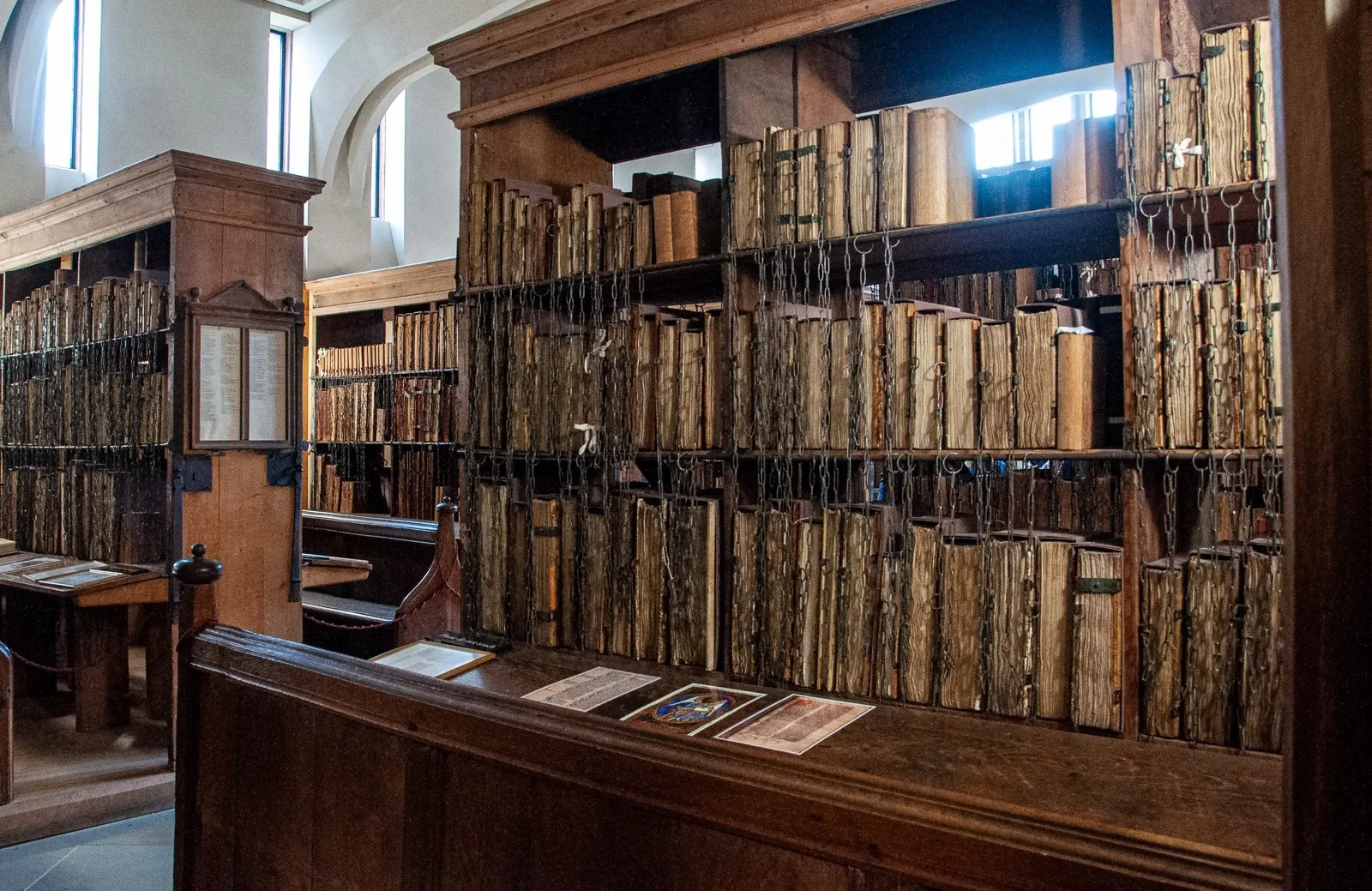
Books attached to chains face the reader with their page edges. The arrangement lets a book be opened without twisting its chain.
Article
The titles are hidden. Book spines face inward, leaving the edges of the pages toward the reader. This arrangement survives in the Chained Library at Hereford Cathedral in England. The chains attached to the books explain why they are shelved this way.
One end of each chain is fixed to the front cover. The ring at the other end slides along a metal rod beneath the shelf. A book can move far enough to be opened on the nearby desk, but cannot be taken away from the bookcase. It is secured while remaining available to read in place.
With the spine facing outward, a reader would have to turn the book after taking it down. Repeating that movement could twist the chain. Facing the page edges outward allows the book to be lowered and opened without turning it around. The unfamiliar arrangement follows the movement of the reader’s hands.
The cathedral preserves the seventeenth-century system with its chains, rods and locks. A dedicated chamber in the New Library Building presents the arrangement used from 1611 to 1841 while providing environmental conditions for conservation. Historic manuscripts remain alongside the furniture used to read them.
Two bays of shelves hold 229 medieval manuscripts, including the eighth-century Hereford Gospels. Some books are far older than the chains and shelving around them. The library preserves not only those volumes but also the arrangement that kept valuable books in place while allowing them to be read.
Sources and editorial notes
www.herefordcathedral.org · 헤리퍼드 쇠사슬 도서관 자료 1
Editorial note: Facts were checked against the linked sources. Interpretations are MUADAILY’s editorial perspective. Image: Stuart Wilding · CC BY-SA 2.0 · The Chained Library at Hereford Cathedral.
Machine-translated from Korean. Read the original.