NGV’s “Plant Life” brings together a mycelium protective-jacket prototype and furniture made with plant-based adhesives. It examines surfaces, joints, and what happens when objects reach the end of their use.
Article
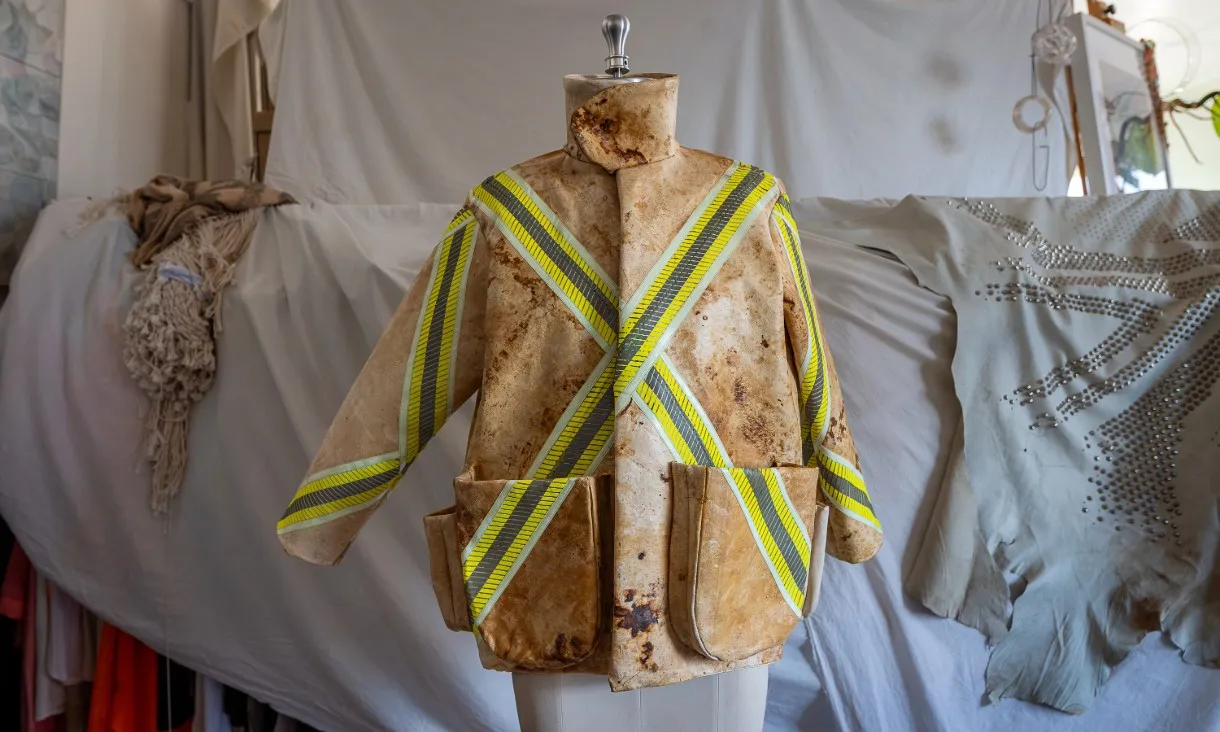
Reflective strips cross a mottled, pale jacket. Shown in the National Gallery of Victoria's “Plant Life” exhibition, it is a prototype wildfire jacket made partly from mycelium leather. The fine, threadlike networks produced by fungi become a material for testing how future protective clothing might be made. The garment brings design and materials research together around a specific use: clothing for firefighters.
RMIT researchers cultivated mycelium using agricultural waste and water, then formed it into leatherlike sheets. Designers and scientists worked together to turn the material into a jacket. Tencel, nylon, polyester, PVC, and metal components are also used. The prototype combines a new material with an existing garment structure to explore protection and wearability.
In its September 2026 announcement, the university reported durability, fire resistance, thermal insulation, and self-extinguishing properties. It also reported OEKO-TEX STANDARD 100 Product Class II certification for direct skin contact. That certification is not approval of the garment's full performance as operational firefighting equipment. The exhibit remains a prototype exploring future protective clothing.
Furniture in the exhibition also reconsiders plant-based materials. Joris Laarman's “Ply Loop Chair” draws attention to the adhesive holding plywood together. A wooden chair's end-of-life treatment depends partly on what bonds its layers. The design uses plant-derived resin and considers how the chair can be disassembled after use, shifting attention from the visible wood to its less visible bonds.
The exhibition structures ask similar questions. NGV uses Plantboard, made with the inner woody material of hemp stems and plant-based resin. Nearby are blocks made from seaweed and oyster-shell waste, accompanied by images proposing buildings made with them. The physical materials are on display; the buildings remain proposals.
“Plant Life: The Nature of Design” opened at The Ian Potter Centre in Melbourne on August 28, 2026, and runs free of charge until February 7, 2027. Seeing materials used in clothing, chairs, and display structures together encourages a closer look at everyday objects. Interest in plants can extend beyond leaves in a pot to a chair's adhesive, while lab-grown mycelium becomes part of a jacket worn around the body.
Sources and editorial notes
NGV — Plant Life: The Nature of Design official exhibition/work description
RMIT University — Mycelium suit prototype presented, 2026-09-17
Editorial note: Facts were checked against the sources above; interpretations reflect MUADAILY’s editorial perspective. Image: RMIT University · Mycelium Wildfire Jacket.
Machine-translated from Korean. Read the original.