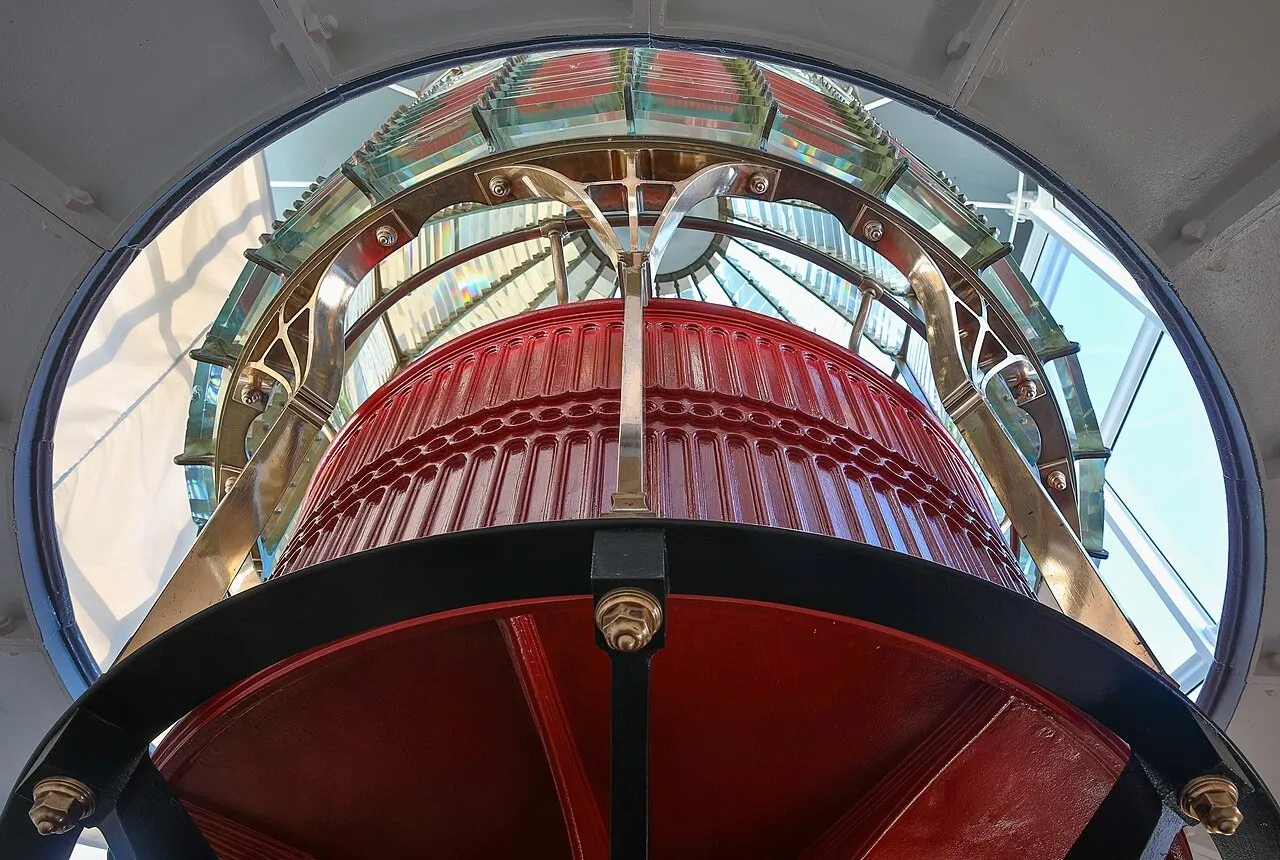
Fresnel optics arrange angled sections to concentrate light without a single massive lens. The glittering structure was a tool for distant ships.
Article
A lighthouse optic glitters like a jewel. Up close, it consists of rings and angled glass sections rather than one smooth convex lens. A Fresnel lens divides the work of a thick lens among thinner structures.
Making an ordinary convex lens larger also makes its centre very thick and heavy. Fresnel’s approach divides the required light-bending surface angles into sections. It redirects light without filling the entire volume with glass.
A lighthouse needs to collect light spreading from a source into a strong, roughly horizontal beam. The lens does not create new light energy. It sends otherwise dispersed light where it can be seen from farther away. Large lighthouse optics combine lenses and prisms.
A rotating assembly sends the beam past a ship at regular intervals. That repeating pattern helps identify the lighthouse. Timing, as well as the glass itself, becomes navigational information.
Some retired optics, such as the old Fire Island lens in New York, have been moved from a lighthouse to an exhibition space. Up close, visitors can examine the angled glass and surrounding rings that redirected the light. What appeared as one light to a distant ship resolves into many pieces of glass.
Sources and editorial notes
Library of Congress · How lighthouse light is concentrated
National Park Service · Fresnel lens history
Image source · Frank Schulenburg
Image use terms · CC BY-SA 4.0
Editorial note: Facts were checked against the linked material. Interpretations are MUADAILY’s editorial perspective. Image: Frank Schulenburg · CC BY-SA 4.0 · Fresnel lens at Point Reyes Lighthouse.
Machine-translated from Korean. Read the original.