Kvadrat Really turns discarded textiles into rigid boards. A chair made from customers’ returned clothing shows how fibers can take on a new role inside a shop.
Article
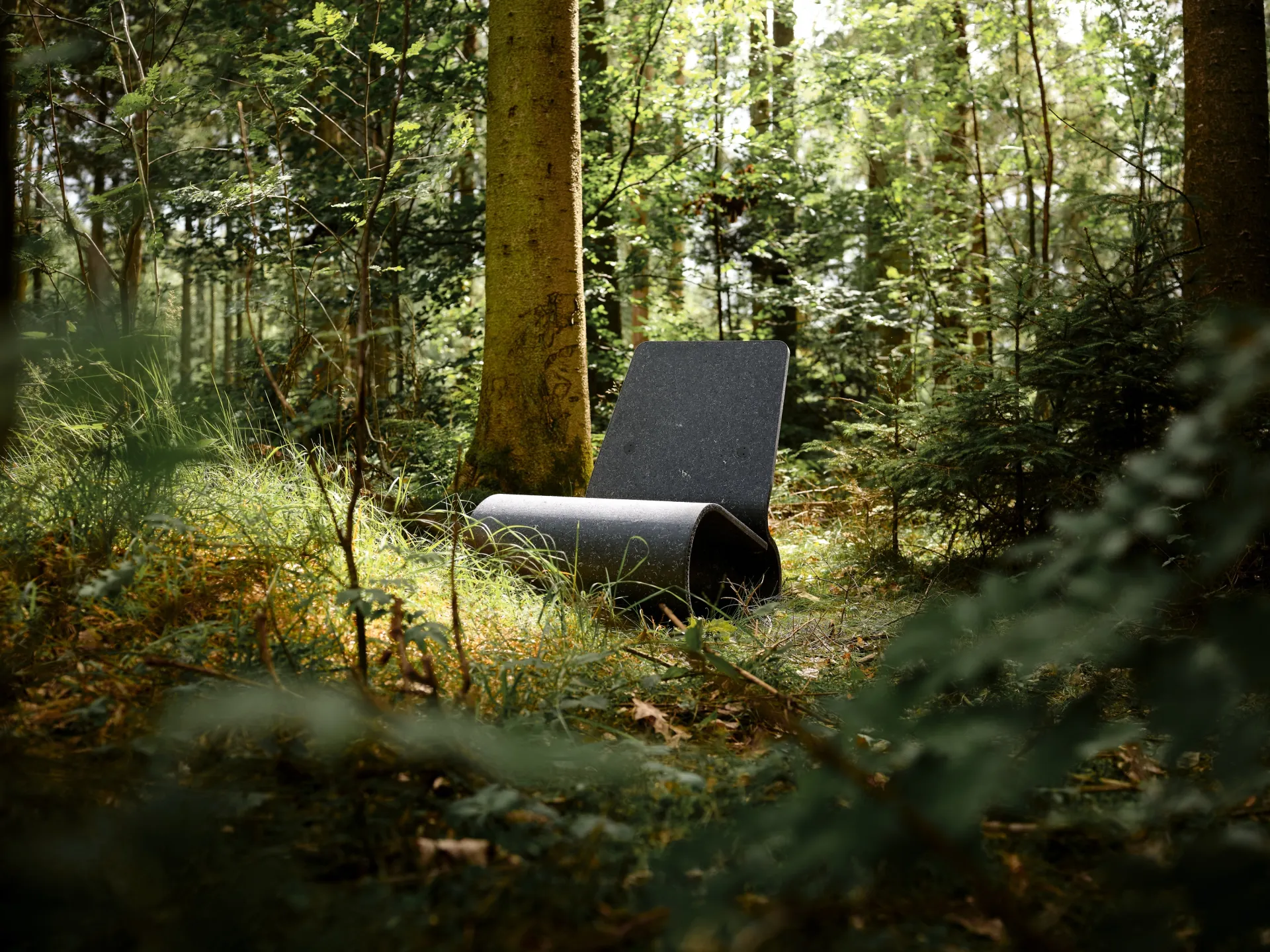
Used clothes have returned to a clothing shop as a chair rather than as new garments. The chair introduced by Danish brand SHAPING NEW TOMORROW in 2022 contains clothing handed in by customers. This is not upholstery: the fibers were turned into rigid boards and used to form the furniture itself. Once-soft garments now support a seated person's weight.
Kvadrat Really makes furniture boards from discarded textiles. It collects leftover fabric and end-of-life material from industrial laundries, fashion businesses, and textile production and supply chains. After sorting by color and quality, the material is broken down into fibers. The garment's shape disappears before the fibers become part of another object.
The loose fibers are mixed with a binder and formed into thin felt sheets. These are layered with thicker fiber material and compressed into boards. The manufacturer's current Textile Board composition is 70 percent textile waste and 30 percent waste-derived binder. It is neither a board made entirely from old clothes nor an adhesive-free material. The fibers need something to hold them together as furniture.
No new dyes are added to create the color. Existing shades of denim, cotton, and wool combine into the surface tone, so batches can differ slightly. Randomly arranged fibers also leave a pattern. Like wood grain, the surface reveals the color and arrangement of its constituent material.
The chair, designed by Jacob Guldmann and Guldmann Studio, demonstrates one use for the board. The brand presented it as a project for its Copenhagen, Hamburg, and Berlin stores. Clothes handed in by customers become visible again where new clothes are chosen. Material that can be hard to trace after entering a collection bin returns as somewhere to sit.
The manufacturer says used boards can also be taken back by agreement and broken down into fibers again. This is not an automatic take-back promise for every product; a collection route is needed to connect the next stage of reuse. The chair already demonstrates one change clearly: clothing that has reached the end of one use can take on another job in a different form.
Sources and editorial notes
Kvadrat Really — Textile Board Current Composition, Color, and Specifications
Kvadrat Really — Fiber collection, sorting, compression and recovery process
Kvadrat Really — SHAPING NEW TOMORROW Hot seat·2022 chair
EPD Danmark — Textile Board environmental declaration data registration
Editorial note: Facts were checked against the sources above; interpretations reflect MUADAILY’s editorial perspective. Photo: Kvadrat Really official project material (photographer not credited).
Machine-translated from Korean. Read the original.