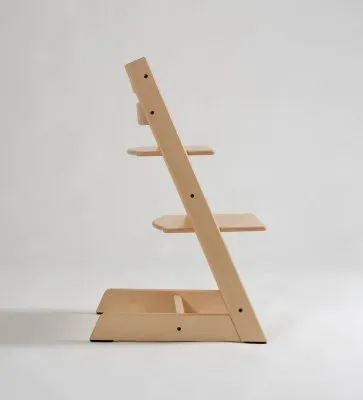
Stokke’s Tripp Trapp has a seat and footrest adjustable in height and depth. The table stays in place while the chair adapts to a growing body.
Article
The table stays the same height, but a child keeps growing. At the right sitting height, their feet may dangle; with their feet on the floor, the table may be too high. Stokke's Tripp Trapp addresses that difference with a separately adjustable seat and footrest, repositioning the support as the child grows.
Designed by Peter Opsvik in 1972, the chair has two boards held between sloping side frames. One is the seat; the other supports the feet. Both height and depth can be adjusted. Rather than asking a growing body to fit a fixed shape, the boards move to fit the person.
The footrest is more than a small step. With the feet supported, contact extends beyond the seat. The manufacturer's fitting instructions explain how to check seat depth and footrest position against the thighs and lower legs. There is more to the fit than simply raising a child to an adult table.
Joining the family at the same table is central to the design. It is furniture to use as a person grows, rather than a separate feeding chair put away after meals. Continued use into adulthood requires adjustments and accessories appropriate to each stage.
The Newborn Set and Baby Set are separate configurations. The basic chair alone is not a seat for a newborn. Official instructions specify the stages appropriate to each set. A chair designed to last needs its fit checked as the user's body and needs change, rather than remaining in its original configuration.
One day, instead of bringing home a new chair, you move a board to another slot. The feet rest at a new height and the sitting depth changes, while the family table remains in place. Tripp Trapp follows the person growing beside it.
Sources and editorial notes
Peter Opsvik · The 1972 design and sharing the family table
Stokke · Official user manual · 1972 · Seat and footrest
Editorial note: Factual statements are based on the sources above; interpretations reflect MUADAILY's editorial perspective. Image: Product Photo: Peter Opsvik.
Machine-translated from Korean. Read the original.