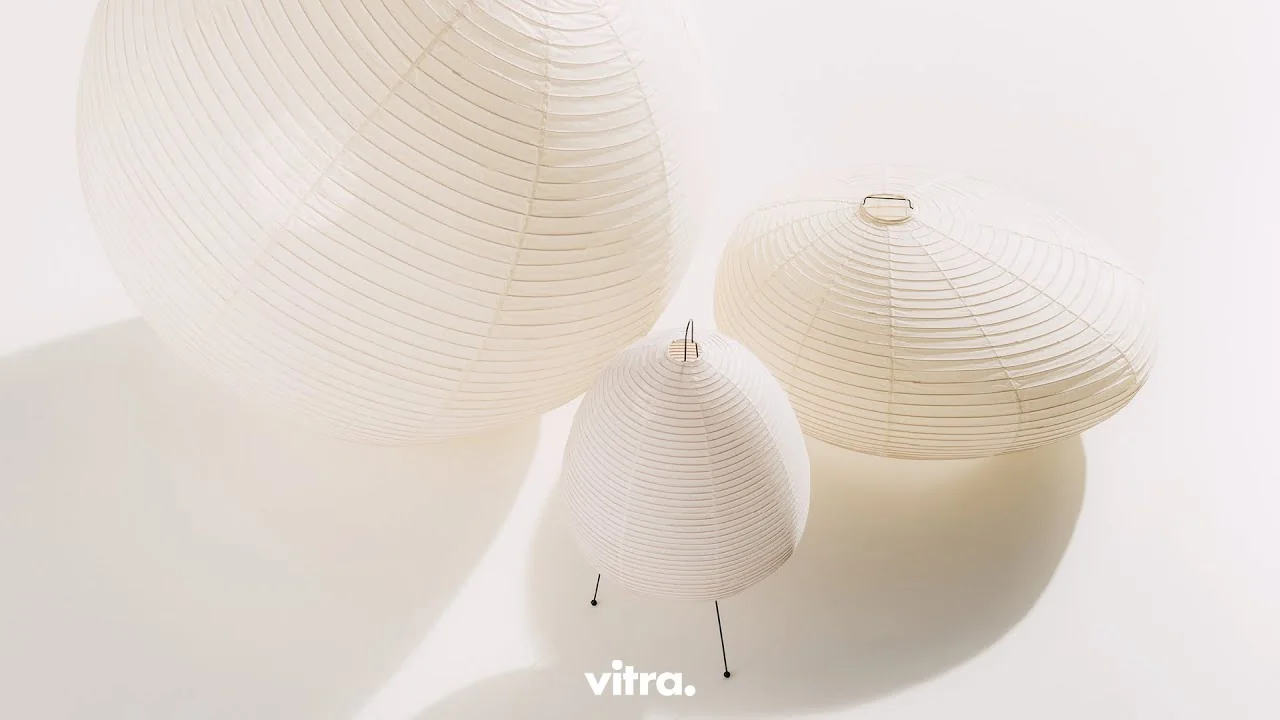
Akari’s paper shades are made over bamboo ribs on wooden molds. Once the paper has dried and the mold is removed, the shade can fold flat for packing.
Article
A light that fills out into a rounded shape in a room can arrive in a flat box. Isamu Noguchi's Akari lamps have collapsible paper shades. Bamboo ribs visible through the thin paper hold their shape, while the wooden mold used during production is removed before the shade is finished.
Noguchi began Akari in 1951 after encountering paper-lantern making in Gifu, Japan. The Noguchi Museum calls the series light sculptures. Table, floor, and ceiling models vary in size and shape according to where they are used. Vitra presents this range alongside the familiar rounded shades: paper and bamboo remain the materials while the forms and positions change.
Ozeki in Gifu makes the shades by hand from bamboo and washi. Washi is Japanese paper; these lamps use paper made from fibers obtained from the bark of mulberry-family plants. Paper and ribs are visible in the finished shade, but production begins with a wooden mold made for the particular model.
The museum's account describes thin split-bamboo strips joined with white cotton thread into a continuous length. This is wound along grooves in the mold to form the ribs. Their spacing and the mold's shape determine the lines on the surface and the overall outline. Akari's different forms begin with different molds.
The maker then applies rice paste with a brush and attaches the paper, pressing it to the mold's shape and trimming the edges. Thin paper spans the gaps between the bamboo ribs, making the broad surface that transmits light. The ribs support it from within.
After the paper dries, the wooden mold is collapsed and removed. The tool that gave the shade its volume does not remain inside the lamp. With the mold gone, the shade can fold into a flat box for transport or storage. That is how its full shape in a room becomes a slim package.
Akari depends on more than the lightness of paper. It also needs the arrangement of bamboo ribs, a mold for attaching the paper, and a sequence that allows that mold to be removed. Follow the fine ribs in a finished lamp and part of the making process becomes visible. Paper transmits the light and bamboo holds the shape after the mold has gone.
Image description: Akari paper lighting in a preview of the official Vitra production video.
Image source: Vitra / Official release video preview
https://www.youtube.com/watch?v=hQ8SbDJ7Cck
Image changes: resized with the original aspect ratio preserved and converted to WebP. No cropping.
Sources and editorial notes
The Noguchi Museum · Akari Light Sculptures · Production Description
Vitra · Akari Light Sculptures · Official Production Process
Source of preview · Vitra / official public video preview
Editorial note: Factual statements are based on the sources above; interpretations reflect MUADAILY's editorial perspective. Image: Vitra / Official release video preview.
Machine-translated from Korean. Read the original.