Anglepoise uses springs to balance its articulated arm. We look at how a mechanism developed in the 1930s lets readers and artists move the light where they need it.
Article
When you open a notebook beside the book you are reading, the place that needs light shifts a little. If you pull the lamp head toward you and it stays put when you let go, you can stop thinking about the lamp. Anglepoise's long arm and exposed springs make that small convenience possible. Its familiar shade is only part of the appeal: just as striking is the way it stays where you put it.
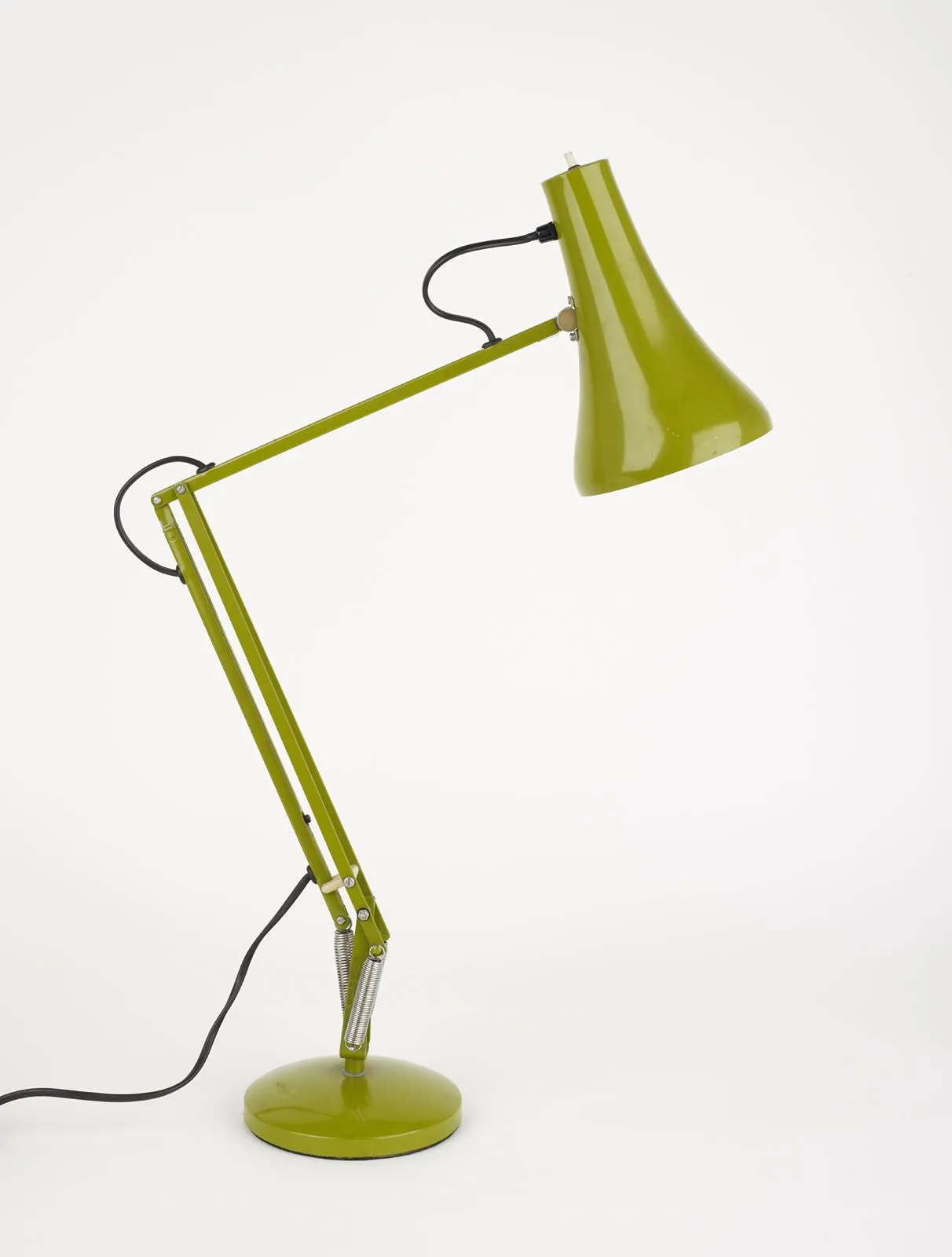
The design began with automotive engineer George Carwardine's experiments with springs. According to London's Design Museum, Carwardine, who worked on vehicle suspension systems, studied spring and lever mechanisms and registered a related patent in 1932. He applied the principle of a mechanism that stays balanced after being moved in different directions to a lamp. A heavy base supports the whole lamp, while its articulated arm carries the shade where it is needed. With the components on view, it is easy to see what supports the lamp and allows it to move.
The lamp did not start out with the form familiar today. The early model introduced in 1934 used four springs. The 1227, which followed a year later, reduced that number to three and had a base better suited to a domestic setting. Later models varied the base, shade, and materials.
For detailed work, you can lower the lamp closer to your hands, then push it back a little when you open another book. The springs support the arm's weight, allowing the lamp to stay in position after you move it. That saves you the trouble of loosening and retightening screws at each joint. You do not have to calculate how to keep it balanced. The springs and joints doing that work are right there in front of you.
The Original 1227 offered by the manufacturer today carries on this balancing mechanism. Even as new colors and sizes have been added, the bending arm and springs remain recognizable features of an Anglepoise. A familiar shape does not mean that vintage lamps and current models share the same electrical specifications, however. The light source and installation requirements still need to be checked for the particular product you plan to use.
Move the lamp, then go straight back to your book. Anglepoise brings to mind a measure of lighting performance beyond brightness: how easily you can put the light where you need it. The arm follows your hand, then waits when you let go. That movement, which takes little explanation to learn, is what keeps this old design worth a closer look.
Sources and editorial notes
Design Museum · The mechanism and history of Anglepoise
Anglepoise · Original 1227 official product page
Editorial note: Factual statements are based on the sources above; interpretations reflect MUADAILY's editorial perspective. Image: Design Museum / Anglepoise reference material.
Machine-translated from Korean. Read the original.