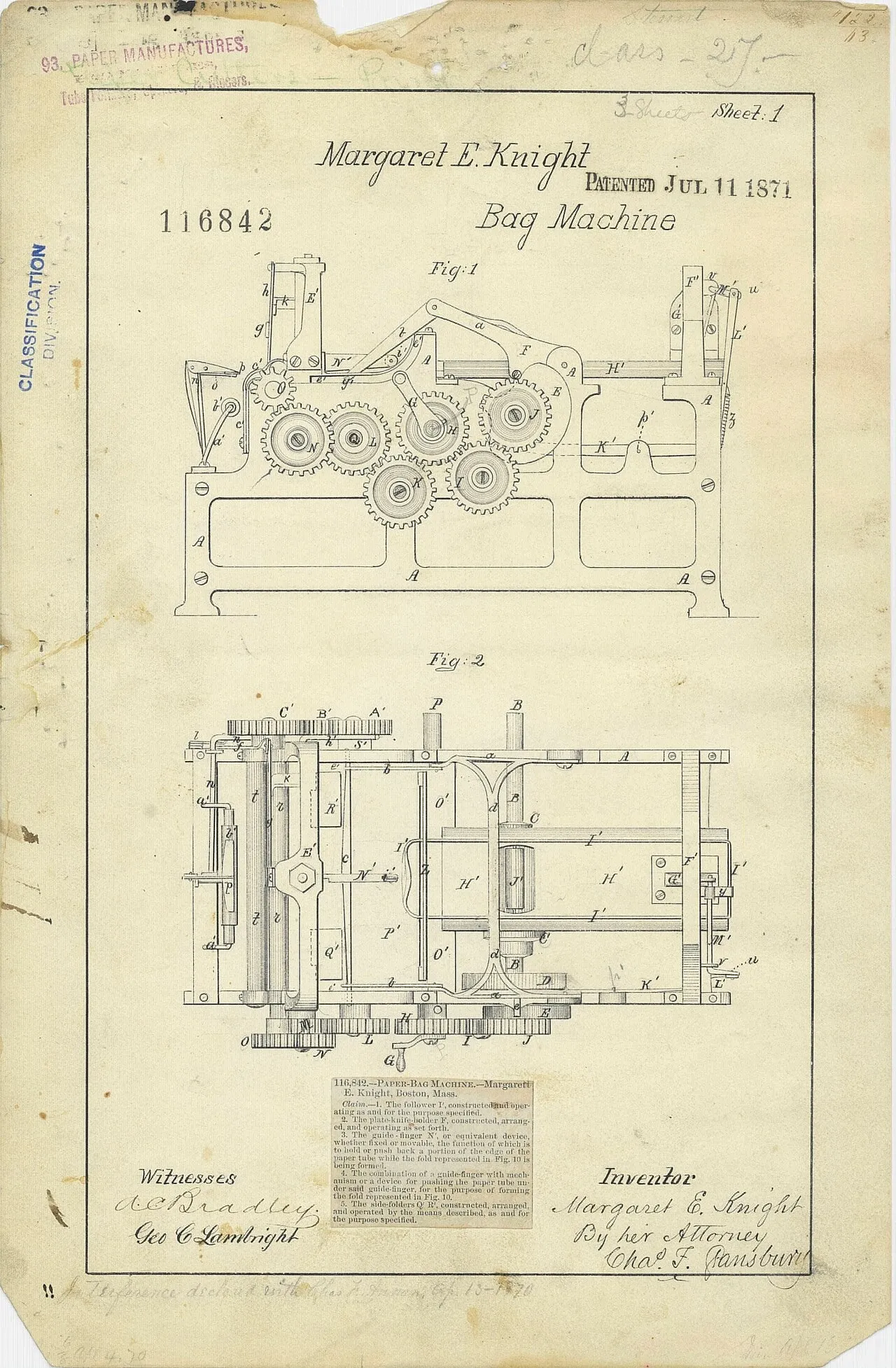
Cut, fold and paste: Margaret Knight’s machine turned the work of making a square-bottomed paper bag into a sequence of mechanical movements.
Article
Set a bakery bag on the table, open its mouth and unfold its base. It can stand reasonably straight without a hand holding it. The gesture is so familiar that it hardly looks like an invention. Yet cutting, folding and pasting flat paper into a useful base was not always a machine’s job.
While working at a Massachusetts paper-bag factory in 1867, Margaret Knight began developing a way to mechanize that process. The challenge involved more than producing bags quickly: the machine had to repeatedly make a flat base that was convenient to fill and stand upright. Cutting and folding had to happen in the right sequence as the paper moved.
Knight’s 1879 patent model at the Smithsonian shows the mechanism for cutting and folding paper. It improved on her 1871 paper-bag-machine patent. She continued refining the sequence and moving parts after building the earlier machine.
The bag continued to change. Charles Stilwell improved the side folds, contributing to a bag that lay flat in storage and stood when opened. Knight’s machinery and later refinements helped make bags easier both to produce and to use.
Unfold an empty bag and its overlapping layers and creases come into view. Following the folds backward suggests how flat paper became a base. Once the bag is opened and filled, those layers hold it upright after the hand lets go.
Sources and editorial notes
Smithsonian · Knight’s paper-bag machine patent model
Smithsonian · Margaret Knight’s paper-bag machine
MoMA · Flat-Bottomed Paper Bag
Image source · NARA collection
Editorial note: Facts were checked against the linked material. Interpretations are MUADAILY’s editorial perspective. Image: NARA collection · Public domain · Margaret Knight’s paper-bag machine patent drawing.
Machine-translated from Korean. Read the original.