The red second hand waits for the next minute. A movement associated with synchronizing station clocks survives in a domestic version.
Article
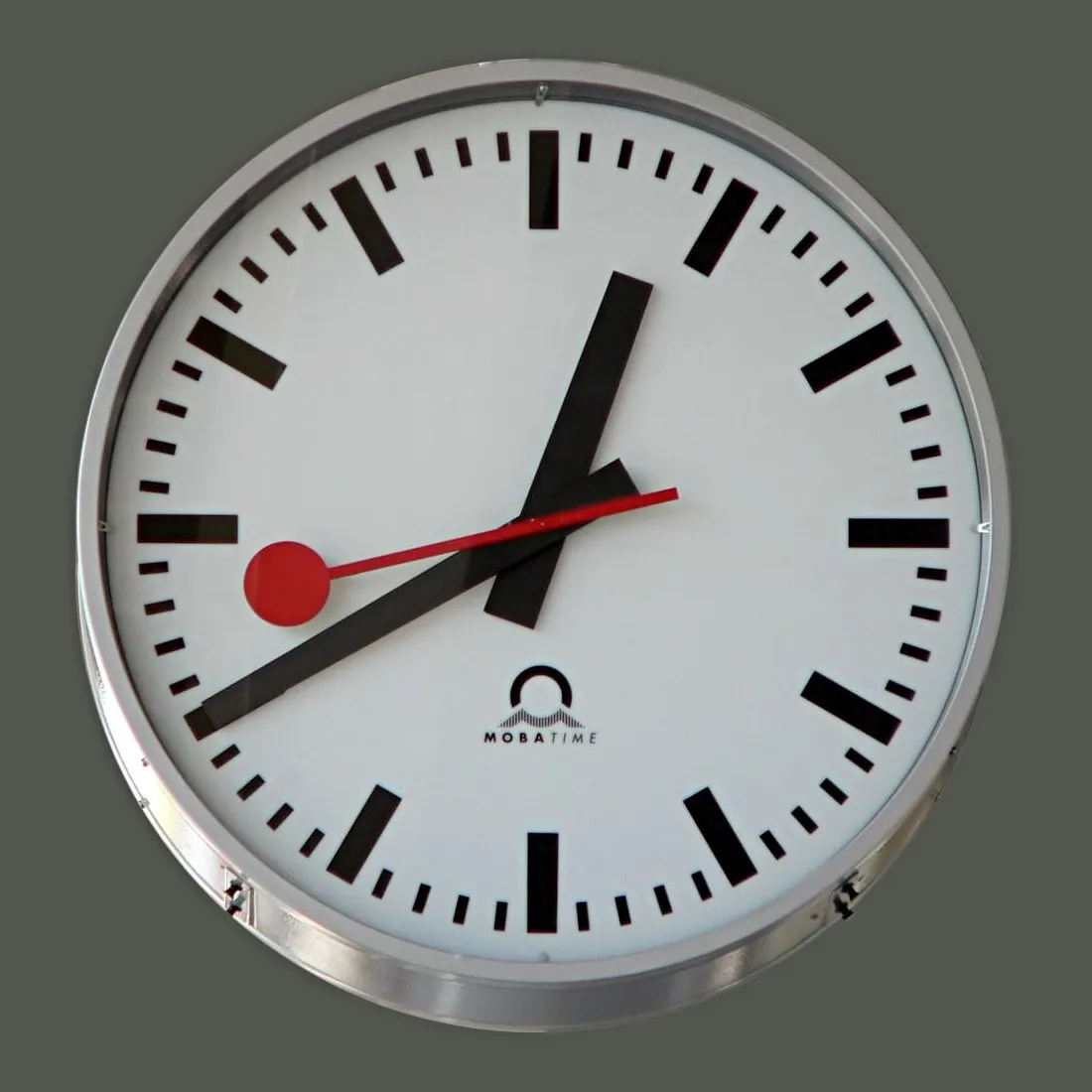
At a station, a red second hand reaches the top of a clock and briefly waits. Just as it seems to have stopped, the minute hand advances and the second hand departs again. This is the Swiss railway clock’s celebrated movement.
The pause is not an accidental error. It relates to synchronizing multiple clocks with a central reference signal. Completing a circuit early and waiting for the next minute allowed clocks around a station to begin that minute together.
The domestic Mondaine stop2go wall clock recreates the movement. The model described by SBB completes a circuit in 58 seconds and pauses for roughly two seconds. Those timings are specific to that model. It synchronizes over wireless internet while retaining the old station-clock gesture of waiting briefly at the top.
Black marks on white and a round-ended red hand are easy to distinguish at a distance. The face directs attention to positions rather than densely printed numbers. Its simple appearance conceals a procedure for coordinating a common starting point.
A precise clock might seem obliged never to stop. Here, waiting was part of synchronization. Above passengers waiting for a train, the clock briefly waits for the next minute too.
Sources and editorial notes
SBB · Mondaine stop2go and station-clock synchronization
Image source · JuergenG, modified by Rainer Z
Image use terms · CC BY-SA 3.0
Editorial note: Facts were checked against the linked material. Interpretations are MUADAILY’s editorial perspective. Image: JuergenG, modified by Rainer Z · CC BY-SA 3.0 · Red second hand of the Swiss railway clock design; not an identification photo of the current stop2go model.
Machine-translated from Korean. Read the original.