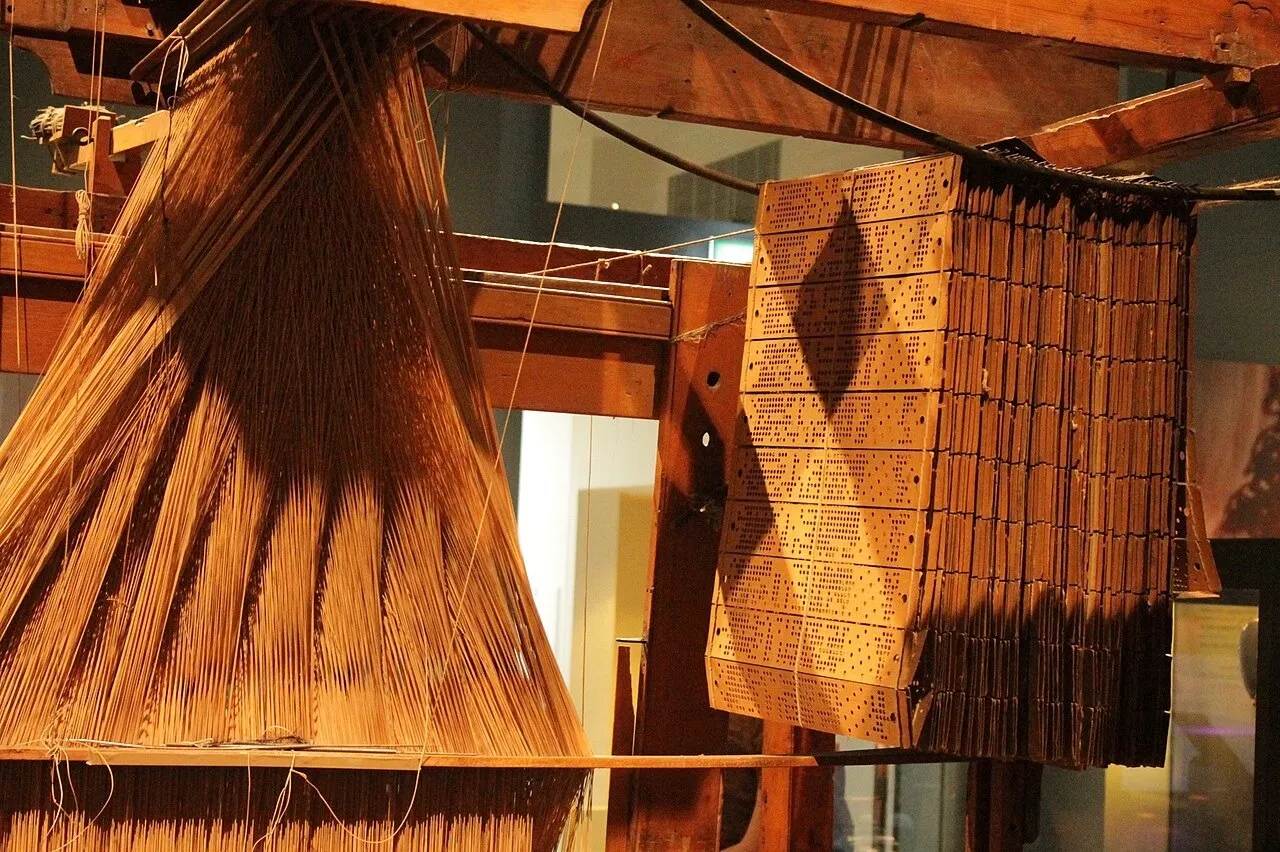
Jacquard cards specify which warp threads to lift, translating a complex textile pattern into a repeatable sequence of actions.
Article
A chain of punched cards hangs beside a textile, connected to a Jacquard loom. The holes determine which warp threads rise so the weft can pass between them. To weave a floral pattern, the loom follows a prepared sequence of cards rather than requiring a person to select and lift each thread anew.
Weaving passes crosswise weft through lengthwise warp. Choosing which warp threads lift changes their intersections. A complex pattern requires those choices to repeat accurately over many rows.
The Jacquard mechanism reads the presence or absence of holes mechanically. Linked cards supply successive stages, and the sequence can repeat. The cards are not the textile itself but a record specifying actions that produce it.
National Museums Scotland describes how recording a sequence in punched cards influenced Charles Babbage’s calculating-machine ideas. Cards specified the pattern, but the loom still needed an operator. The Science Museum’s surviving handloom shows the card mechanism alongside the parts worked by a person.
Flowers and curves appear on the cloth; holes appear on the linked cards beside it. Each passing card changes which warp threads rise before the weft crosses between them. The intricate pattern grows row by row from that recorded sequence.
Sources and editorial notes
Science Museum Group · Jacquard hand loom
National Museums Scotland · Jacquard loom
Image source · Stephencdickson
Image use terms · CC BY-SA 4.0
Editorial note: Facts were checked against the linked material. Interpretations are MUADAILY’s editorial perspective. Image: Stephencdickson · CC BY-SA 4.0 · Jacquard loom with linked punched cards.
Machine-translated from Korean. Read the original.