Colours float on a liquid surface and are drawn into patterns with combs. The marbled endpapers inside a book are lifted one sheet at a time.
Article
Open a book cover and coloured waves may spread across the paper inside. Some resemble marble veins; others curve into regular feather-like patterns. Traditional paper marbling does not draw these directly on the sheet. Colour is floated on liquid first, then transferred to paper.
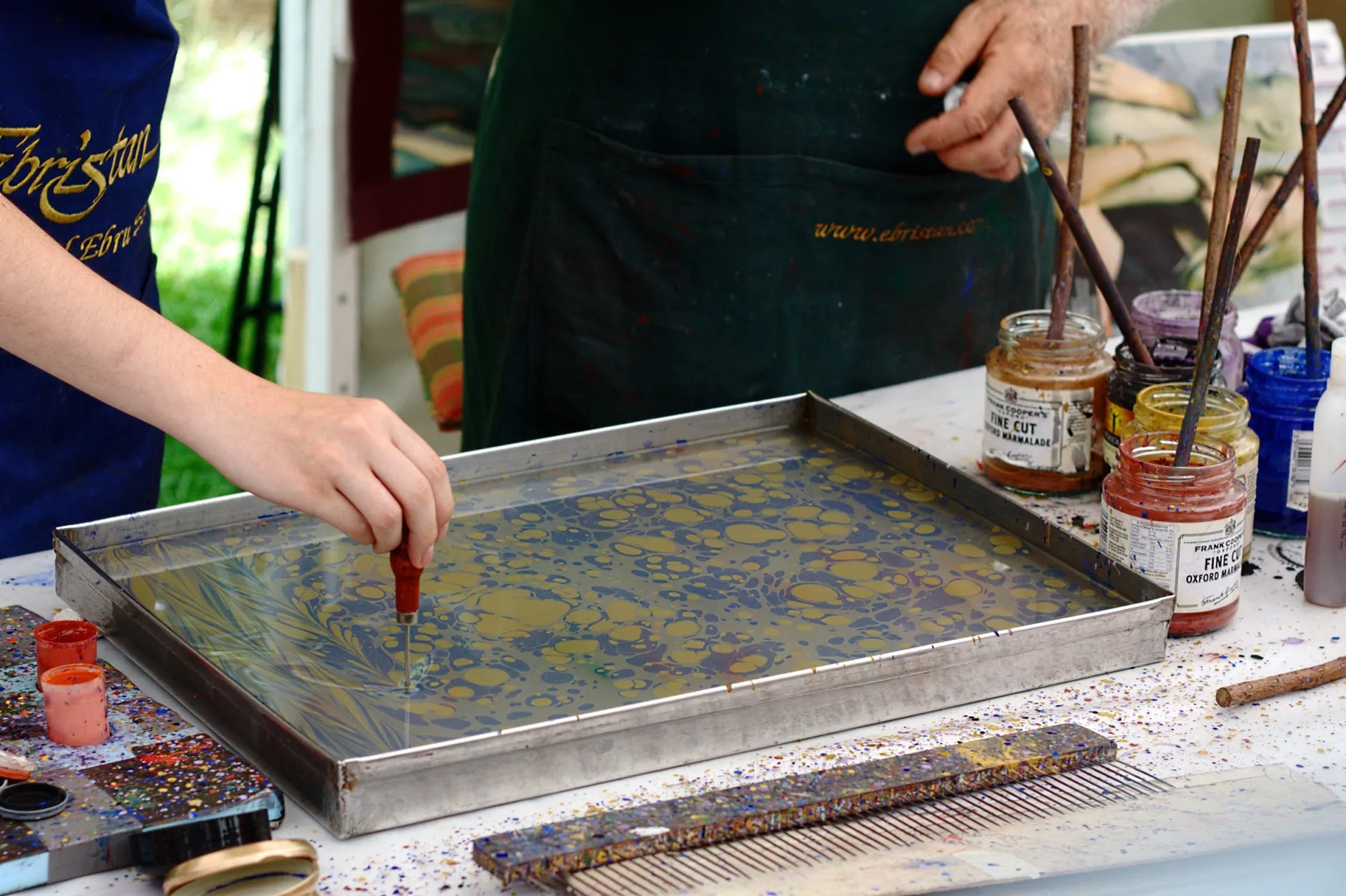
A shallow tray holds a liquid that supports the paint. Materials such as carrageenan can increase its viscosity and make the process easier to control. Drops of colour spread across the surface; adding another colour pushes earlier ones aside and creates new boundaries.
A pointed tool or a comb draws through those boundaries, stretching them together. Comb spacing and direction help produce repeated patterns. What looks like accidental spreading may depend on a careful sequence of movements.
Prepared paper is lowered gently onto the surface to receive the pattern. It is then lifted, rinsed and dried. In Europe, marbled paper was used for covers and endpapers, while marbling was also applied to ledger edges. Interruptions to the edge pattern could reveal missing or altered pages.
After one sheet is lifted, the surface must be prepared for the next. The same comb and colours can create a similar pattern, but the flowing lines settle into slightly different places each time.
Sources and editorial notes
heritagecrafts.org.uk · 물 위 무늬를 옮기는 마블링 자료 1
heritagecrafts.org.uk · 물 위 무늬를 옮기는 마블링 자료 2
Editorial note: Facts were checked against the linked sources. Interpretations are MUADAILY’s editorial perspective. Image: Zephyris · CC BY-SA 3.0 · Preparing coloured patterns in a marbling tank.
Machine-translated from Korean. Read the original.