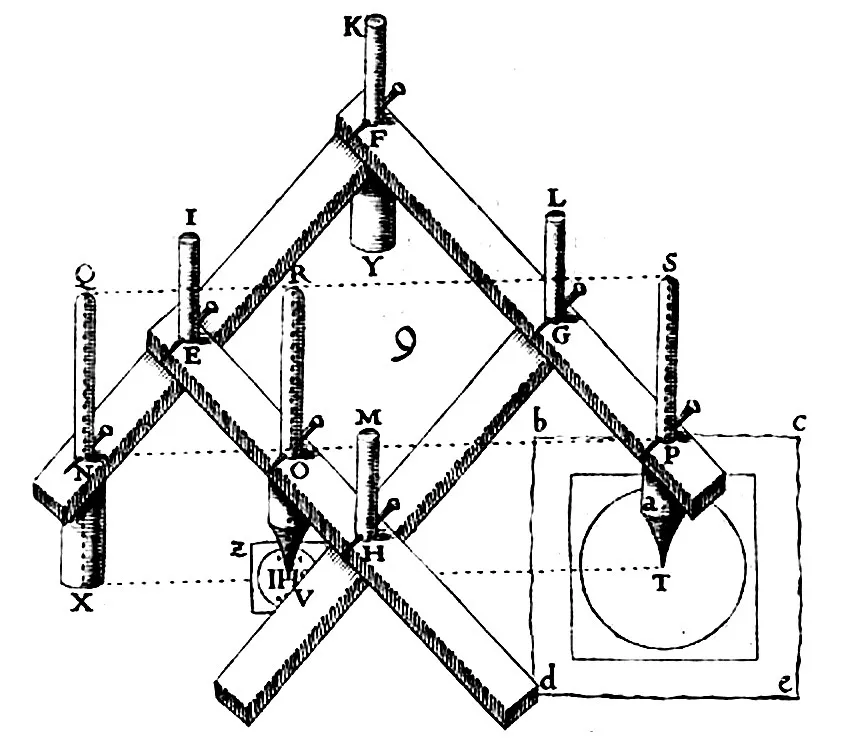
A pantograph uses linked rods and fixed proportions to enlarge or reduce drawings. A tracing point guides a pencil elsewhere on the mechanism.
Article
Trace the outline of a small picture and a pencil beside it draws a larger one. No screen or motor is involved. A pantograph uses articulated rods to copy a drawing at another scale. The enlargement is set by hand before tracing begins.
Its basic structure is a set of rods forming a parallelogram. One point is fixed, another holds a stylus that follows the original, and a third carries the drawing pencil. As the joints move, the geometric relationship between the rods keeps the two moving points in a constant proportion.
The positions of the pencil and tracing point determine the size of the copy. A short movement over the original can produce a longer line at the pencil. Reversing the arrangement can reduce a large drawing.
Accurate copying needs a stable support and freely moving joints. A slipping anchor or loose connection can displace a line even when the geometric ratio is correct. The steadiness of the hand tracing the original also remains visible in the result.
An early pantograph preserved by the Science Museum shows linked rods made with brass and wood. Spread over the paper, its long arms extend around the drawing. Even when following a small curve in the original, several articulated rods change direction together.
Sources and editorial notes
collection.sciencemuseumgroup.org.uk · 그림을 확대 축소하는 팬터그래프 자료 1
catalogue.museogalileo.it · 그림을 확대 축소하는 팬터그래프 자료 2
Image source · Christoph Scheiner / Amada44
Editorial note: Facts were checked against the linked sources. Interpretations are MUADAILY’s editorial perspective. Image: Christoph Scheiner / Amada44 · Public domain · A pantograph illustration from Christoph Scheiner’s book.
Machine-translated from Korean. Read the original.