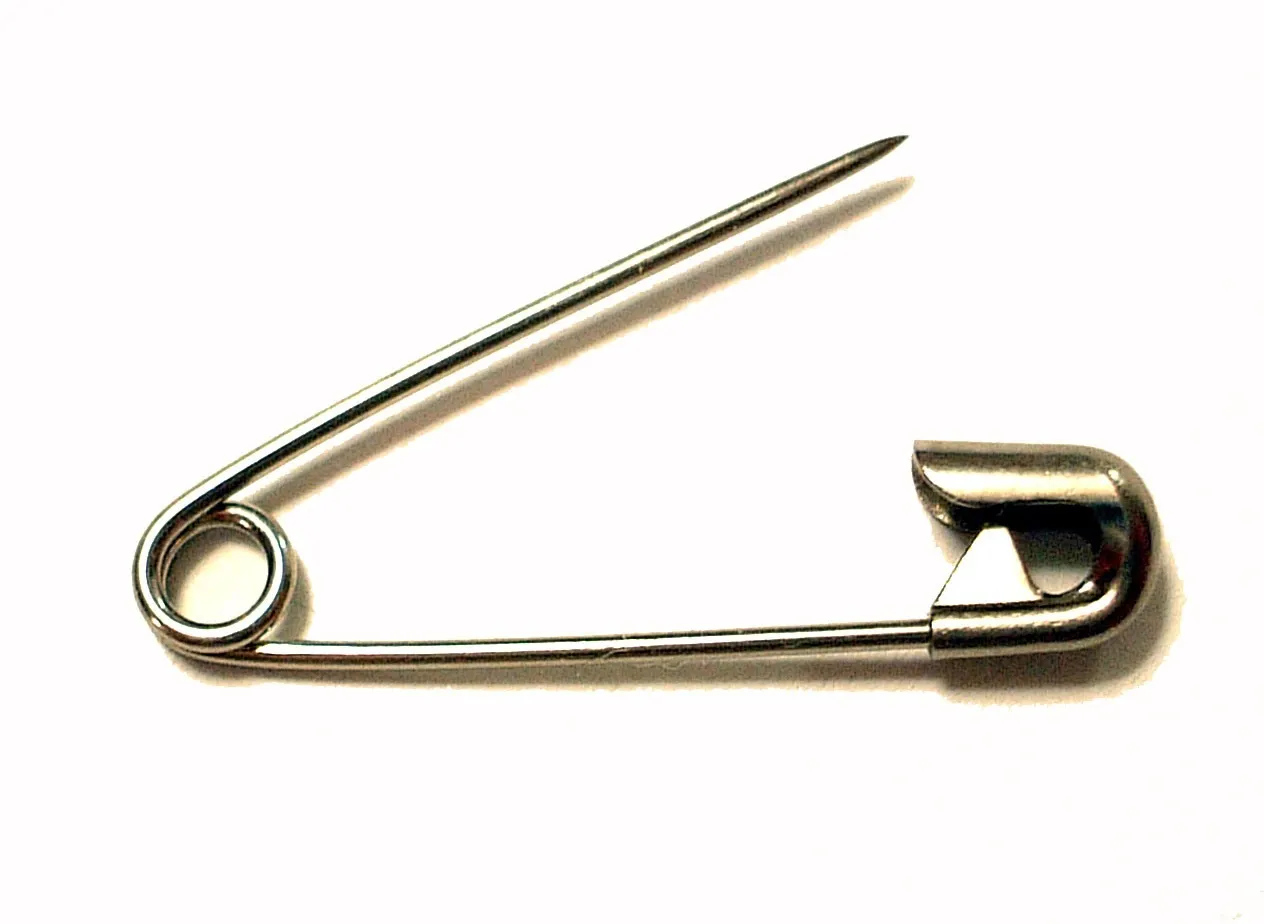
A bent piece of wire combines a spring with a cover for its sharp tip. Both functions are built into the movement of opening and closing it.
Article
To open a safety pin, press its pointed end inward slightly and move it sideways out of the clasp. Release it, and the pin springs apart. The small coil at the opposite end acts as a spring. Closing the pin means pressing against that force and slipping the point into the clasp.
American inventor Walter Hunt patented a device leading to the modern safety pin in 1849. A single piece of bent metal wire provided spring tension, while a clasp held and covered its point. The design kept the sharp tip covered after the pin had fastened the cloth.
Pins for fastening clothing existed long before Hunt. Ancient Roman fibula brooches served that purpose, and another version of the safety pin appeared in 1842. Hunt’s design added the spring mechanism that pushed the point into place.
Once the point has passed through the fabric and entered the clasp, spring force helps keep it seated. To release it, press the point and move it sideways again. Its sharp end stays covered while fastening the cloth and emerges when the pin is opened.
Sources and editorial notes
lemelson.mit.edu · 옷핀 스프링과 덮개 자료 1
www.moma.org · 옷핀 스프링과 덮개 자료 2
Editorial note: Facts were checked against the linked sources. Interpretations are MUADAILY’s editorial perspective. Image: Haragayato · CC BY-SA 3.0 · A safety pin showing its coil and clasp.
Machine-translated from Korean. Read the original.