One continuous curve runs from backrest to seat and floor. Making that shape support a sitter required repeated changes to the Panton Chair’s materials and production methods.
Article
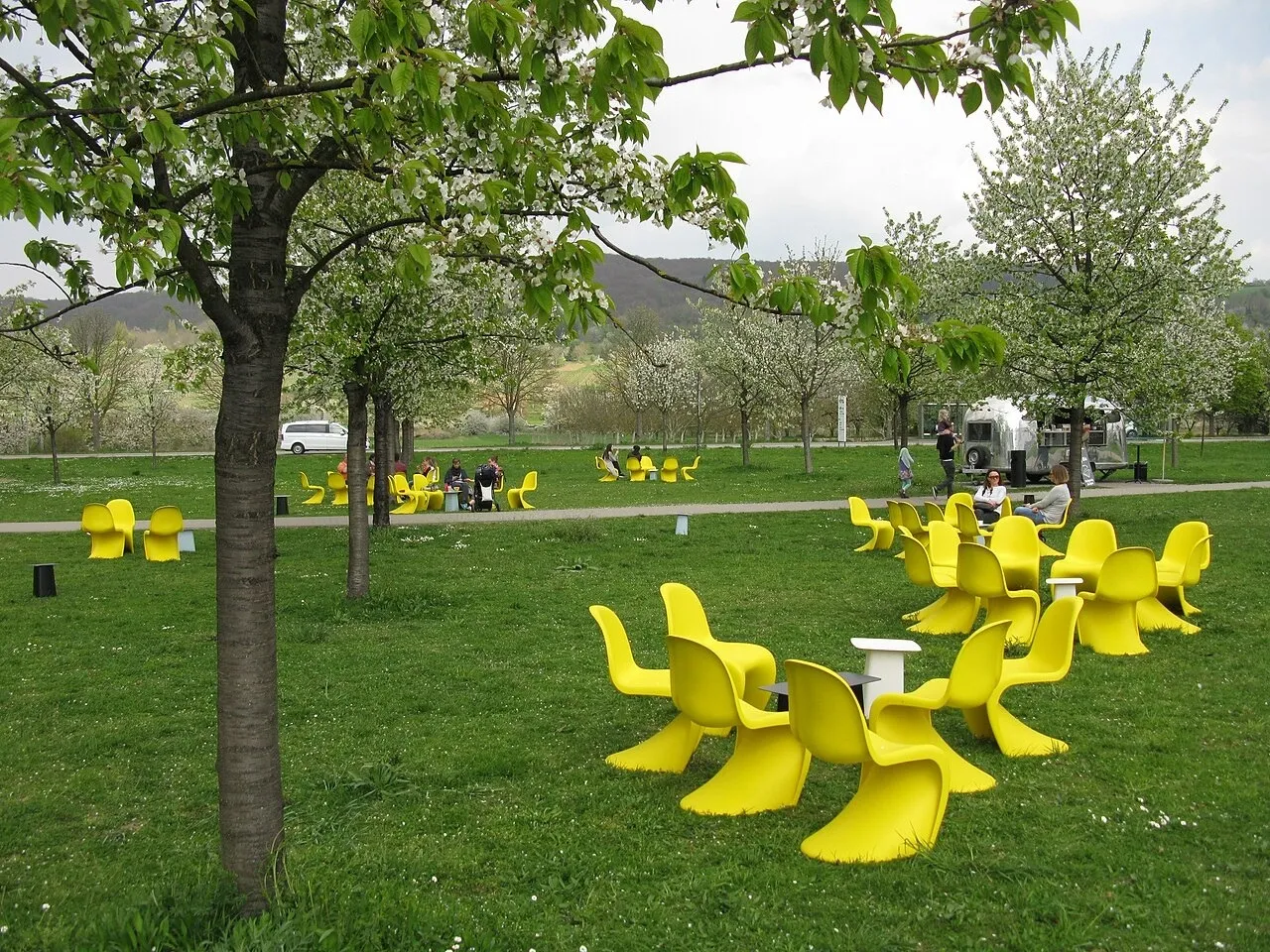
Seen from the side, a continuous curve runs from backrest through seat to floor. There are no rear legs, yet someone can sit on it. Verner Panton’s chair appears as a single bent form rather than an assembly of separate parts.
Making that form into a product was less smooth. Ideas and models from the 1950s led to development with Vitra and initial series production in 1967. A sketch did not instantly become today’s chair. The shape had to support a person and be reproducible.
Materials and manufacturing changed repeatedly. Early glass-fibre-reinforced polyester gave way to experiments with other resins and moulding methods, including versions with added reinforcement. The familiar polypropylene version arrived in 1999. Chairs bearing the same name can therefore use different materials.
Removing visible joints simplified the appearance while increasing the material’s responsibilities. It had to carry loads through the curved body to the floor and reliably retain the intended form during manufacture.
From the side, the space beneath the seat makes it appear to float. A sitter’s weight passes through the curved body to the floor. The continuous line from backrest to base becomes a supporting structure the moment someone sits down.
Sources and editorial notes
Verner Panton Design · Panton Chair
Image source · Andreas Schwarzkopf
Image use terms · CC BY-SA 3.0
Editorial note: Facts were checked against the linked material. Interpretations are MUADAILY’s editorial perspective. Image: Andreas Schwarzkopf · CC BY-SA 3.0 · Panton chairs outside the VitraHaus.
Machine-translated from Korean. Read the original.