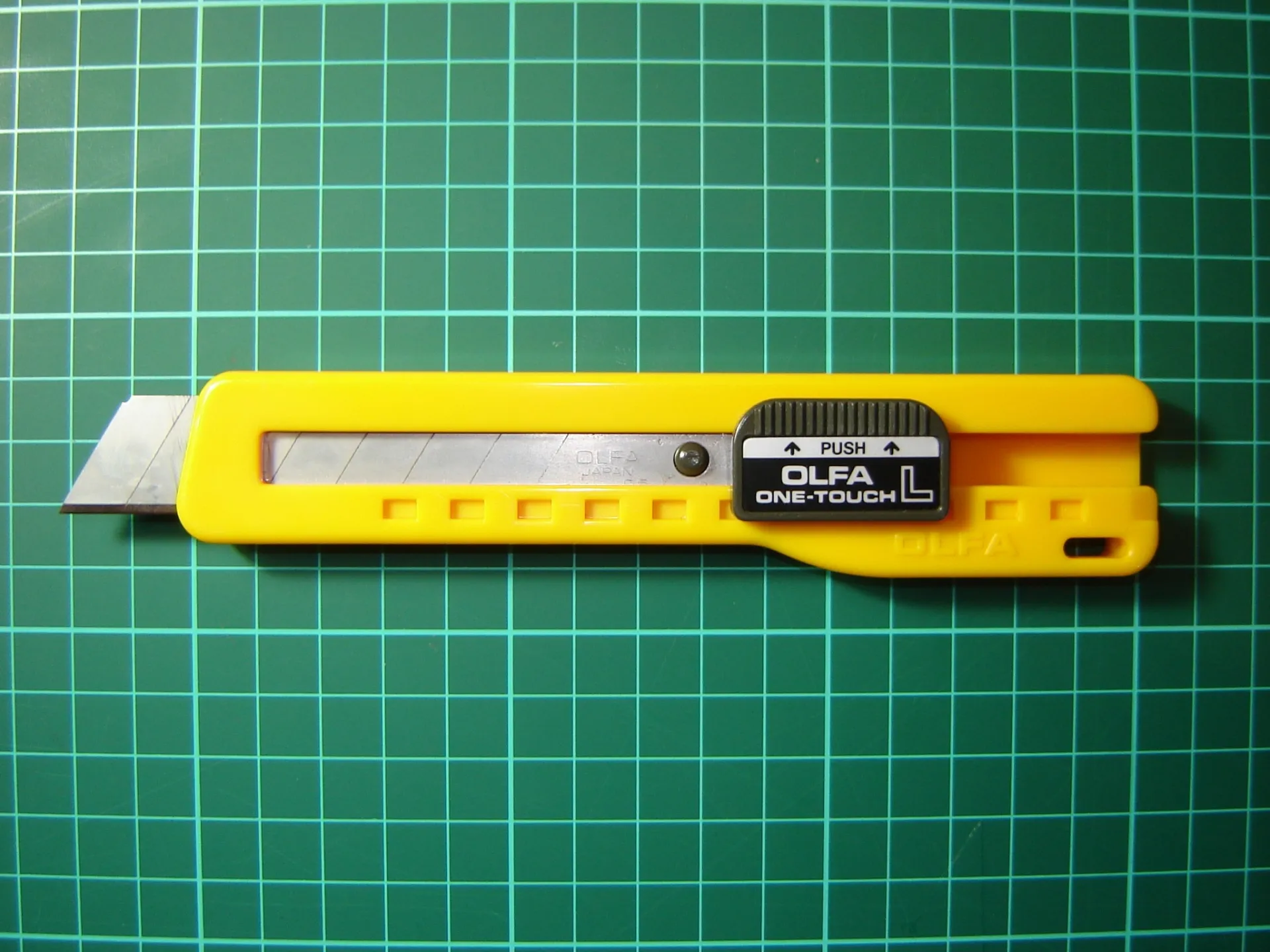
OLFA founder Yoshio Okada combined memories of broken glass and segmented chocolate to make a blade that exposes a fresh edge one section at a time.
Article
When a snap-off cutter stops slicing paper cleanly, its worn tip can be broken away. The next section moves forward to meet the paper. Instead of sharpening or replacing the entire blade, the user exposes fresh sections at the end that does most of the work. OLFA founder Yoshio Okada drew inspiration from chocolate and broken glass.
In OLFA’s account, Okada encountered the shortcomings of paper-cutting tools while working in printing-related jobs. Knives dulled and needed sharpening. He remembered seeing paper cut with pieces of glass as a child: a newly broken edge was sharp. He also thought of chocolate bars divided into segments. What if a blade had predetermined breaking points?
Making that idea work presented a different problem. The blade had to break along the intended line yet withstand cutting. Okada adjusted the spacing and depth of the grooves, the heat treatment and the grinding. His 1956 prototype was approximately 13 cm long and 1 cm wide, with break lines at 5 mm intervals.
The first order of 3,000 cutters arrived with uneven finishing. Some blade channels were obstructed, among other defects, so Okada reworked them individually with pliers and files. The company’s account says this took three months. Before the replaceable-edge idea could become a usable product, the blade had to move properly inside its holder.
The yellow handle also served a purpose. OLFA introduced yellow on its A and L models in 1967 so the cutter would stand out in a toolbox. The brand name was derived from the Japanese expression for breaking a blade.
OLFA now makes replacement blades of different widths and thicknesses for different jobs. Cutters that look similar still require the correct blade size. Advancing only a small section at a time, rather than exposing the whole blade, remains part of using the descendants of that first prototype.
Sources and editorial notes
Image source · Guillermo Arévalo Aucahuasi
Image use terms · CC BY-SA 3.0
Editorial note: Facts were checked against the linked material. Interpretations are MUADAILY’s editorial perspective. Image: Guillermo Arévalo Aucahuasi · CC BY-SA 3.0 · OLFA cutter with a segmented snap-off blade.
Machine-translated from Korean. Read the original.