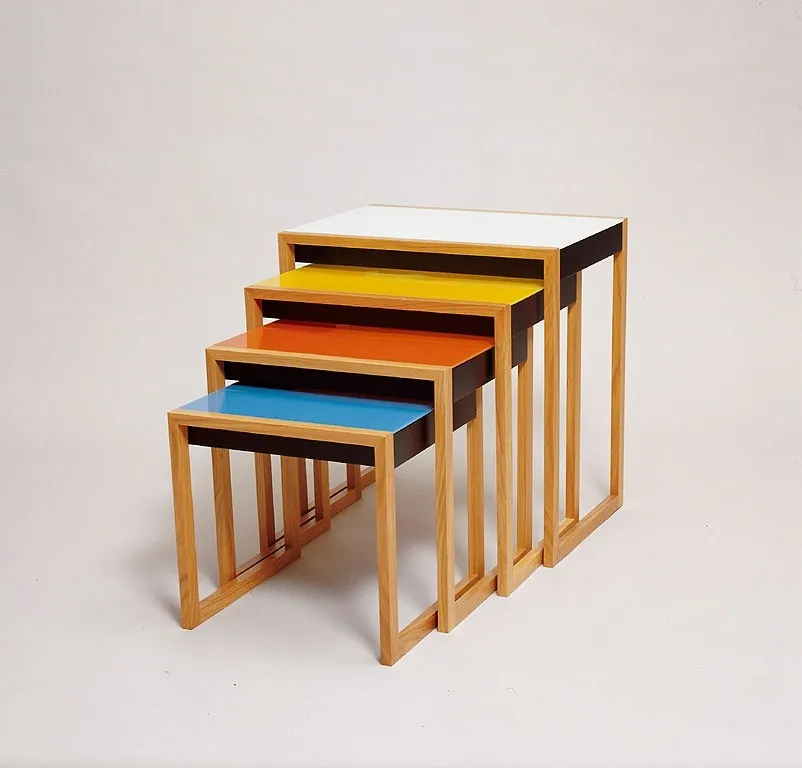
White, yellow, red and blue tops slide into view. Josef Albers’s nesting tables combine colour with a graduated set of sizes.
Article
A small blue table slides beneath a red one. Above them sit a yellow table and then a white table. Nested together, the four occupy roughly the footprint of the largest; pulled apart, they offer four places to set things down. Josef Albers designed these nesting tables in 1926–1927.
Nesting means that a smaller object fits inside a larger one. These tables decrease in width as well as height. The Mercedes-Benz Art Collection lists its white table at 62.8 cm tall and the small blue one at 40 cm. Each frame must leave enough space between its legs for the next table to slide inside.
The tops are painted glass and the frames are wood. Smooth glass planes and slender wooden lines perform different roles. When separated, white, yellow, red and blue appear as individual surfaces. Nesting them hides parts of the tops, changing the visible area of each colour according to how far each table is pulled out.
Albers taught glasswork at the Bauhaus and also designed furniture and tableware. The collection describes his emphasis on economical use of materials and learning through handling them. These tables provide four surfaces without requiring four separate floor spaces all the time.
It is easy to imagine moving the smaller tables beside chairs when guests arrive. Afterwards, each lower table slides under a taller one. There are no folding hinges or removable tops. Four differently sized frames fit together as they are.
Sources and editorial notes
www.mercedes-benz.art · 요제프 알베르스 네스팅 테이블 자료 1
Editorial note: Facts were checked against the linked material. Interpretations are MUADAILY’s editorial perspective. Image: The Josef and Anni Albers Foundation / VG Bild-Kunst · Mercedes-Benz Art Collection · Editorial quotation · Collection photograph of Josef Albers’s nesting tables.
Machine-translated from Korean. Read the original.