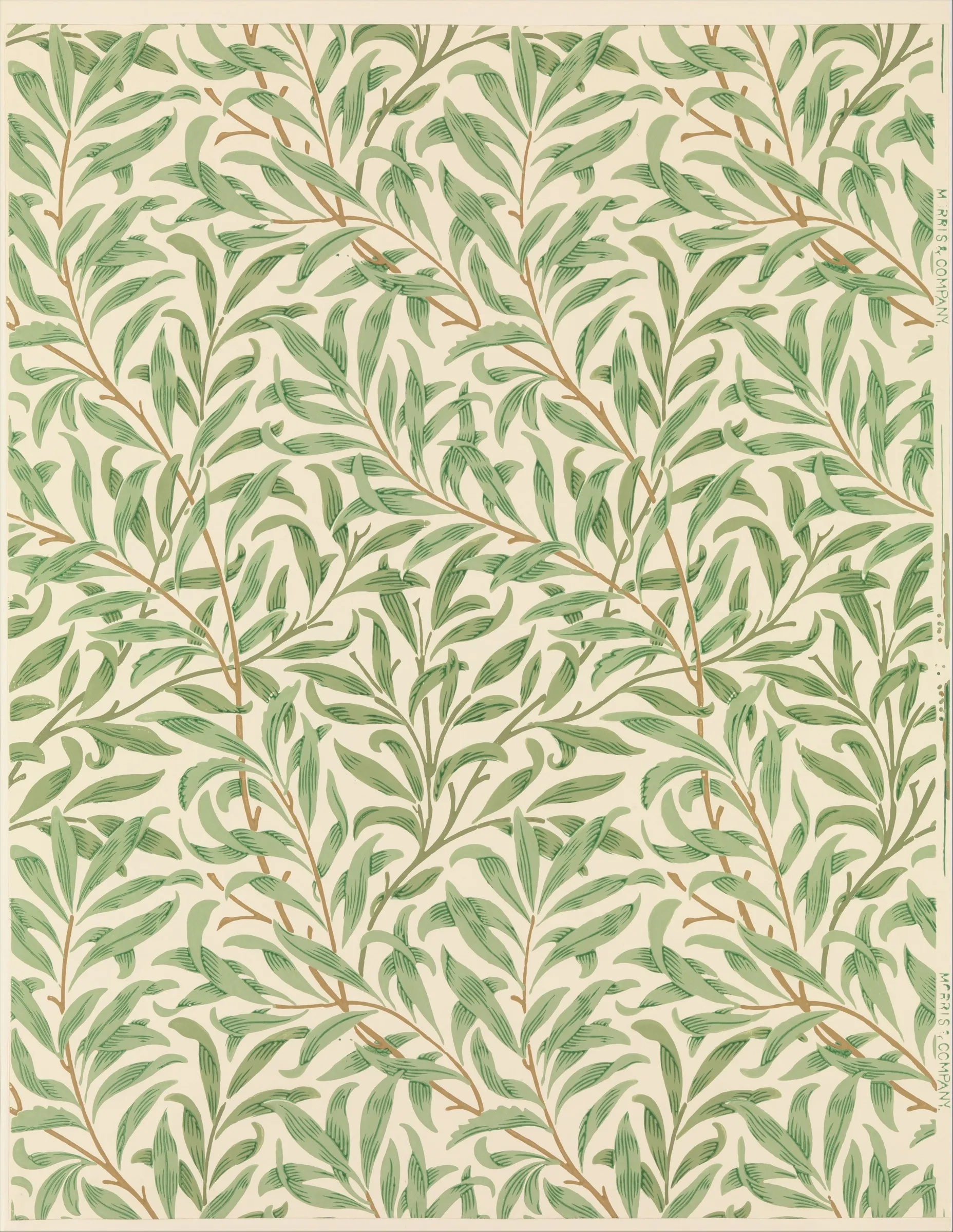
Separate printing blocks build the colours, leaves and stems of a repeating wallpaper pattern.
Article
Even a densely flowered wallpaper has a printing sequence. A background is laid down, another colour follows, and stems and leaves must meet their intended positions. In block-printing a William Morris design, the paper stays in place while the printer changes blocks.
Morris adjusted the direction of branches and overlapping leaves so the pattern would continue across adjoining sheets, both sideways and vertically. The spaces created when a flower repeats matter alongside the flower’s own shape.
A reconstruction film published by the V&A shows a process using 30 blocks and 15 colours, which can take up to four weeks. The number of blocks and the work required vary with each design’s size, colours and overlapping elements.
The St James’s pattern, created for St James’s Palace, was more elaborate: it used 68 blocks for a repeat spanning two wallpaper widths. Each block had to leave its colour in the right place so the leaves and stems would align.
Up close, individual veins and petals stand out. From farther away, the same curves continue across the wall. The printer builds that larger surface by positioning the next block on the sheet in front of them.
Sources and editorial notes
www.vam.ac.uk · 윌리엄 모리스 벽지 목판 자료 1
www.vam.ac.uk · 윌리엄 모리스 벽지 목판 자료 2
Image source · William Morris / Morris & Co.
Editorial note: Facts were checked against the linked sources. Interpretations are MUADAILY’s editorial perspective. Image: William Morris / Morris & Co. · CC0 · William Morris’s Willow Bough wallpaper, Metropolitan Museum of Art.
Machine-translated from Korean. Read the original.