One end tips onto the next step and the other follows. Richard and Betty James turned a spring into a toy.
Article
Tip one end of a spring onto a lower step and its body stretches before the trailing end follows. The movement can repeat at the next step. Slinky appears to walk downstairs without feet or a motor.
Its origins lay in machinery. The Strong museum recounts that engineer Richard James noticed the movement of a falling spring while working with springs intended to stabilize shipboard equipment. He and Betty James developed it as a toy, first sold in 1945.
How far a spring stretches and how it returns to shape affect its movement. A very stiff coil resists tipping; an excessively loose one struggles to hold its shape. Whether moving between the hands or down a staircase, its extended body needs to gather back together.
Gravity and the spring’s restoring force act together as it descends. As its weight shifts onto the next step, the trailing end follows. This repeated movement does not continue on a flat floor, and stair dimensions unsuited to the toy can also bring it to a stop.
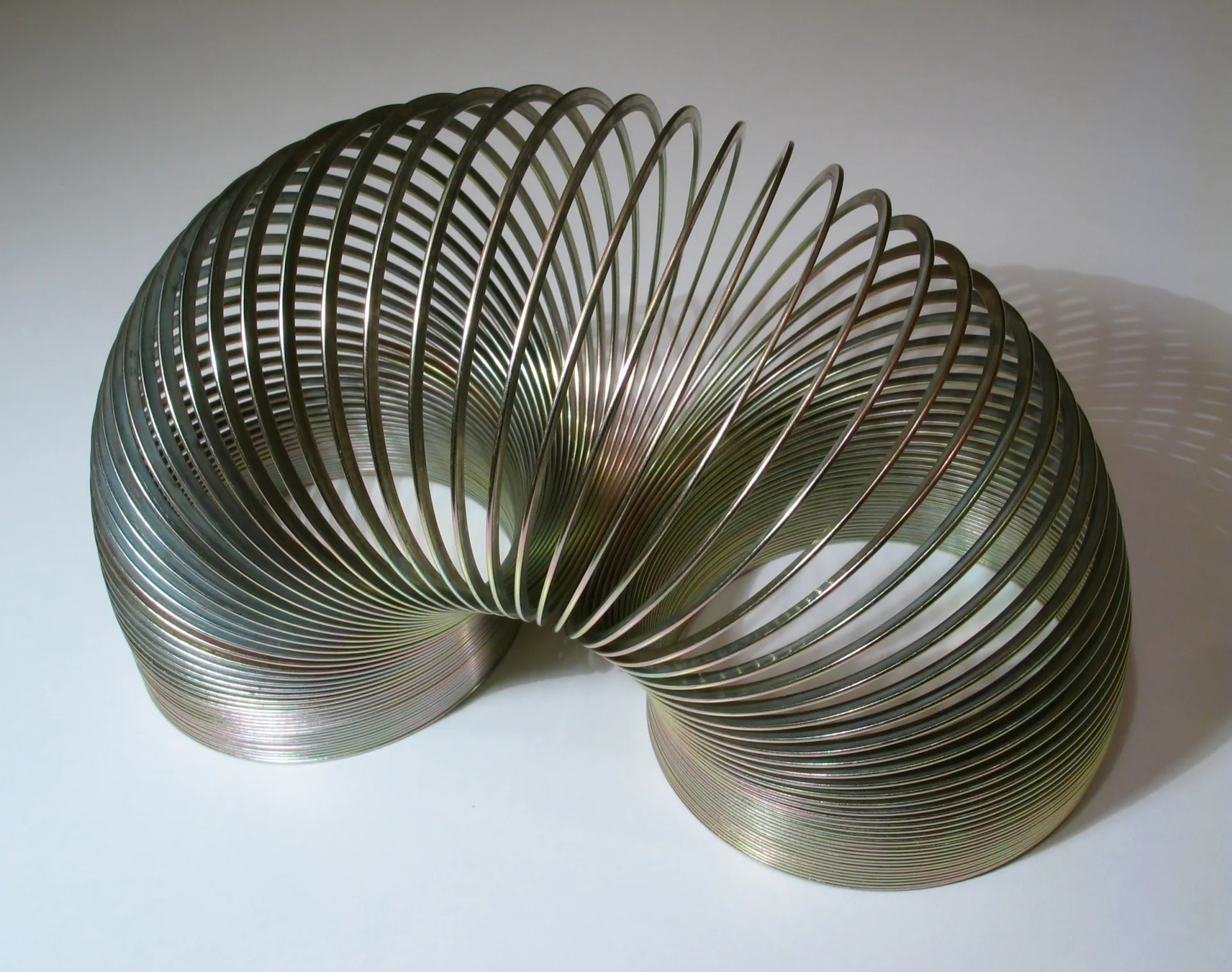
MoMA credits the design to both Richard and Betty James. At rest it is a small metal cylinder. Lift one end sideways and that cylinder lengthens and curves between the hands.
Sources and editorial notes
www.moma.org · 슬링키 스프링 장난감 자료 1
www.museumofplay.org · 슬링키 스프링 장난감 자료 2
Image use terms · CC BY-SA 3.0
Editorial note: Facts were checked against the linked sources. Interpretations are MUADAILY’s editorial perspective. Image: Roger McLassus · CC BY-SA 3.0 · A metal Slinky extended into a curve.
Machine-translated from Korean. Read the original.