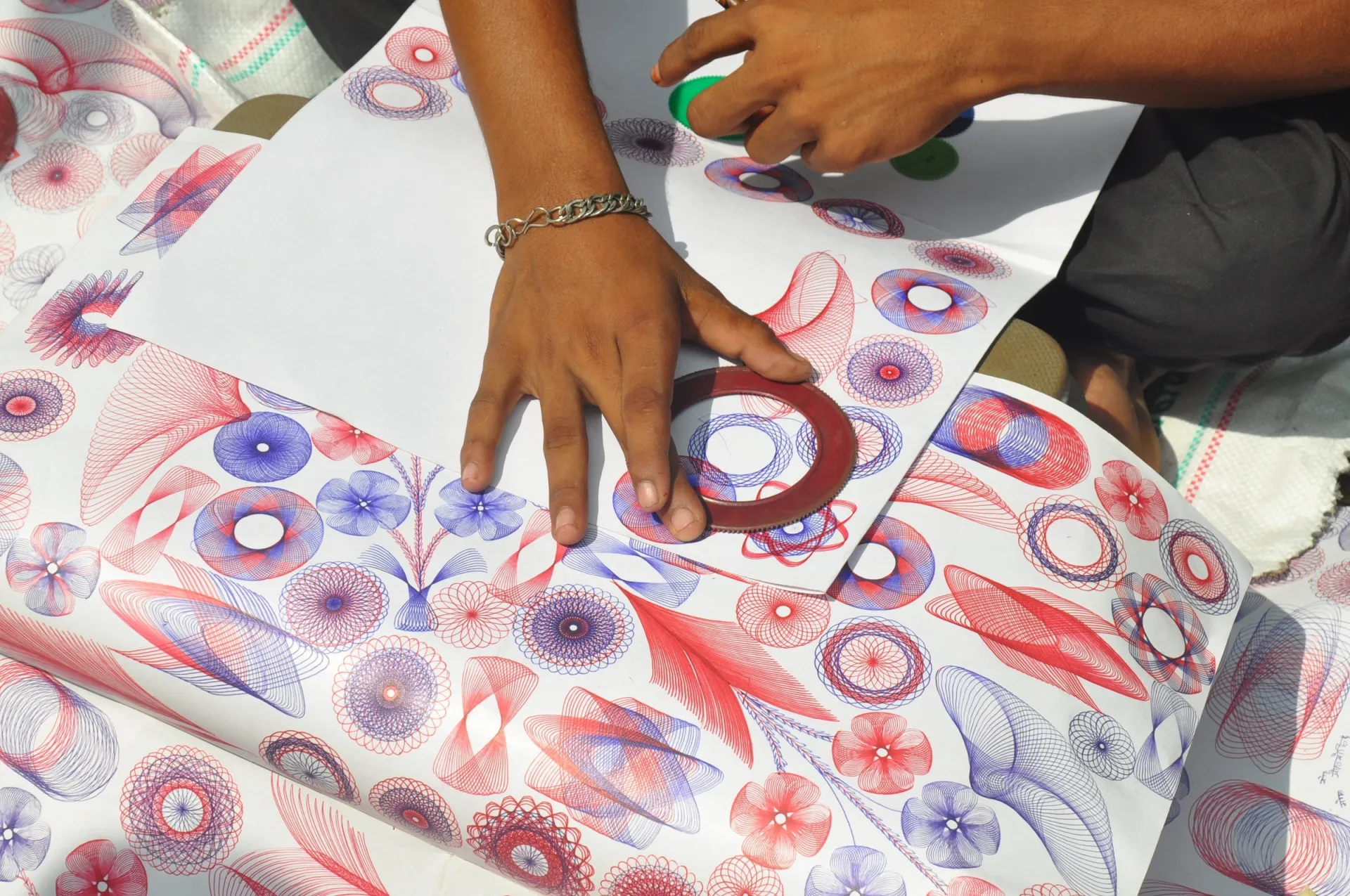
Spirograph guides a pen with meshing teeth. Changing the wheel or pen position changes the pattern.
Article
Place a pen in a small gear’s hole and roll it inside a larger ring. One curved line becomes an overlapping, flower-like pattern after several circuits. Spirograph turns the motion of meshing teeth into marks on paper.
The hand moves the pen, but the teeth guide the wheel. As the wheel rolls inside the ring, the pen follows a point offset from its centre. That creates an inward-and-outward curve rather than a simple circle.
This also explains the multiple holes in a wheel. A pen near the centre travels differently from one near the edge. Even with the same ring and wheel, changing holes alters the central opening and shape of the curve.
Denys Fisher’s Spirograph appeared at the Nuremberg toy fair in 1965. The Smithsonian’s set contains rings and wheels of different sizes. Changing a wheel or moving the pen to another hole lets the same hand movement produce different patterns.
If the teeth skip, the next line departs from its intended track. Keeping the ring fixed and the pen in one hole lets the line travel through repeated loops toward its starting position. Changing ink colour still leaves the pen following the curve guided by the ring and wheel.
Sources and editorial notes
americanhistory.si.edu · 스파이로그래프 톱니바퀴 그림 자료 1
instructions.hasbro.com · 스파이로그래프 톱니바퀴 그림 자료 2
Image source · Kannanshanmugam,shanmugamstudio,Kollam
Editorial note: Facts were checked against the linked sources. Interpretations are MUADAILY’s editorial perspective. Image: Kannanshanmugam,shanmugamstudio,Kollam · CC BY 3.0 · Drawing patterns with a Spirograph.
Machine-translated from Korean. Read the original.