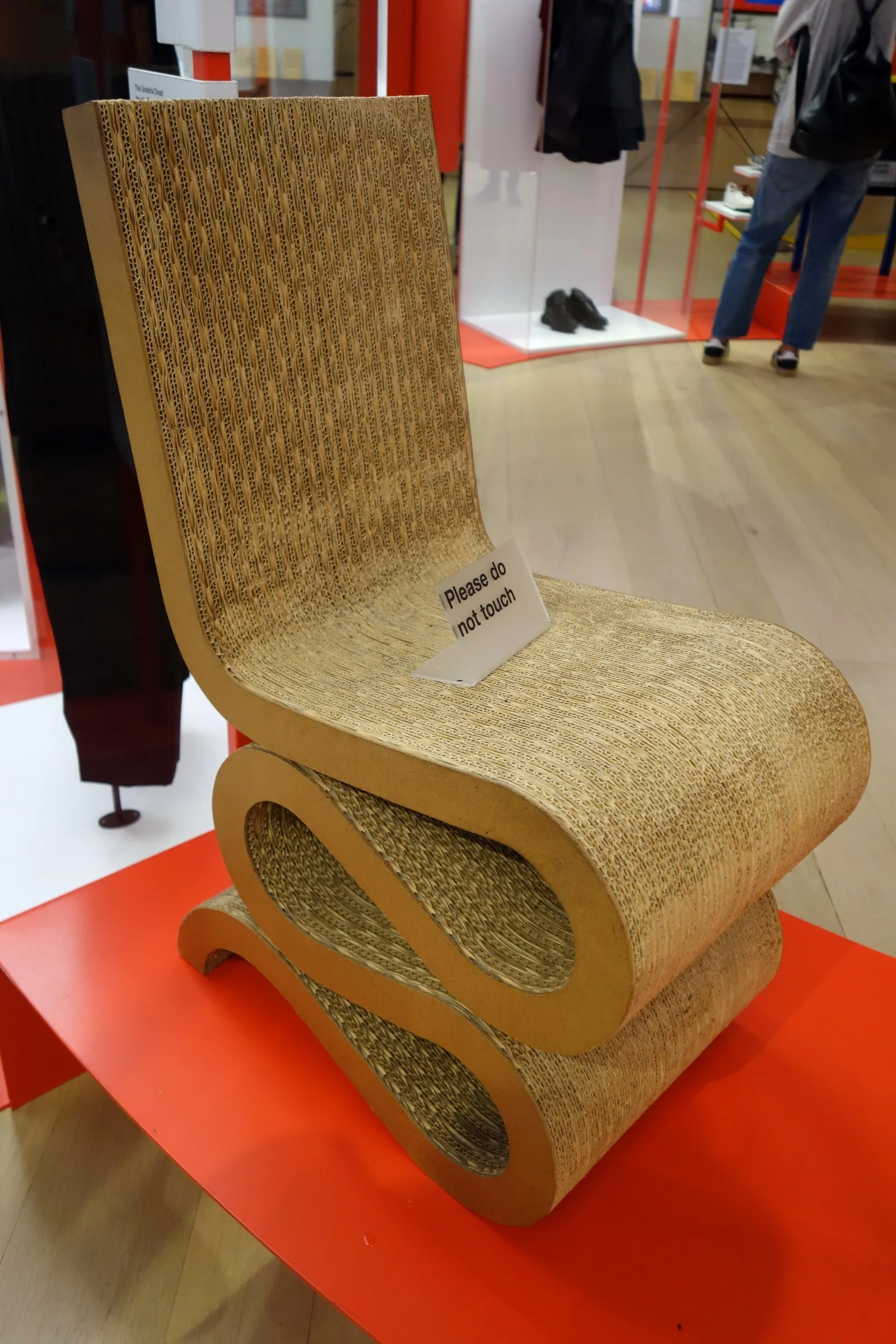
Wiggle Side Chair exposes the edges of its stacked paper, extending a material familiar from architectural models into furniture.
Article
From the side, a thick line bends repeatedly from the floor toward the backrest. Up close, Frank Gehry’s Wiggle Side Chair reveals closely spaced lines across its surface: the exposed edges of layers of corrugated cardboard bonded together.
Cardboard was familiar to Gehry from architectural model-making. He brought it into furniture, including desks and seating. Wiggle Side Chair became a prominent part of the Easy Edges range introduced in the early 1970s.
Many thin sheets of corrugated cardboard are stacked and bonded into a thick assembly, with hardboard also used at the sides. The layered material and the chair’s form work together to support a person’s weight.
The chair resembles a side profile extended across a substantial width. Beneath the seat, the material bends into a continuous connection with the floor. Four separate straight legs are absent.
London’s Design Museum offers a model-making activity based on the design. A small model does not have the strength of usable furniture, but it reveals the method of building volume from repeated profiles. Sheets cut to the same shape give the model depth as they are glued side by side.
Sources and editorial notes
designmuseum.org · 위글 골판지 의자 자료 1
www.agsa.sa.gov.au · 위글 골판지 의자 자료 2
Editorial note: Facts were checked against the linked sources. Interpretations are MUADAILY’s editorial perspective. Image: Daderot · CC0 · Wiggle Side Chair displayed at London’s Design Museum.
Machine-translated from Korean. Read the original.