Inspired by a saddle, Peter Opsvik’s chair leaves more than one direction open to the sitter.
Article
Sitting backwards on the HÅG Capisco allows the sitter to rest their chest against the backrest and extend their arms forwards. This posture is part of its intended use. Peter Opsvik designed the support to work in front of the body as well as behind it. [1]
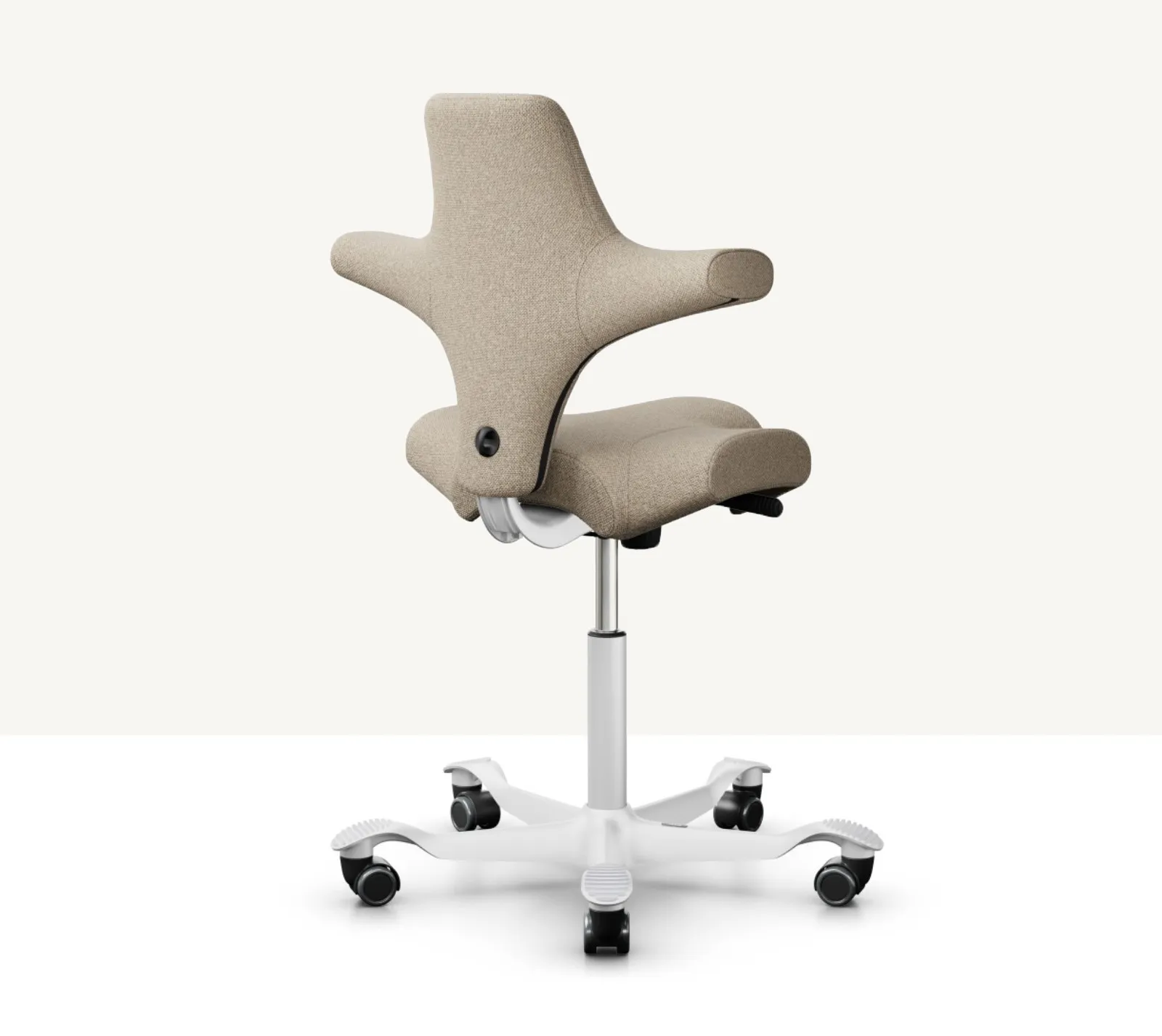
Designed in 1984 and revised in 1999, Capisco took inspiration from a rider’s posture. Openings in its seat and backrest leave room for arms and legs. Its distinctive outline follows those spaces. [1]
When a sitter leans forwards, an ordinary backrest loses contact with the body. Capisco allows the sitter to turn around and use that support again. Its narrow, saddle-like front also leaves room to vary the angle of the thighs. [1]
With an adjustable desk, the chair can accommodate low sitting and higher, almost standing positions. Desk height and foot support also need to suit the sitter as their posture changes. The freedom to sit in several directions works together with finding a comfortable position.
A picture of someone sitting backwards explains Capisco better than a front view alone. Turning around places the backrest in front of the chest, while the arms pass through gaps in its outline. The same chair provides another place for the body to settle.
Sources and editorial notes
Editorial note: Facts were checked against the linked sources. Interpretations are MUADAILY’s editorial perspective. Image: Peter Opsvik / HÅG · The HÅG Capisco, designed by Peter Opsvik, with its saddle-shaped seat and branching backrest.
Machine-translated from Korean. Read the original.