The Smithsonian’s seed and nursery catalogs offer clues to the flowers and vegetables people could choose, and the qualities sellers emphasized.
Article
Choosing seeds means imagining plants that have not yet grown. The seeds in a palm reveal little about the color of the flowers or the shape of the mature vegetables. Illustrations in seed catalogs helped fill that gap. As sales tools, they invited readers to picture how a corner of the garden or a row of vegetables might look months later.
Smithsonian Libraries holds about 10,000 seed and nursery catalogs dating from 1830 onward. Burpee catalogs sit alongside those of competing firms. Different companies presented the same kinds of plants with different pictures and descriptions, allowing readers to compare which qualities sellers chose to emphasize.
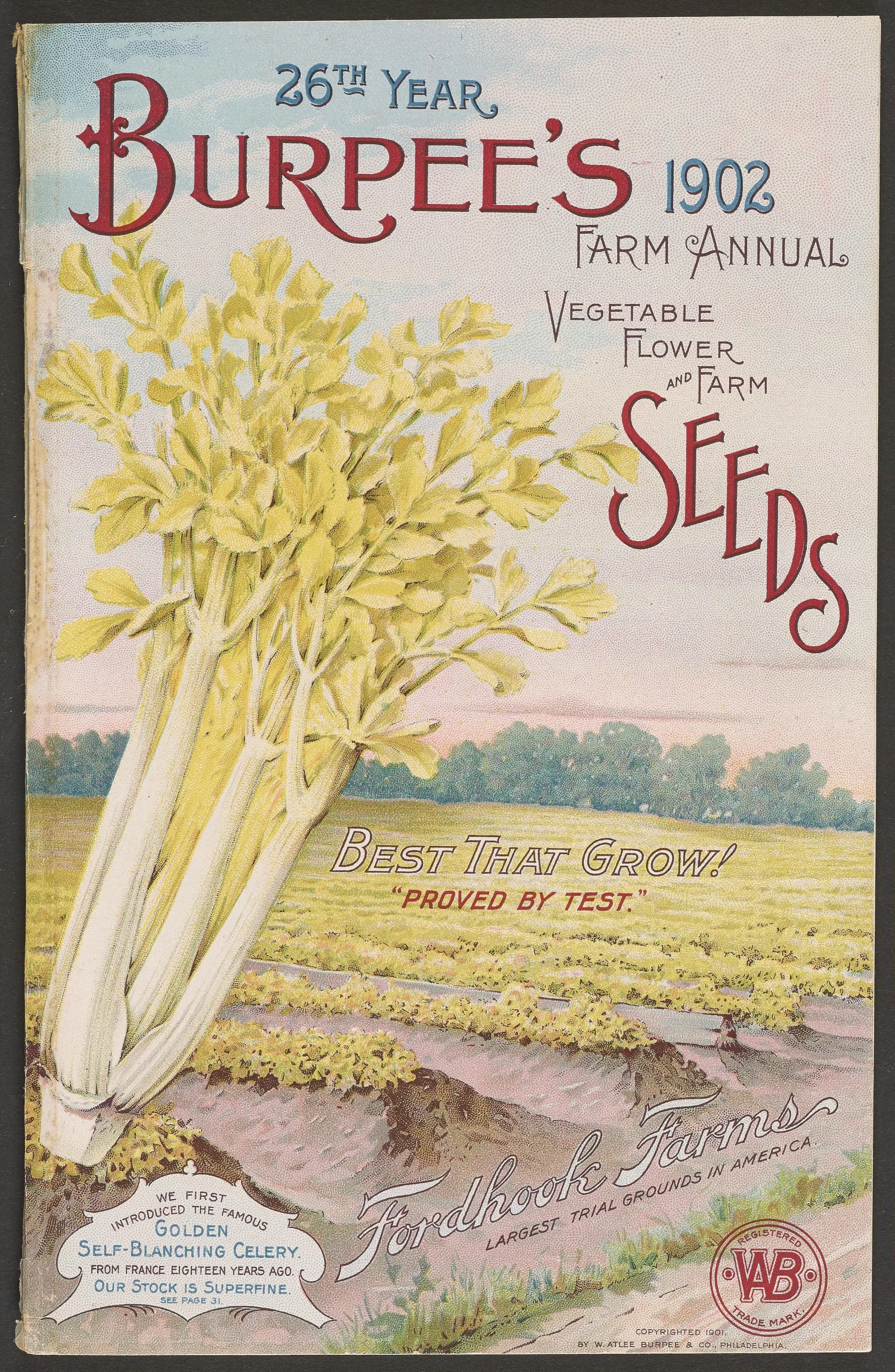
The 1902 Burpee catalog cover used as this article’s lead image features a large vegetable with spreading leaves and stems. Behind it stretches a field too broad to take in at a glance, while the plant in front is close enough to examine leaf by leaf. A real garden would rarely offer both views from one position. The illustration brings the scale of a farm and the detail of an individual crop onto a single page.
The cover and the pages inside served different purposes. An eye-catching variety might lead the cover, while product descriptions supplied details for deciding what to order. It resembles the distinction between a shop’s opening image and its product information online. For customers unable to inspect the plants in person, pictures and words offered a way to judge them before buying.
By collecting competing firms’ catalogs as well, the library makes it possible to compare how different covers promoted the same subjects. That is easy to miss if the collection is treated simply as an exhibition of attractive pictures. Plants needed time to grow then as now, but the desire for a particular garden could begin while turning the pages, before any seed was planted.
An old catalog cover prompts different questions from a garden photograph. The most prominent flower in an illustration was not necessarily the most widely planted. What the cover does preserve is the seller’s choice of what to show first. Looking through the library’s collection of flowers and vegetables, ordering a packet of seeds becomes another way of choosing the future appearance of an empty garden.
Sources and editorial notes
library.si.edu · Official source
library.si.edu · Official source
Editorial note: Factual statements are based on the sources above; interpretations reflect MUADAILY’s editorial perspective. Image: Smithsonian Libraries and Archives · No Copyright – United States.
Machine-translated from Korean. Read the original.