James Dewar’s low-temperature research produced a double-walled vessel. Its vacuum gap and silvered surfaces slow different routes of heat transfer.
Article
Putting hot water in a vacuum flask does not switch on a heater. The flask slows the escape of heat already inside. With a cold drink, it slows the entry of heat from outside. That is why the same vessel can keep a drink either warm or cool.
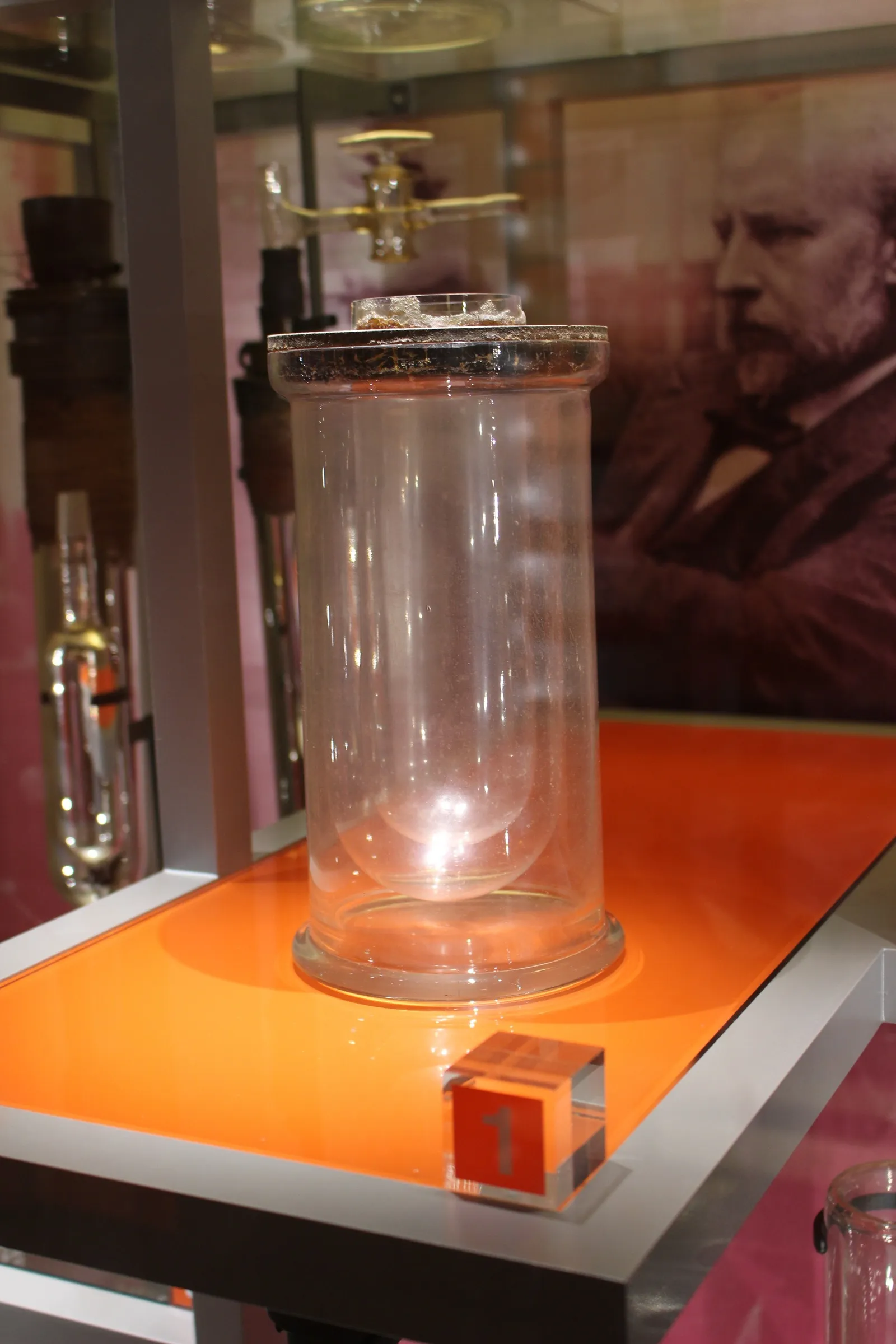
An early laboratory vessel illustrating this principle survives at Britain’s Royal Institution: James Dewar’s vacuum flask, developed in 1892. Dewar studied gases that become liquid at very low temperatures. To keep those liquids available for experiments, he needed containers that limited heat entering from their surroundings.
His vessel has two walls. Air is removed from the space between the inner and outer containers, creating an insulating vacuum. With little air left in that gap, there are fewer routes for heat transfer through it. Holding the outside therefore does not immediately bring the hand into thermal contact with the contents.
A vacuum cannot block every route. Thermal radiation travels through empty space. Dewar silvered the vessel’s surfaces to reduce radiative heat exchange and narrowed its neck to limit another route for heat to enter or escape. Double walls, a vacuum and reflective surfaces address different mechanisms.
Modern flasks vary in materials and lid design, but the evacuated double wall remains familiar. Opening the lid brings the drink into direct contact with outside air. When water cools more quickly after being poured into a cup, a route previously obstructed by the walls and lid has opened again.
Sources and editorial notes
www.rigb.org · 듀어 진공 플라스크 자료 1
collection.sciencemuseumgroup.org.uk · 듀어 진공 플라스크 자료 2
Editorial note: Facts were checked against the linked material. Interpretations are MUADAILY’s editorial perspective. Image: Vera de Kok · CC BY 4.0 · Dewar vacuum flask displayed at the Royal Institution.
Machine-translated from Korean. Read the original.