MIT’s SANDO looks beyond a path that is clear right now. It calculates where moving obstacles could reach over the next interval.
Article
There is no guarantee that a clear path ahead of a drone will remain empty. When a person takes a step and another object moves next to it, the path just calculated must be recalculated. In an unmapped space, the planner must also account for obstacles that may newly appear.
SANDO, announced by MIT researchers, is a method of planning flight paths in such environments. It is a study that mathematically deals with the conditions of not colliding with moving obstacles while finding a way to reach the goal quickly. The paper was first released in April 2026, went through a revised version in September, and MIT introduced the research content in October.
Keeping a corridor clear over time
The key is a ‘safe passage’ that changes over time. Instead of just avoiding the area where the obstacle is, it calculates how far the object can go within a certain amount of time. The system uses the maximum possible speed to estimate the obstacle’s reachable area, then keeps the drone’s corridor outside that area.
For example, even if there is an object at the same distance in front, the space to be left is different if it moves slowly or quickly. SANDO is closer to avoiding the range of possible movements under given conditions, rather than accurately guessing one future movement.
Finding a fast path within a safe path
Within the passage thus secured, an efficient flight trajectory is calculated again. Planning to avoid dangerous areas with many obstacles and detailed route calculations that adhere to collision avoidance conditions are connected. If the environment changes during flight, the computer on board updates the passage and route.
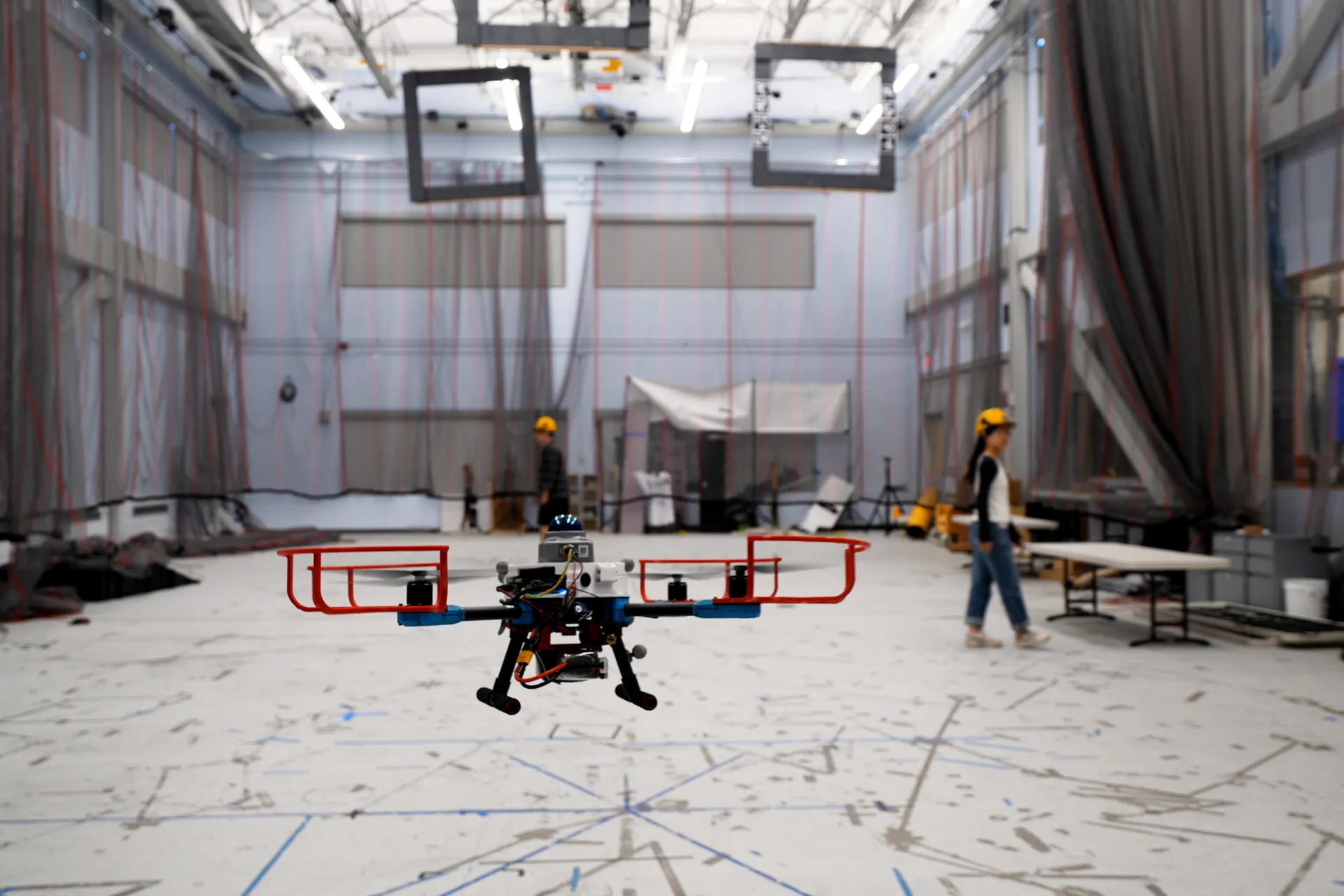
The researchers reported that they completed the test without a collision in 12 real-world drone flights with moving obstacles. However, this result and guaranteeing no accidents in all environments are different things. The paper makes explicit assumptions about the range of obstacle speed and size and location estimation error. The safety proof applies within those assumptions; treating it as an unconditional ability would misrepresent the result.
Exploring collapsed structures or unfamiliar spaces is a possible application proposed by the researchers. The current result is a route planning technology that has been verified through experiments and simulations, and does not mean that it has been immediately deployed to all disaster sites.
This calculation lies behind the saying that drones fly smartly. In addition to passing through the currently empty gap, it is a calculation that asks whether the gap will still be clear when the drone arrives.
Sources and editorial notes
MIT News · SANDO research and real-world flight testing
Research Paper · SANDO v3, Assumptions and Experimental Scope
MIT ACL · Official Research Code
Editorial note: Facts were checked against the sources above; interpretations are MUADAILY’s editorial views. Image: Melanie Gonick, MIT · CC BY-NC-ND.
Machine-translated from Korean. Read the original.