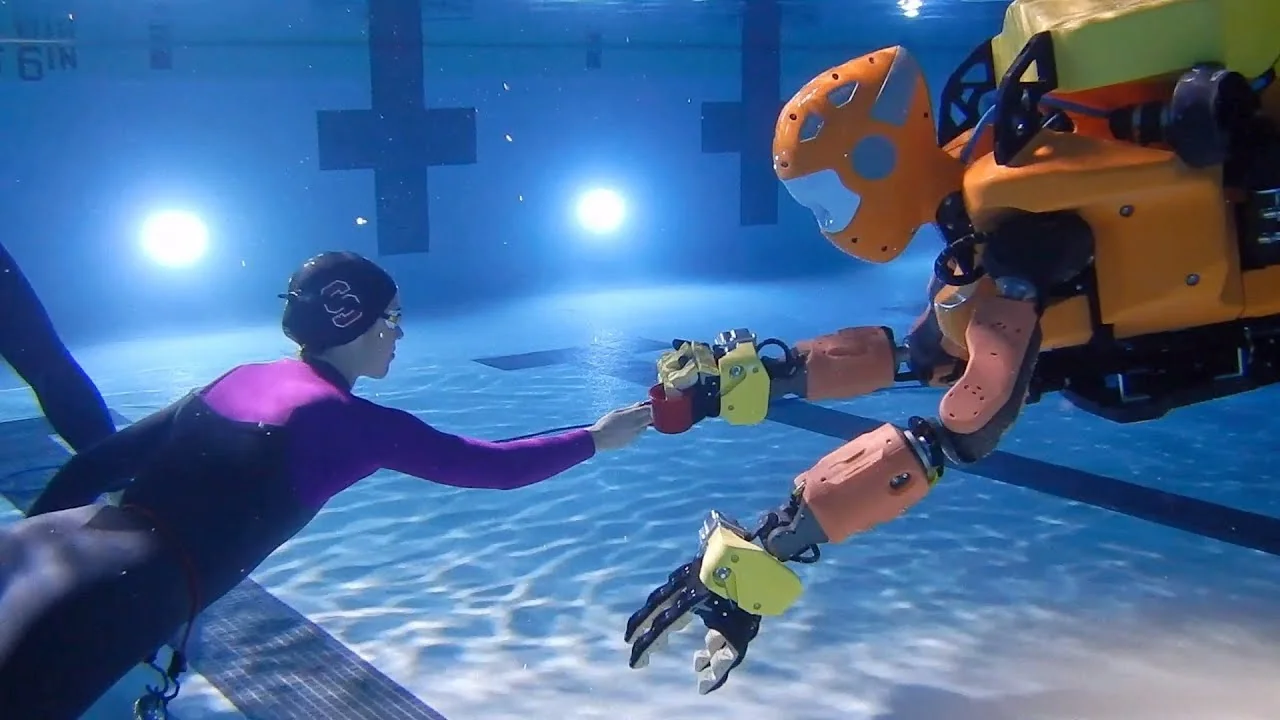
Stanford’s OceanOneK connects an underwater robot with an operator aboard a ship through touch feedback. The operator sees the site on screen and feels forces as the robot contacts an object.
Article
Finding an underwater artifact on screen is one thing; lifting it without damage is another. Images alone do not tell an operator exactly when a hand makes contact or how much force it applies. Stanford's underwater robot OceanOneK lets its operator remain above water while feeling forces from contact deep below.
Its predecessor, OceanOne, recovered a small vase from the Mediterranean shipwreck La Lune in 2016. Research leader Oussama Khatib held the controls aboard a boat. Guided by marine archaeologists familiar with the site, he moved the robot's hands, picked up the vase, and placed it in a recovery basket. He did not have to dive to the wreck himself.
Force sensors in the robot's wrists sent information back to the controls, allowing the operator to feel the forces involved in grasping the object. Stereo cameras served as eyes, helping convey distance and shape. Alongside commands sent down to the robot, a return path carried the physical response of what its hands touched.
The OceanOneK expeditions reported by Stanford in 2022 reached deeper water. The team explored Mediterranean wrecks, including ships and aircraft, and descended nearly a kilometer. Two arms occupy the human-like upper body, while eight thrusters at the rear provide movement in different directions. The robot can hold its position near the seabed while its hands work.
Greater depth required preparation for greater pressure. The researchers used a special buoyancy material containing glass microspheres and equipped the arms with an oil-and-spring mechanism. The arrangement compresses the oil to match external pressure. The robot resembles a diver, but its internal pressure compensation is designed for a machine.
Operating at sea also brought problems outside the robot itself. Buoyancy material around its long power and communication tether collapsed, leaving the heavy line piled on top of the robot and preventing it from rising. The team retrieved the slack to free it. Skills developed in a laboratory or pool depended in the field on the tether and supporting equipment as well.
Handling an artifact remains a shared task. Archaeologists guide the work, and the operator adjusts the robot's movements using the camera view and feedback at the controls. When OceanOne lowered the vase into its basket, a person was judging its shape and weight through the system. The robot's arms are underwater; the hands at the controls remain above.
Image Description: Preview of Stanford's official video introducing OceanOneK. It shows underwater robots and divers for research.
Image source: Stanford / Official release video preview
https://www.youtube.com/watch?v=h2CLLBUpPZg
Image changes: resized with the original aspect ratio preserved and converted to WebP. No cropping.
Sources and editorial notes
Stanford Report · OceanOneK connects human’s sight and touch to the deep sea · 2022-07-20
Stanford Report · Maiden voyage of Stanford’s humanoid robotic diver · 2016-04-27
Source of preview · Stanford / official public video preview
Editorial note: Factual statements are based on the sources above; interpretations reflect MUADAILY's editorial perspective. Image: Stanford / Official release video preview.
Machine-translated from Korean. Read the original.