DART struck Dimorphos in 2022. Changes in its orbital period and the debris thrown from its surface reveal the impact’s effect.
Article
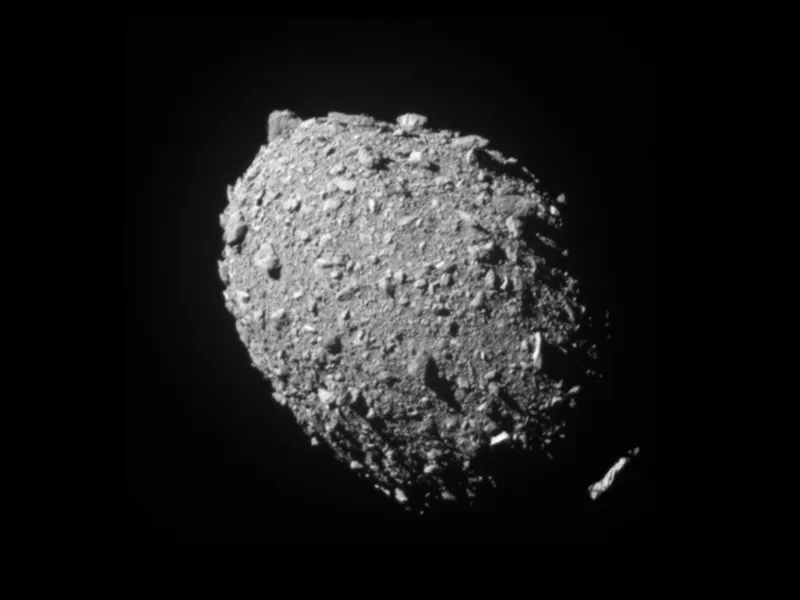
Rocks grow larger in the camera view as a spacecraft approaches an asteroid. At the end, stones fill the frame and the images stop. These were the final views from NASA's DART as it struck Dimorphos on September 26, 2022. The collision was deliberate: a test of whether hitting a small body could change its motion.
Dimorphos orbits the larger asteroid Didymos. Researchers compared that orbital period before and after the impact, rather than its period around the Sun. Changes in the light received on Earth as the two bodies obscure one another help reveal the time Dimorphos takes to complete an orbit.
Before impact, that took about 12 hours. Later analysis found a reduction of roughly 33 minutes. A detailed analysis presented by NASA's Jet Propulsion Laboratory in 2024 describes further change for a time after impact as more rock escaped. The eventual period of about 11 hours and 22 minutes was established through continued observation, not one measurement at the moment of collision.
The spacecraft's direct impact was only part of the effect. Material ejected from the surface added a recoil in the opposite direction, like the push felt when throwing an object. Even impacts with the same mass and speed can produce different results depending on a target's structure and materials. Ejected rock and dust were therefore important evidence too.
This asteroid system was not hurtling toward Earth. DART tested a planetary-defense method on a target that posed no danger, rather than responding to an unfolding disaster. It did not blow an enormous body apart as in a film. The aim was to test a small change in motion that could alter a path over time.
Success therefore required more evidence than the impact footage. Continued telescope observations tracked the orbital period, ejected material, and changes in the asteroid's shape. The spacecraft's last images show where it hit. Evidence of what the impact achieved continued to arrive afterward.
Image caption: Dimorphos taken by DART · NASA/Johns Hopkins APL
Image source: https://science.nasa.gov/mission/dart/
Sources and editorial notes
Guide to using NASA images and media
Editorial note: Factual statements are based on the sources above; interpretations reflect MUADAILY's editorial perspective. Image: Dimorphos by DART · NASA/Johns Hopkins APL.
Machine-translated from Korean. Read the original.