Diaphragms using wood left over from piano soundboards, amplifiers designed around their drivers, and YPAO room correction: a closer look at Yamaha’s wireless hi-fi speakers and their TV connections.
Article
A living-room music system usually needs space for an amplifier and a source as well as speakers. Yamaha’s NX-70A puts those components inside a wireless stereo speaker system. Music can be selected on a phone, while a TV connected over HDMI can use the same speakers. Yamaha announced the new model in June 2026, with a late-August release planned for Japan.
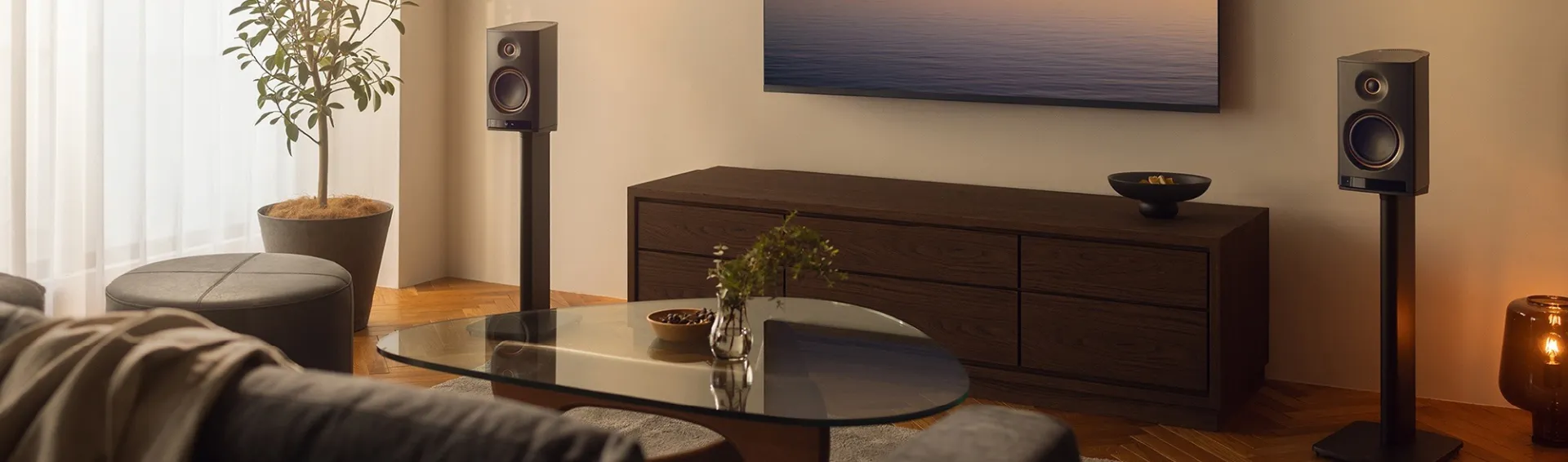
The system consists of two relatively compact speakers, each 33.3 cm tall. Each contains a 13 cm woofer, a 3 cm tweeter and separate amplifiers for the two drivers. Yamaha specifies 100 watts for the woofer and 60 watts for the tweeter in each cabinet. Instead of choosing a separate amplifier and wiring it to passive speakers, the owner uses a driver-and-amplifier combination chosen by the manufacturer.
The diaphragms contain a material that reflects Yamaha’s instrument-making business. In an article for the Japan Audio Society, the development team explains that spruce offcuts from grand-piano soundboard production at the Kakegawa factory are turned into pulp. This is mixed with materials including Zylon, a PBO fibre. Related materials are used in both drivers to help their tonal character blend, with the mixture adjusted for the NX-70A’s size and drive system.
The new Synergistic Drive technology treats the amplifier and driver as one control system. It senses the current actually flowing through the voice coil and corrects it against a reference signal. The developers describe this as a way of reducing distortion associated with the driver’s magnetic circuit. The amplifier is therefore designed around the particular driver, rather than simply placed in the same box.
YPAO addresses the effects of the room. The supplied microphone measures sound at the listening position, allowing the system to compensate for response changes caused by reflections from walls and furnishings. YPAO Volume can also adjust the bass and treble balance at low listening levels. Room measurement and volume-dependent tonal adjustment are separate functions.
Music connections include MusicCast, AirPlay 2, Google Cast and Roon Ready. Bluetooth is available too, with SBC and AAC listed in the specifications. The USB-A port reads music files from storage devices; it is not a USB DAC input for a direct USB connection to a computer. The appropriate connection depends on the source device.
A TV connects through HDMI eARC or ARC. Volume can be controlled with the TV remote, making it practical to use one system for both music and television. The manual specifies two-channel PCM for TV audio, however. If no sound is heard, the TV’s digital audio output setting is a useful first check. An eARC socket does not mean the speakers directly reproduce multichannel formats such as Dolby Atmos.
Wireless does not eliminate every cable. The speakers can exchange their audio signal wirelessly, but each still needs mains power. A wired connection between the pair is also possible. Anyone planning to place them on shelves or at opposite ends of a TV cabinet needs to check the location of power sockets as well as the available space.
The announced Japanese price is ¥385,000 including tax for the pair. The optional SPS-70A stands cost ¥88,000 per pair. These are Japanese launch prices, not Korean retail prices. A Korean release date and price were not found in the official material reviewed for this article.
Sources and editorial notes
www.yamaha.com · 야마하 NX-70A 자료 1
www.jas-audio.or.jp · 야마하 NX-70A 자료 2
manual.yamaha.com · 야마하 NX-70A 자료 3
manual.yamaha.com · 야마하 NX-70A 자료 4
Image use terms · Yamaha press image
Editorial note: Facts were checked against the linked material. Interpretations are MUADAILY’s editorial perspective. Image: Yamaha · Yamaha press image · Official Yamaha photograph of NX-70A speakers on optional stands.
Machine-translated from Korean. Read the original.