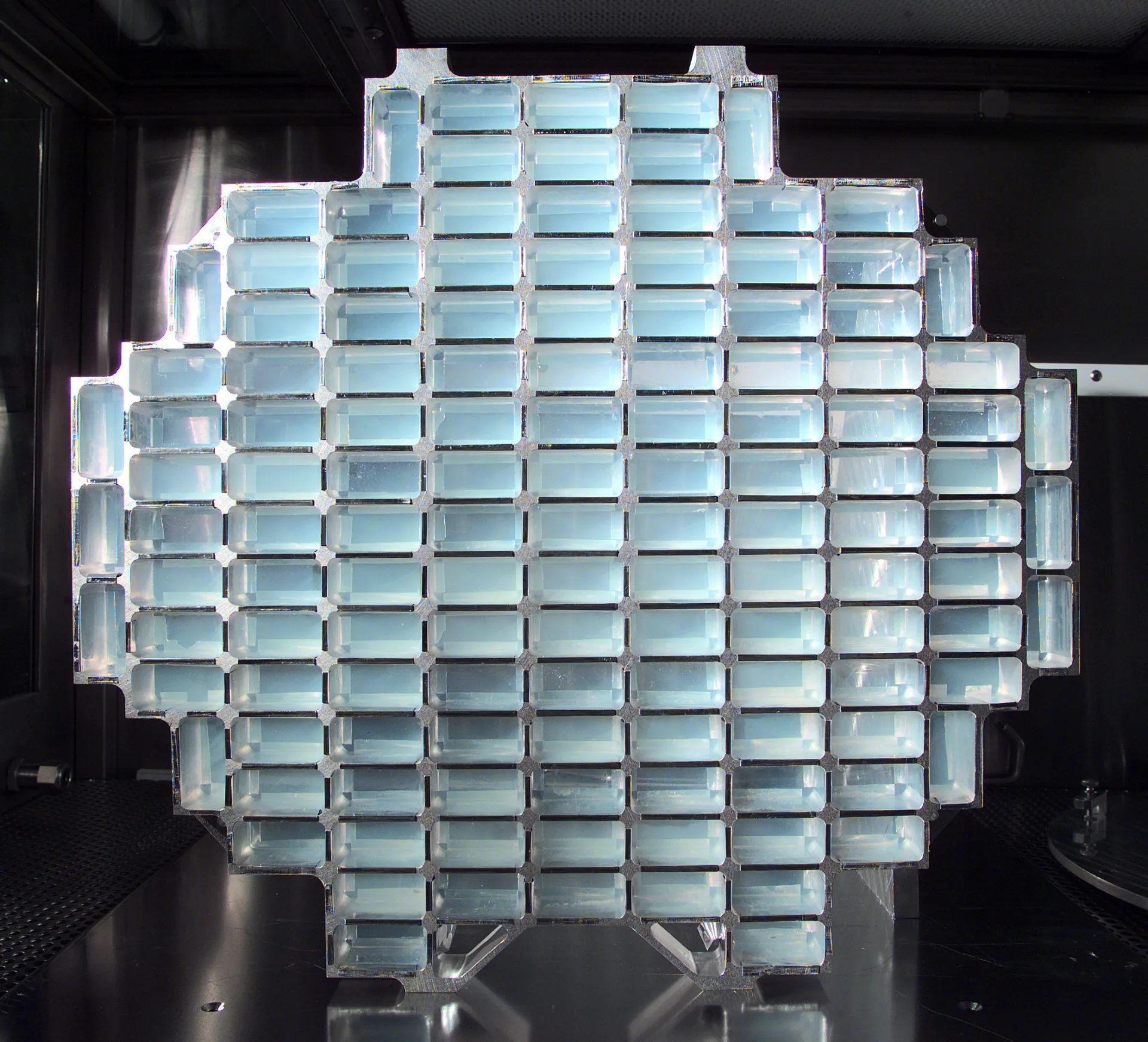
Porous aerogel gradually slowed fast-moving dust grains. The narrow tracks left inside helped researchers locate the particles.
Article
A tennis-racket-shaped frame holds a pale-blue material. This is the dust collector flown by NASA’s Stardust spacecraft. Its frame was filled with extremely porous aerogel to catch particles arriving from space.
Stardust collected dust around comet Wild 2 as it passed nearby in 2004. Its sample capsule returned to Earth in 2006.
A fast grain striking a hard surface experiences severe impact and heating. The collection aerogel was a lightweight solid made mostly of empty space, allowing a grain to slow as it travelled through. JPL explains that its density increased with depth, producing more gradual deceleration.
Particles left long, narrow tracks, wider at the entrance and tapering inward. Those traces helped researchers locate samples. Capture can alter the grains, so scientists also have to assess changes caused by the collection process.
The collector’s two sides were used at different times: one for comet dust and the other for material arriving from interstellar space. Back on Earth, researchers followed the tiny tracks through the translucent material to find grains trapped along them and at their ends.
Sources and editorial notes
www.jpl.nasa.gov · 스타더스트 에어로젤 자료 1
www.jpl.nasa.gov · 스타더스트 에어로젤 자료 2
Editorial note: Facts were checked against the linked sources. Interpretations are MUADAILY’s editorial perspective. Image: NASA/JPL · Public domain · Stardust’s aerogel-filled dust collector.
Machine-translated from Korean. Read the original.