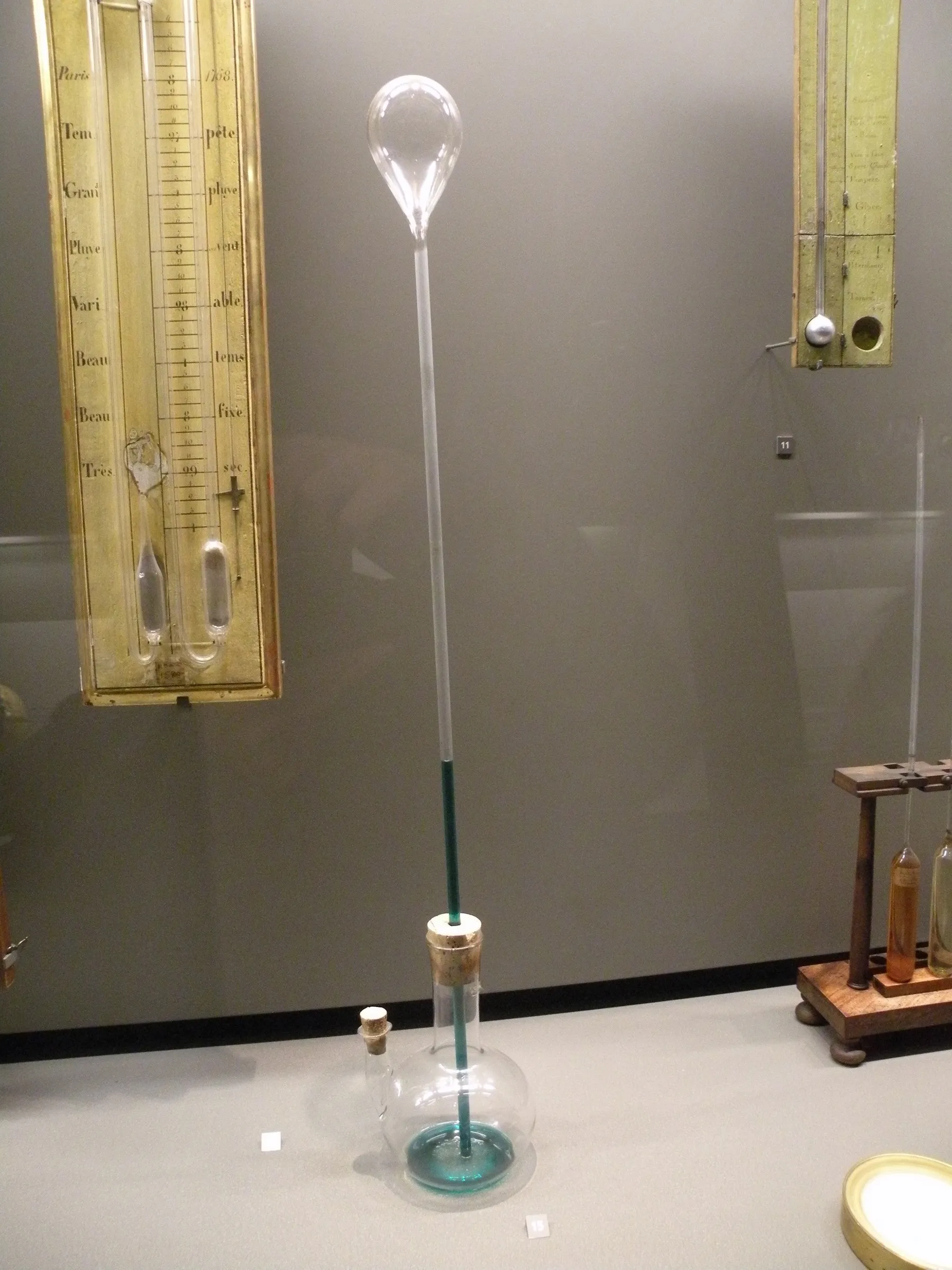
Cooling air draws water into a narrow glass neck. A museum replica explains an instrument that preceded the modern thermometer.
Article
Warm a long-necked glass vessel with your hands, invert it and place its opening in water. When your hands are removed, water rises into the narrow neck. Galileo’s thermoscope made changes in warmth visible as changes in water level.
Florence’s Museo Galileo holds a nineteenth-century glass replica of the instrument. The museum explains the earlier device through Vincenzo Viviani’s biography and a letter by Benedetto Castelli.
Air in the vessel expands when warmed and contracts when cooled. With the opening submerged, cooling creates a pressure difference that draws water into the tube. As the warmth from the hands dissipates, the rising water column makes the temperature change visible.
The instrument lacked the standardized numerical scale of a modern thermometer and was affected by atmospheric pressure. A particular water level could not simply be read as a Celsius temperature. Reading the same temperature as the same number required reference temperatures, a scale and ways to reduce atmospheric pressure effects.
It also differs from the decorative Galileo thermometer containing coloured floating glass bulbs. Here the moving element is a water column in a narrow neck. Remove the warming hands and that column slowly changes position.
Sources and editorial notes
www.museogalileo.it · 갈릴레오 온도경 자료 1
catalogue.museogalileo.it · 갈릴레오 온도경 자료 2
Image use terms · CC BY-SA 3.0
Editorial note: Facts were checked against the linked sources. Interpretations are MUADAILY’s editorial perspective. Image: Chatsam · CC BY-SA 3.0 · A reconstruction of Galileo’s thermoscope at the Musée des Arts et Métiers, Paris.
Machine-translated from Korean. Read the original.