For the first time, the launch tower caught Starship’s second-stage spacecraft after an orbital flight. The spacecraft fired an engine to leave orbit, then turned into its landing attitude for the final descent.
Article
SpaceX recovered Starship’s second stage with the launch tower after its return from Earth orbit. The upper-stage spacecraft returned to the launch site in Texas on November 14 (November 15 in Korea) during Flight 15. It was the first time the tower’s arms had caught Starship’s second stage.
The Starship system combines a Super Heavy first-stage booster with a second-stage spacecraft mounted above it. The booster initially lifted the vehicle, then separated as the upper stage continued under its own power. Launched on November 13 local time, the upper stage circled Earth 14 times. More than 22 hours passed between liftoff and return.
Reaching orbit requires both altitude and enough speed to travel around Earth. To return, the spacecraft fires an engine again to slow down and set a course into the atmosphere. During preparations, SpaceX reported that the vehicle and its heat shield were healthy.
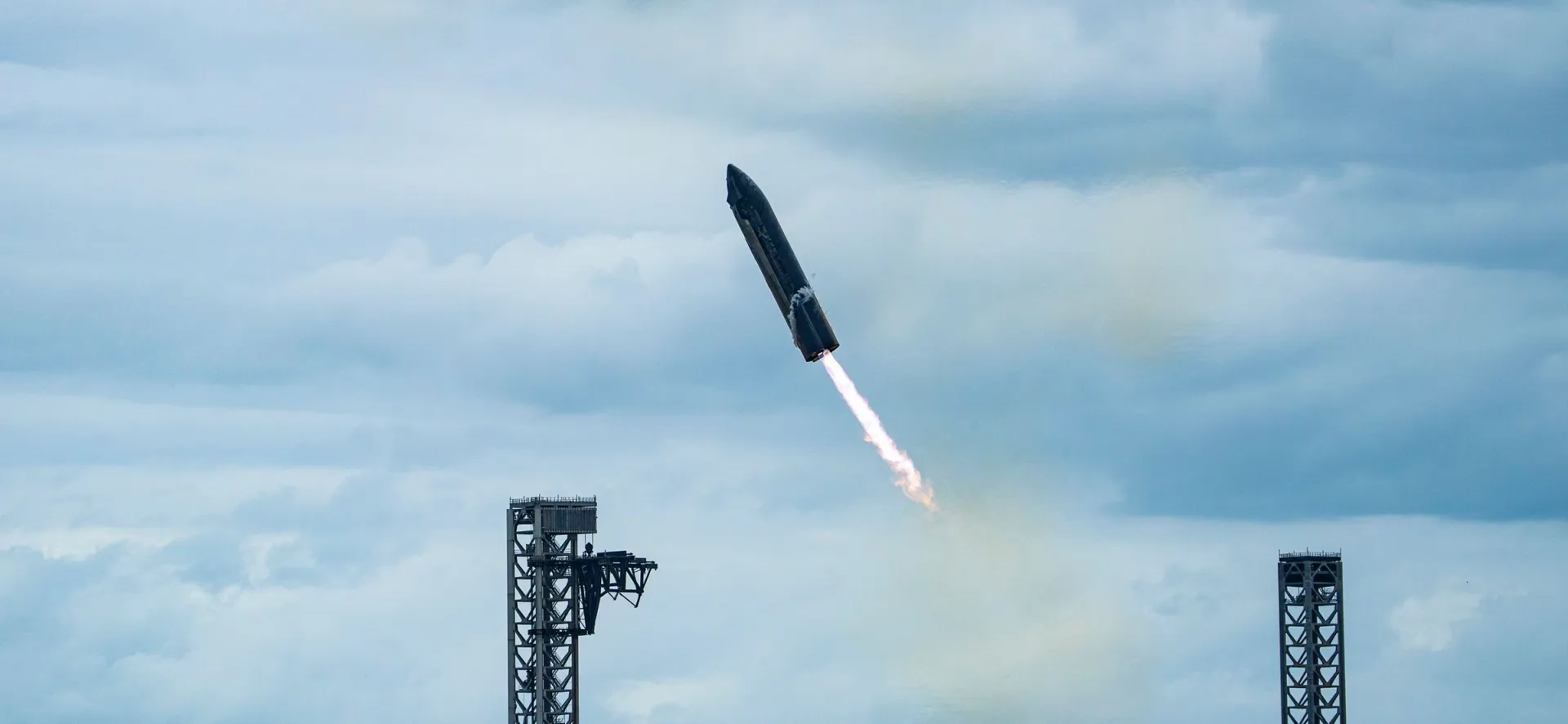
On this flight, one Raptor engine reignited to take Starship out of orbit. The upper stage passed through the atmosphere, returned to the Texas coast and flew over the Gulf before approaching the launch site. As it descended through the clouds, three Raptor engines fired to turn it into its landing attitude. The tower’s two arms closed as the vehicle came down slowly. SpaceX released an official video of the catch.
The first-stage booster was not recovered on the same flight. Super Heavy diverted offshore instead of returning to the launch site. The test therefore fell short of recovering both stages.
Official catch video · SpaceX
https://x.com/SpaceX/status/2121715216597827756
Sources and editorial notes
AP — Starship returns from orbit and is captured by launch pad arms
SpaceX — Starship and its heat shield are healthy
Space.com — Starship Flight 15 live updates
SpaceX — Super Heavy offshore diversion
SpaceX — Super Heavy landing burn and splashdown
Image: SpaceX · Starship’s upper stage descending toward the launch tower, in an official Flight 15 photograph.
Machine-translated from Korean. Read the original.