Timing a laser pulse’s return reveals distance. Passive reflectors send light back toward its source without using electrical power.
Article
Send a laser pulse toward the Moon and wait for its return. Precisely measuring the round-trip time makes it possible to calculate distance. Retroreflectors on the lunar surface provide small targets, directing light back toward where it came from instead of scattering it in many directions.
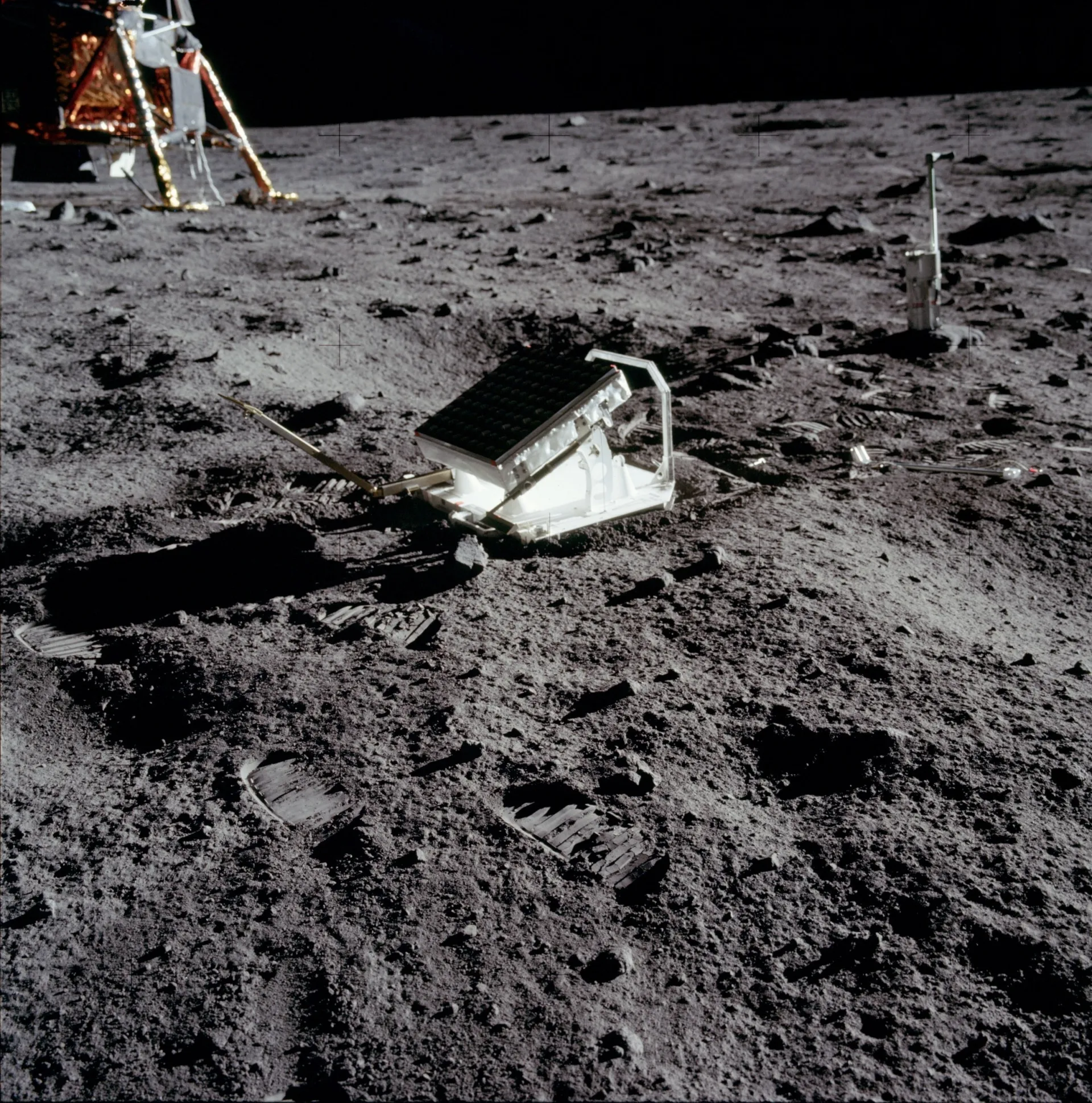
Reflectors placed by Apollo astronauts have been used to measure the distance from Earth to the Moon. No motor continually turns them toward Earth. Light reflects in sequence from surfaces set at right angles and returns toward its source. Precise measurements require ground observatories equipped with lasers, telescopes and timing instruments.
The same principle can help locate lunar spacecraft. A small laser retroreflector array described by NASA places eight reflectors in a compact hemispherical mount. It needs no electrical power and serves as a marker for laser pulses from an orbiter. Its size and operating distance differ from those of the Apollo reflectors targeted from Earth.
In 2024, NASA’s Lunar Reconnaissance Orbiter sent laser pulses to a reflector aboard Japan’s SLIM lander and received return signals. SLIM had landed with its top facing sideways, restricting the angles from which the reflector could be targeted. The LRO team worked with Japanese researchers to establish the lander’s position and orientation, then selected orbital passes likely to give the laser a clear path to it.
Even after a lander’s communications equipment stops working, its unpowered reflector can remain a target that returns light. A later spacecraft can direct a laser toward that known surface location and time the return to measure the distance to it. A small device left on the Moon can thus provide a reference point for subsequent missions.
Sources and editorial notes
science.nasa.gov · 달 레이저 반사경 자료 2
Editorial note: Facts were checked against the linked sources. Interpretations are MUADAILY’s editorial perspective. Image: NASA · Public domain · The laser retroreflector placed on the Moon by Apollo 11.
Machine-translated from Korean. Read the original.