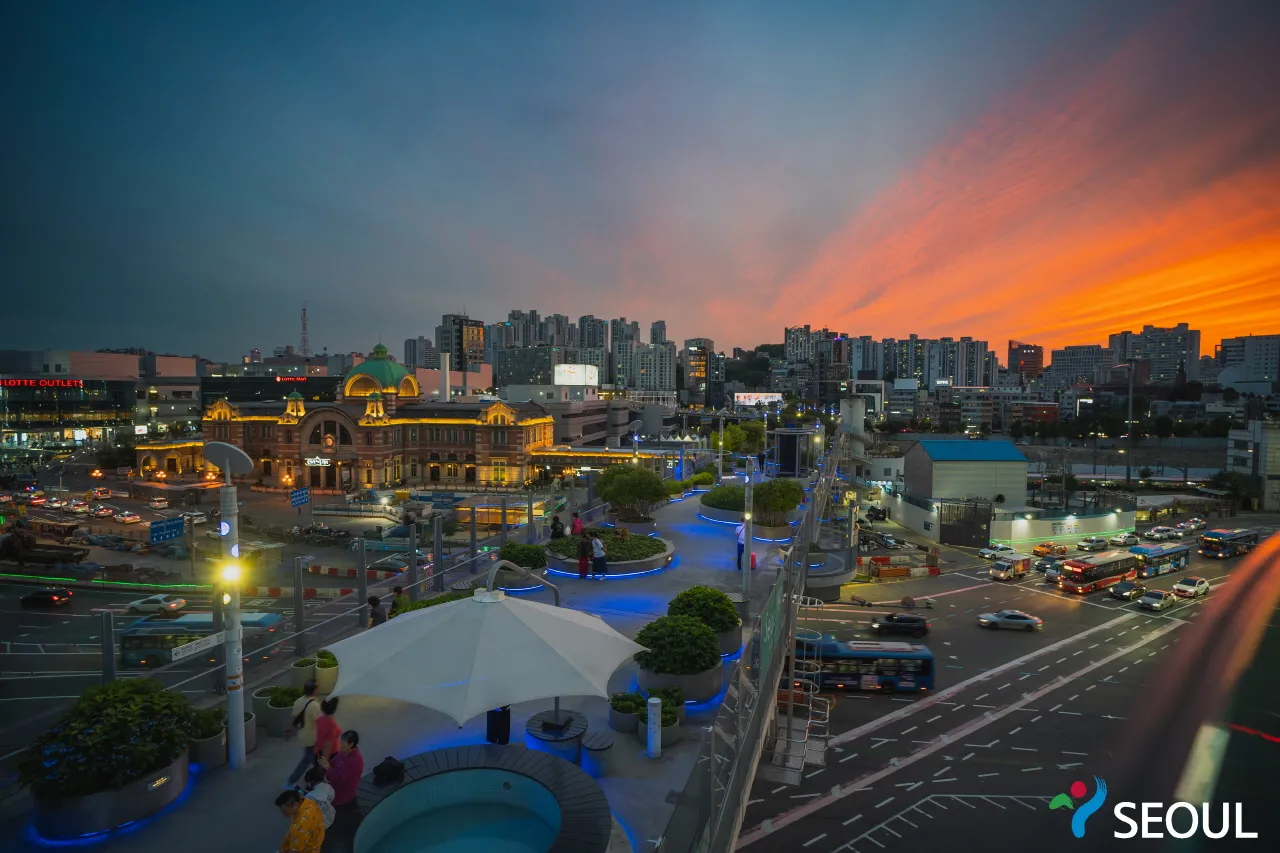
People now walk where cars once crossed the Seoul Station overpass. Plants and pedestrian paths on the retained structure offer places to stop and look at a city once glimpsed through a car window.
Article
From a car passing Seoul Station, buildings and alleys quickly slip out of view. Walking through the same area, you can notice another sign, stop and choose a direction. Seoullo 7017 is an urban park made by converting the Seoul Station overpass into a pedestrian route. It lets people see the city from the height where cars once traveled.
Built in 1970, the overpass reopened for pedestrians in 2017. The 70 and 17 in its name link the year of construction with the year of conversion. The road was not removed to make room for a new park: its structure remained, while the way people used it changed.
Plants where cars once passed
Seoul describes Seoullo 7017 as an elevated linear park and pedestrian route in the city center. Plants and flowers line the path, which connects with surrounding walking routes. A passage through the Seoul Station area now offers things to pause and examine.
Stopping on a road for vehicles obstructs traffic. On a walking path, it is part of the experience. People can pause to look at a plant or take in the city below. A route once used to reach a destination quickly now makes room to rest or look around along the way.
The walk begins on the way up
The view from the top is only part of Seoullo. Where you enter and leave determines the route you actually walk. Continuing to Seoul Station or into the surrounding alleys makes the same overpass part of different journeys.
An elevated garden and a convenient everyday walking route are not quite the same thing. Finding an entrance and connecting it with a destination also shape the experience. That is why Seoullo makes sense as a route linking its surroundings, rather than a viewing platform set apart from the city.
Walking on the old road
Seoullo makes something apparent that a purpose-built walking path might not: the place beneath your feet once carried the weight and movement of cars. The surviving structure makes the change in use easy to recognize.
Access and maintenance continue to need attention after a conversion. But the visible change is clear. A structure built for fast movement now gives people a place to walk slowly. The scenery around Seoul Station that once passed a car window can now be studied a little longer from the path itself.
Sources and editorial notes
Seoul City · June 30, 2023, Seoullo 7017 official introduction and photo material
Seoul Metropolitan Government, Mediahub · 2017, Seoullo 7017 Creation and Meaning of Name
Editorial note: The year of construction and spatial characteristics are based on official data from the Seoul Metropolitan Government. Past introduction materials were not used as news of new openings and are not reviews of on-site visits. The pedestrian experience and implications of urban reuse are MUADAILY's editorial interpretations. Image: Seoul Metropolitan Government · Seoullo 7017 (2023.06.30) · https://english.seoul.go.kr/seoullo-7017-3/.
Machine-translated from Korean. Read the original.