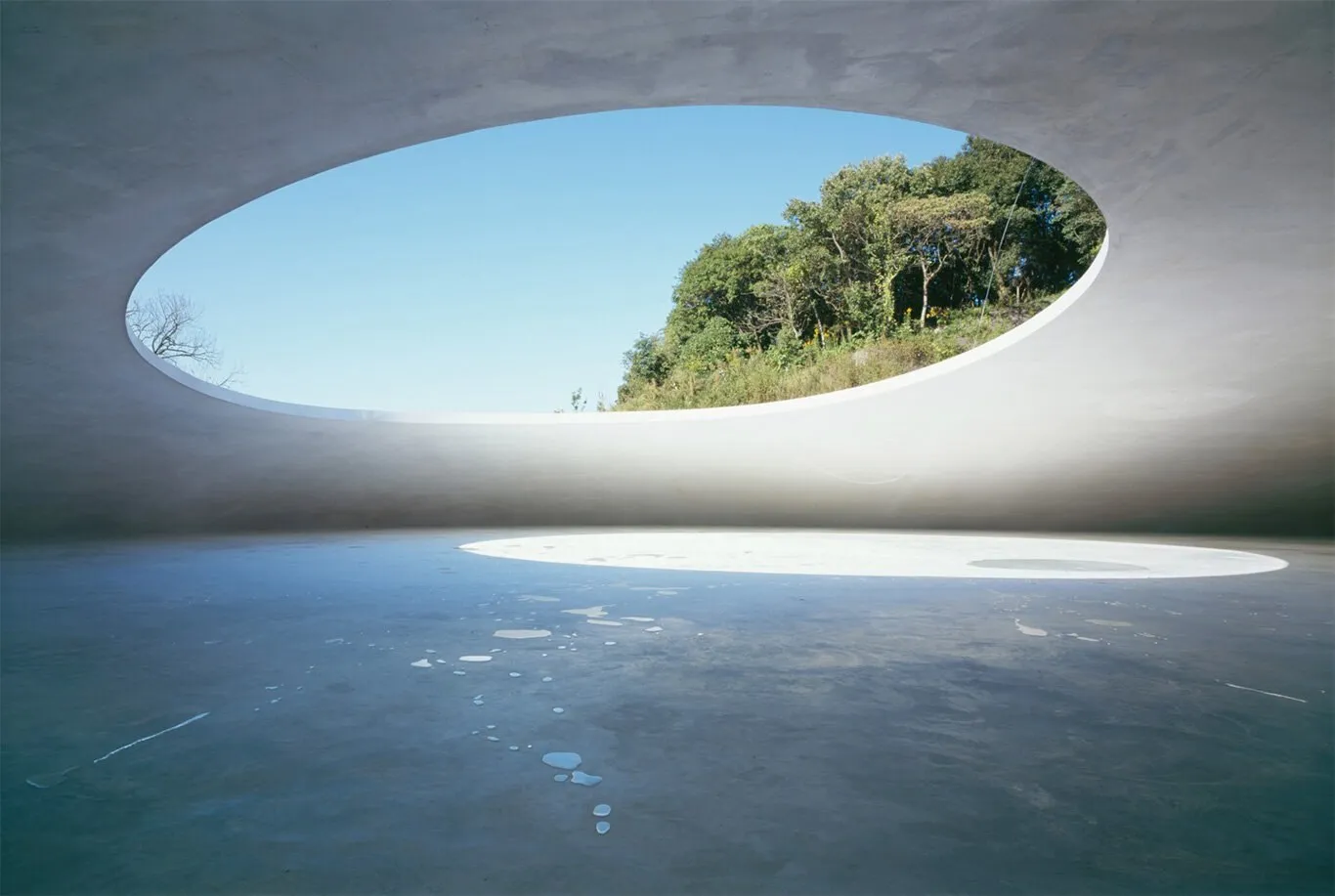
At Teshima Art Museum, water emerges from the floor as light enters through the roof. Rei Naito’s artwork meets Ryue Nishizawa’s architecture.
Article
Small drops of water gather and move across the floor. Instead of searching for a painting on a wall, you watch where the water will go next. Teshima Art Museum in Japan brings together Rei Naito's artwork “Matrix” and Ryue Nishizawa's architecture.
The museum stands beside rice terraces on a hill overlooking the Seto Inland Sea. Its low concrete shell resembles a drop of water spreading on the ground. The operator describes a column-free space measuring roughly 40 by 60 meters, rising to only 4.3 meters at its highest point. The broad interior is enclosed by a low roof.
Two oval openings admit light, wind, and sound. Rather than sealing the gallery off to maintain constant conditions, they leave it open to the sky and weather. A passing cloud and direct sunlight can make the same floor look different.
Water emerges little by little from points in the floor throughout the day. Droplets form, gather, and travel across the surface. These are elements of an artwork showing water appear and move, rather than a natural spring or a leaking roof.
The rice terraces outside are more than a photographic backdrop. The operator says they were restored with local residents, and the museum stands beside them. The island's cultivated landscape and the new art space come into view together. Watching tiny drops inside and looking beyond the fields outside are closely connected experiences.
A single photograph cannot capture a whole day's changes. Water takes time to gather, and light moves across the space. As the outdoors enters through the roof, new drops form on the floor. One drop moves on, while another begins elsewhere.
Sources and editorial notes
Benesse Art Site Naoshima · Teshima Art Museum · Matrix · Architecture and rice fields
Benesse Art Site Naoshima · Official introduction of the museum in Japanese
Editorial note: Factual statements are based on the sources above; interpretations reflect MUADAILY's editorial perspective. Image: Teshima Art Museum · Photo source: Benesse Art Site Naoshima.
Machine-translated from Korean. Read the original.