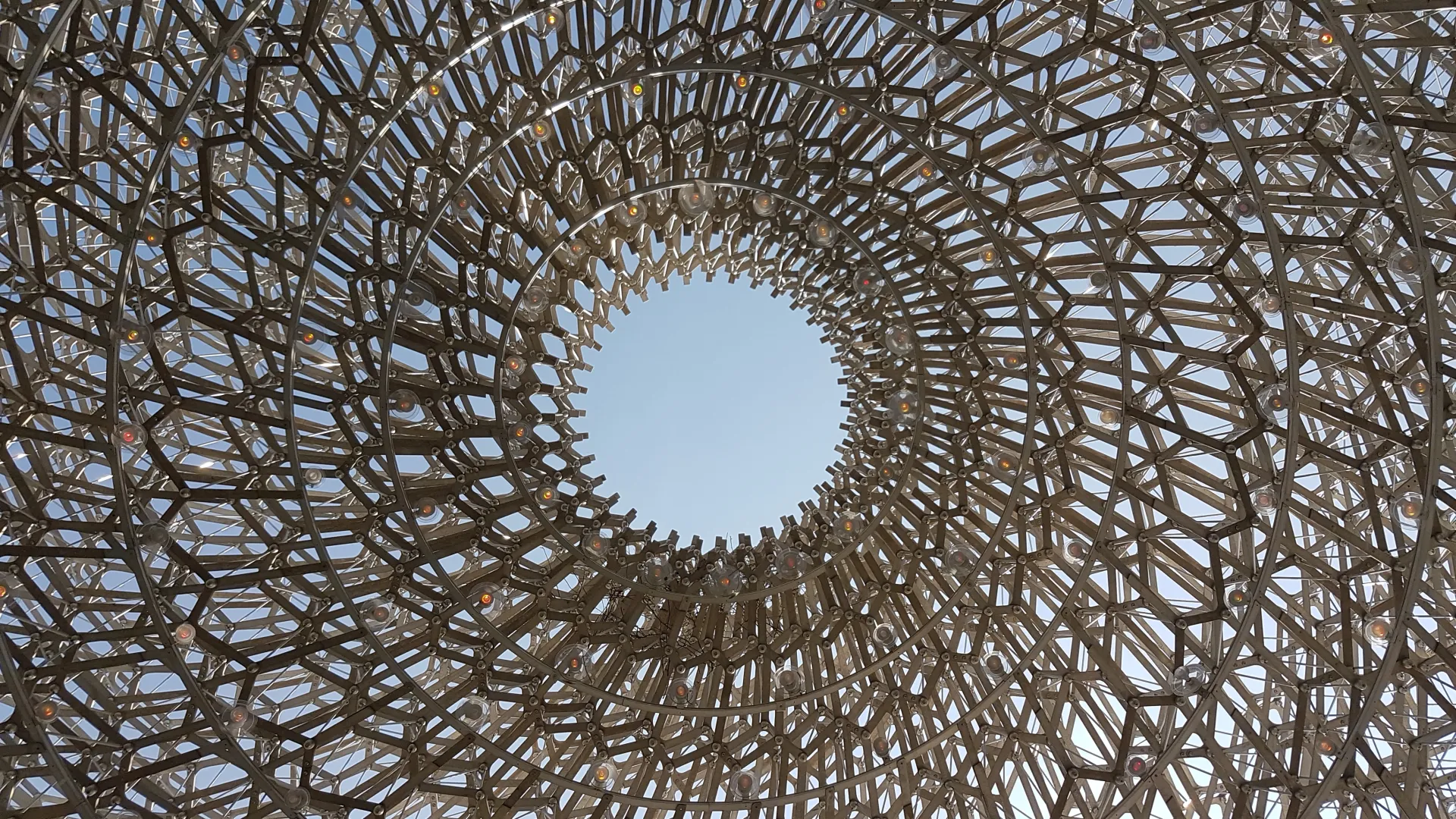
At London’s Kew Gardens, The Hive responds to vibrations detected in a real beehive, bringing the activity of a bee colony into a space people can enter.
Article
Lights change and sounds shift inside a metal structure in a garden. It may look like a programmed installation, but The Hive at Kew Gardens in London is connected to a beehive elsewhere in the grounds. A sensor detects vibrations from the bees’ activity, and the signals affect the artwork’s light and music. Small, otherwise hard-to-notice movements become part of an experience large enough to walk into.
British artist Wolfgang Buttress designed The Hive for the UK Pavilion at the 2015 Milan Expo, before it moved to Kew. Roughly seventeen metres high, its closely spaced metal elements overlap into a three-dimensional mesh without fully closing off the interior. It is an artwork evoking bee activity through structure and sensation, rather than a literal enlargement of a honeycomb.
Its key device is a vibration sensor in a real beehive. Kew explains that this detects the bees’ activity and transmits signals in real time. One thousand LED lights inside The Hive switch on and off in response. What may look random to a visitor reflects activity in a colony elsewhere in the garden.
The sound needs a further distinction. Not everything from the speakers is a live relay of the hive. A prerecorded library combines bee sounds and musicians’ performances; live vibration signals trigger those sounds when they cross particular thresholds. Prepared material and changing bee activity work together. Knowing which element is live makes the connection more precise.
The installation invites a different sort of attention from reading information about bees. Visitors can recognise that the lights surrounding them are linked to the insects’ activity. Those lights do not, however, allow a visitor to diagnose the colony’s health or interpret an individual bee’s behaviour. The work turns a measured signal into an artistic experience, with a particular set of possibilities and limits.
The Hive does more than borrow a shape from nature. It makes activity too small or remote to notice accessible to the senses. Visitors stay for a while; the bees continue their own routines. Different lives within the same garden meet through sensors, light and recorded sound.
Photograph: JRennocks, 2018 / Wikimedia Commons, CC BY 4.0. Reduced in size with the original aspect ratio preserved and converted to WebP.
https://commons.wikimedia.org/wiki/File:The_Hive_at_Kew.jpg
https://creativecommons.org/licenses/by/4.0/
Sources and editorial notes
Kew Gardens · How real bees drive the lights and sound
Kew Gardens · Official guide to The Hive
Editorial note: Facts were checked against the sources above; interpretations reflect MUADAILY’s editorial perspective. Image: JRennocks / Wikimedia Commons / CC BY 4.0 · Resized proportionally and converted to WebP.
Machine-translated from Korean. Read the original.