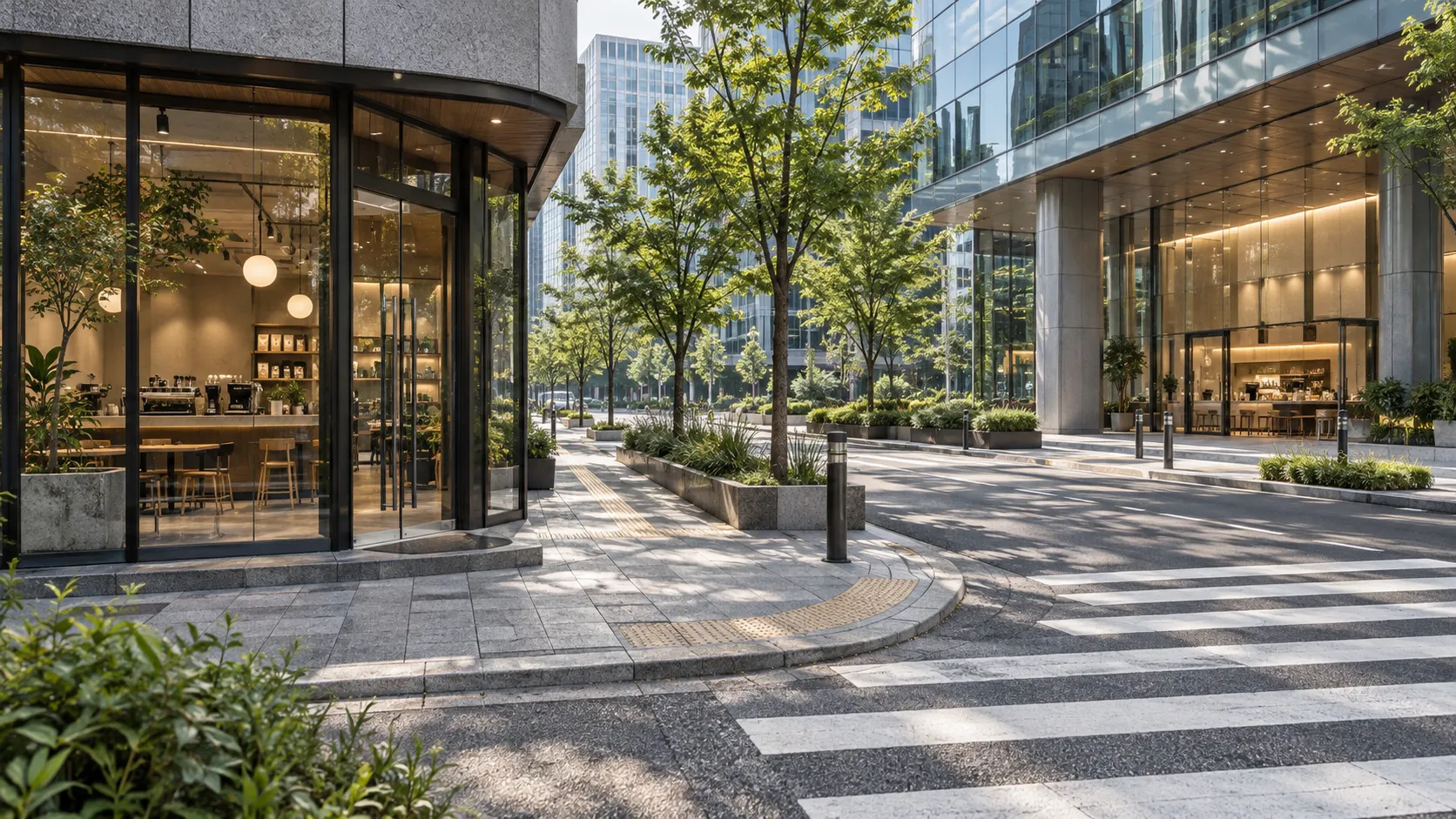
Two stores close together on a map can occupy very different places in a walk. Entrances and everyday routes help explain the space between matching signs.
Article
Walking down the street for coffee, you spot a familiar green sign. If you go a little further, you will see the same sign again. It seems like one location would be enough, but why are two Starbucks stores so close together?
This question cannot be answered simply by enlarging the map. On the map, the two points are close, but on the road, there are crosswalks, stairs, and building entrances between them. If the direction you go to work or the exit from the subway is different, the store you go to first can be different even within the same block.
Same Yeouido, different entrance
In Starbucks’ official store materials, distinct store names appear, such as ‘Yeouido IFC (1F)’ and ‘Yeouido IFC Mall (L1)R’. Even though they share the same name, IFC, the building’s ground-floor location and the mall’s level designation point to different ways of reaching the stores. R identifies a Reserve store, distinguishing it from a regular branch.
Those labels do not tell us what proportion of customers are office workers or shoppers. This is because individual store opening decisions and actual user data cannot be known through public lists alone. However, it is understandable that the address of the same place can be a different starting point for people entering from outside the building and people moving inside the mall.
Sitting down or taking coffee to go
Visiting a store has more than just one purpose. For some, a cafe is a place to sit and wait, and for others, it is a place to get a drink before entering the office. Starbucks' official store locator not only shows types such as Drive-Thru, Walk-Thru, and Reserve, but also shows various conditions such as parking, proximity to the subway, and being located in a hospital or terminal.
Time also becomes a part of the route. Siren Order allows you to select a store to order from, and available times vary depending on operating hours. Even when ordering a familiar drink, today's route comes before the brand when deciding which store to receive it from.
However, these conditions are not a secret formula that explains all nearby stores. Lease terms, building structure, and operational plans may also be important in actually opening a store, but the reasons for deciding on a specific store cannot be determined without first-party data. Finding the same sign and knowing the inside story of the company are two different things.
The walk between two points
When comparing nearby stores, look at the path to the door first rather than the straight line distance. Does the route require crossing a road, entering a building or taking another escalator? Even a short detour can change the location you use if repeated every day.
The two stores shown on the map are in the same neighborhood. However, one person chooses coffee at the entrance of the building on the way to work, and the other person chooses coffee inside the shopping mall. Between one Starbucks and another nearby are those extra steps that the matching signs do not show.
Sources and editorial notes
Starbucks Korea · Find an official store
Starbucks Korea · Official event store list
Starbucks Korea · Store and ordering information
Editorial note: Facts were checked against the sources above; interpretations are MUADAILY’s editorial views. Image: MUADAILY.
Machine-translated from Korean. Read the original.