With a slate and stylus, the raised text appears on the reverse. That changes both the direction of writing and the placement of dots.
Article
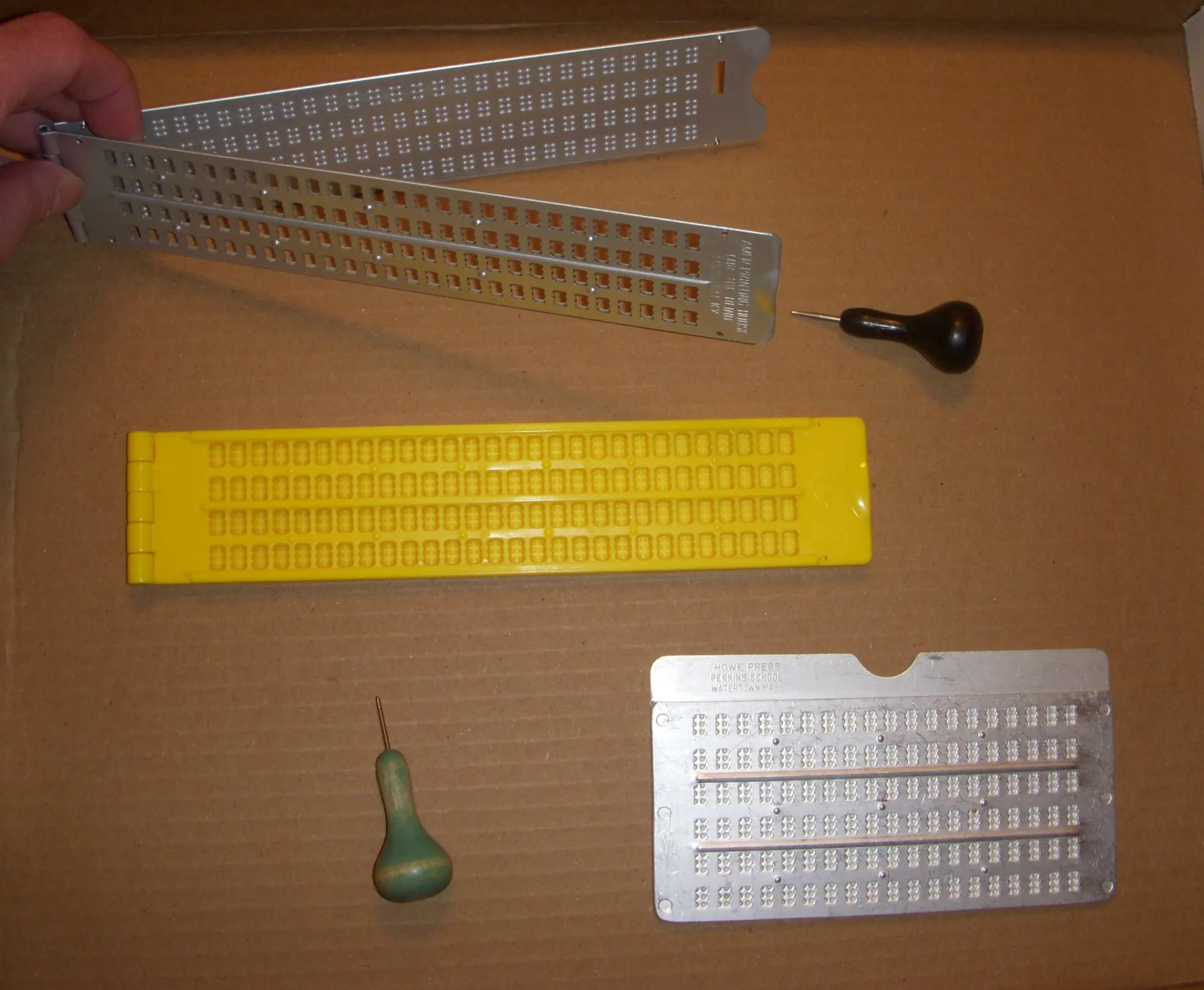
Press a stylus into paper held in a braille slate and a raised dot appears on the other side. The readable text is being made on the back of the sheet. That is why a conventional slate and stylus require writing in the opposite direction from reading.
The basic cell developed by Louis Braille has six positions: two columns of three. Different raised-dot combinations represent different signs. Including the blank cell gives 64 possible combinations.
Viewed from the reading side, the left column is numbered 1, 2 and 3 from top to bottom; the right is 4, 5 and 6. In English braille, a uses dot 1 and b uses dots 1 and 2. The six-dot framework is shared, but the writing conventions vary by language; Korean braille has its own rules.
On a conventional slate, the writer moves from right to left and reverses the dot positions. Turning the finished sheet over puts the sequence and positions the right way round. Braille typewriters and electronic devices can use other input methods; this reversal is specific to the method described here.
The slate holds the spacing while the stylus presses the required positions. Once the sheet is turned over, those individual impressions form a line that can be followed with a fingertip.
Sources and editorial notes
Editorial note: Facts were checked against the linked sources. Interpretations are MUADAILY’s editorial perspective. Image: Jeepday · Public domain · Braille slates and styluses used to emboss paper.
Machine-translated from Korean. Read the original.