From finished classics to prototypes and experiments, Vitra Schaudepot opens up the making and keeping of furniture to visitors.
Article
The first question in front of a chair is usually whether it can be sat on. Line up different chairs, though, and there is more to see: why is a backrest open, why do the legs curve backward, and how does bent wood differ from bent metal? Vitra Schaudepot is a permanent exhibition space for the Vitra Design Museum's furniture collection. Everyday furniture is brought out for a longer look.
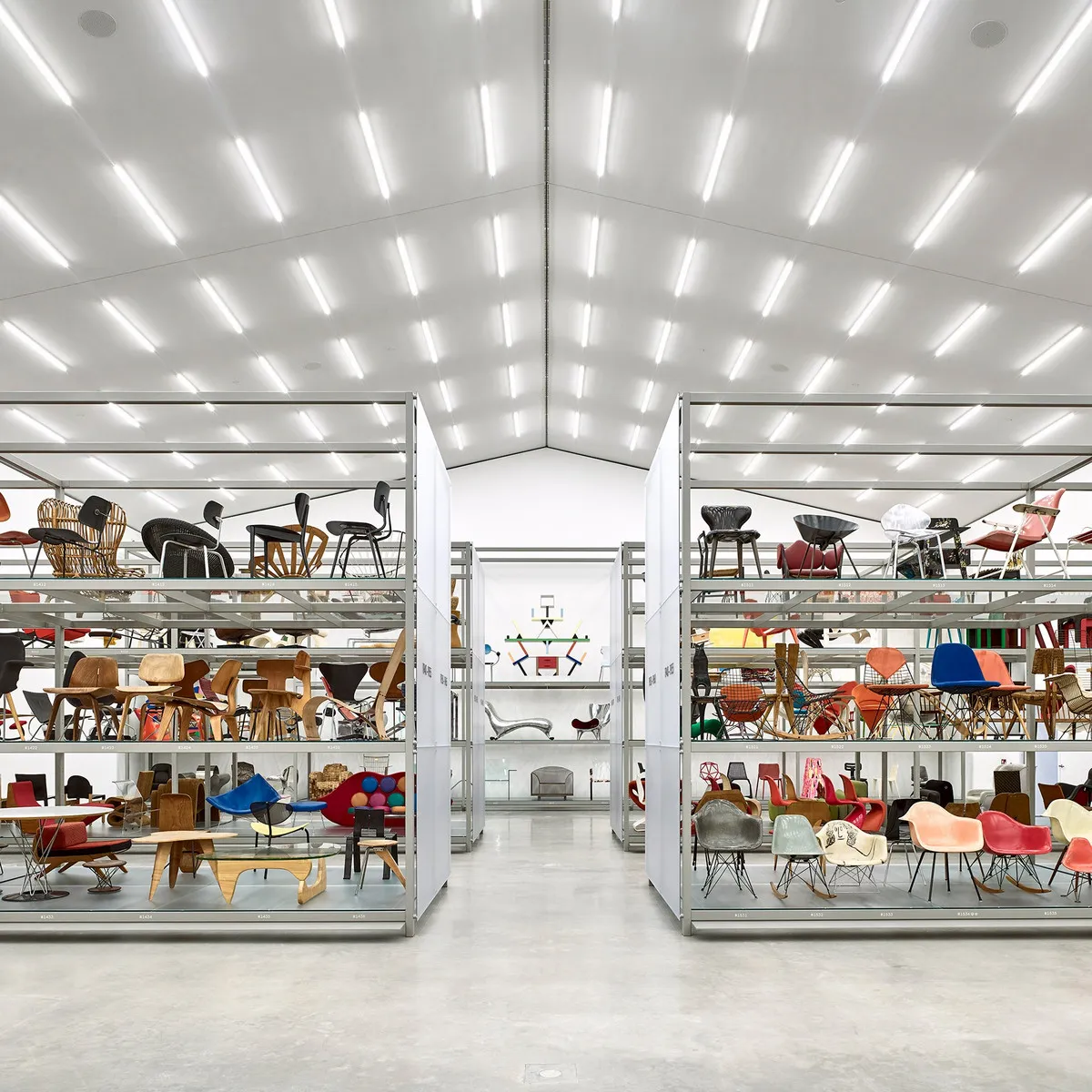
The space opened in 2016 on the Vitra Campus in Weil am Rhein, Germany, in a building by Herzog & de Meuron. It presents a selection of about 400 pieces from the nineteenth century to the present. Chairs are part of a wider display of modern furniture design.
Famous finished designs sit alongside less familiar objects. Early bentwood furniture, work by Le Corbusier, Alvar Aalto, and Gerrit Rietveld, and 3D-printed furniture appear together. Anonymous pieces, prototypes, and experimental models are included too. The process of finding a form is treated as worth showing alongside forms that became famous.
Different materials call for different methods. Cutting and joining boards, bending wood, and printing a shape involve different choices even when making a seat. Nearby pieces allow comparisons: where was material left thick, and where was it removed to save weight? Older furniture gives context to newer work, while new objects invite another look at earlier decisions.
The name Schaudepot refers to a collection store open to view. A museum cannot display everything at once; here, part of its storage and research becomes visible. The basement Schaudepot Lab explores materials and manufacturing, and large windows reveal parts of the storage areas. Behind the objects on display, cataloguing and preservation continue.
A visitor need not begin with a course in design history. There may be a structure resembling a dining chair at home, or a chance to compare the joints between seats and legs. A prototype suggests a form still being resolved; a familiar finished object raises questions about why its design endured. Names and dates need not all be memorized first.
None of these hundreds of pieces may be going home with the visitor. But they can provide a reason to look under an everyday chair afterward. An object normally trusted with body weight begins to reveal the choices behind its materials, joints, and support.
Sources and editorial notes
Vitra · Schaudepot overview and number of objects on display
Vitra Design Museum · Guide to collections and underground lab
© Vitra Design Museum · Photo Mark Niedermann · Image distribution source
Editorial note: Facts were checked against the sources above; interpretations reflect MUADAILY’s editorial perspective. Image: © Vitra Design Museum · Photo Mark Niedermann.
Machine-translated from Korean. Read the original.