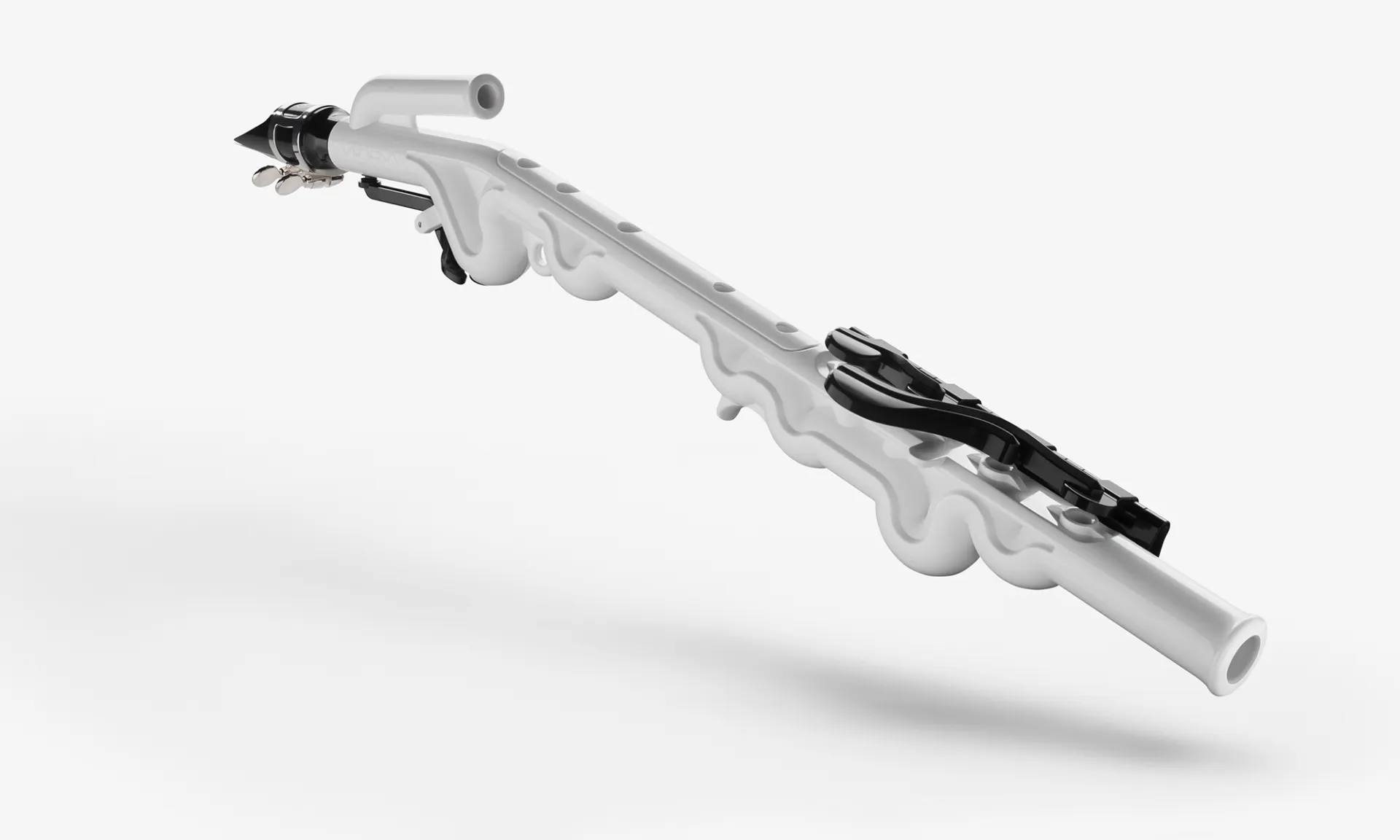
Yamaha Venova combines a branched tube with a winding body. The design brings a saxophone-like resonance into a compact instrument while keeping the tone holes within reach.
Article
Round holes run along a white body. Covering them with the fingers recalls a school recorder, but Yamaha's Venova has a reed at its mouthpiece, like a saxophone. Beneath the holes, the tube curves in waves. The shape is not decoration for its own sake; it brings the instrument's sound and the player's reach into the same design.
Introduced in 2017, Venova is an acoustic wind instrument whose reed vibrates with the player's breath. It does not use electronics to play back a saxophone sound. Even with the same fingering, changes in breath pressure and the mouth affect the tone. To produce a rich, saxophone-like sound in a compact body, Yamaha altered the way air vibrates inside the tube.
The key is a branch near the mouthpiece. Cylindrical-bore instruments such as clarinets behave acoustically differently from instruments with a widening conical bore, such as saxophones. Adding a branch to Venova's cylindrical tube gives it characteristics closer to a conical tube. It is less a miniature saxophone than a different tube geometry designed to produce a related resonance.
The winding tube addresses the player's fingers. Bending the body preserves the required tube length while bringing the tone holes closer together. Direct finger coverage becomes easier, reducing the need for complex keywork. The holes lie in a row along the top like those of a recorder, with the curved tube running beneath them. The air's route need not follow the same line as the fingers.
Materials also reflect portability and care. The ABS-resin body is light and washable with water. The current range includes soprano, alto, and tenor versions with different sizes and pitch ranges. Recorder-like fingering does not mean the sound will come immediately, however. Controlling the reed with the mouth is a separate skill, and Yamaha provides guidance starting with posture and producing a note.
The designer described this as a rare opportunity to develop a new appearance directly from the sound-producing structure. Venova's profile makes sense when fingers and acoustics are considered together: the holes stay within reach while the tube winds around to retain its length. Curves that might have been hidden beneath a smooth shell remain visible, showing how the compact instrument was worked out.
Sources and editorial notes
Yamaha Innovation Road · Venova YVS-100, first introduced in 2017
Yamaha · 2023-05-30 Description of sound/fingering of branch pipe and meandering structure
Yamaha Design · 2017 Venova Designer Description
Yamaha USA · Current product line, sound, materials, and basic performance information
Editorial note: Facts were checked against the sources above; interpretations reflect MUADAILY’s editorial perspective. Image: Yamaha Corporation / Venova official press release.
Machine-translated from Korean. Read the original.