Charles and Ray Eames' wooden splints supported the body with curves and holes. We see how furniture research developed through wartime production experience.
Article
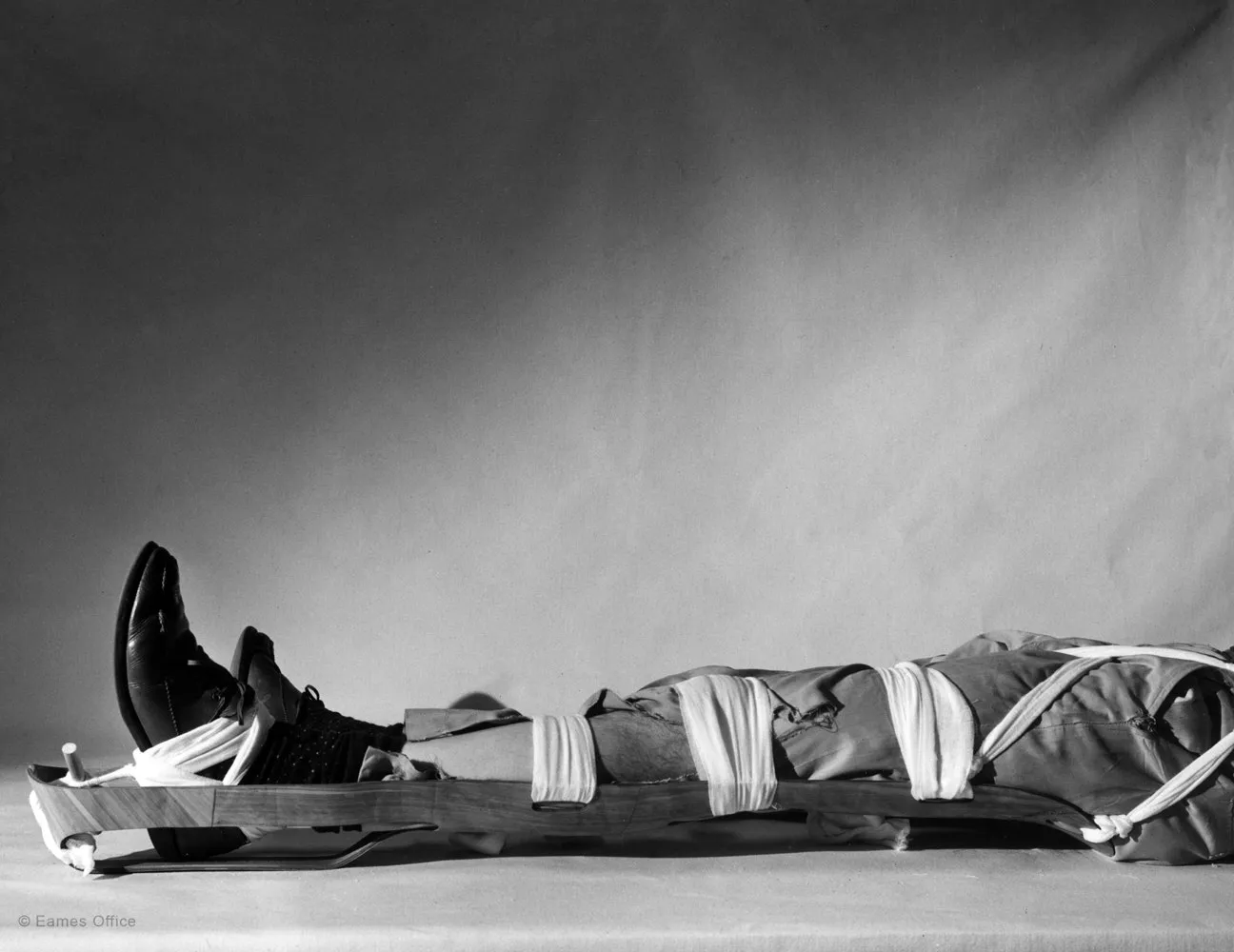
A long, curved piece of wood is pierced by several openings. It might look like an experiment for a chair back, but Charles and Ray Eames designed their Leg Splint to support injured legs. Their plywood techniques, now familiar from furniture, also helped transport wounded people during the war.
During World War II, the US Navy needed light, portable splints. The Metropolitan Museum of Art dates the example in its collection to 1942 and identifies its material as molded plywood. Thin layers of wood are formed into a curve, making a support shaped to the body rather than a flat board placed beside the leg.
Following the body's contours involves more than an attractive curve. Bending plywood in several directions creates stress, and bandages need somewhere to pass through. Eames Office explains that the openings relieved stress in the bent plywood and provided passages for bandages and fastenings. Even the gaps served a purpose.
Making one piece in a workshop is different from repeatedly producing the same shape. The Eameses secured facilities and funding to work at a larger scale. In the process, they developed both body-supporting curves and methods for producing consistent pieces in quantity. That is why the splint appears in histories of furniture design.
It would be misleading to suggest that making splints first gave them the idea of designing chairs. They were already researching plywood furniture. Wartime work helped turn those experiments into production techniques that later fed back into furniture. Experience with the material accumulated across different objects.
Looking again, the curves and openings no longer seem decorative. You can see where the leg rests and the bandages pass. The need to support a body comfortably was already there before those techniques took the form of a chair.
Sources and editorial notes
The Met · 1942 Leg Splint and plywood forming technology
Eames Office · Openings in the splint, wartime production, and the return to furniture
MoMA · Leg Splint collection record
Editorial note: Factual statements are based on the sources above; interpretations reflect MUADAILY's editorial perspective. Image: Archival photo courtesy of Eames Office.
Machine-translated from Korean. Read the original.