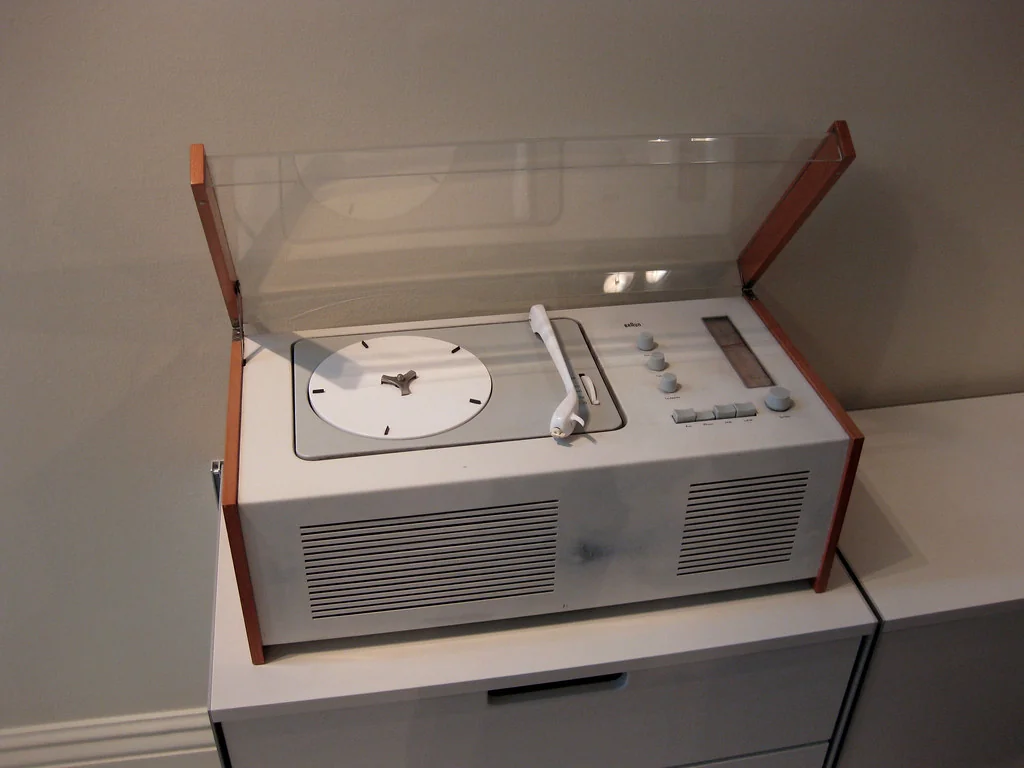
The 1956 Braun SK4 combines a white metal body, wooden sides, and a transparent lid. Dieter Rams and Hans Gugelot’s design keeps the turntable and controls in view.
Article
Close the record player's lid and the mechanism remains visible. Braun's SK4 presents its turntable and controls beneath a transparent cover instead of hiding them in a piece of furniture. The turntable sits on the left, with controls beside it in the same body. Familiar as this arrangement looks today, it offered a different appearance for audio equipment in 1956.
Dieter Rams and Hans Gugelot both contributed to the design. MoMA lists them together in its record for the SK4/10 model. Attributing the object to Rams alone leaves out that collaboration. The Design Museum also describes the involvement of Gugelot's team and colleagues at Braun.
Radios and record players of the period could resemble traditional furniture, enclosed in wooden cabinets. The SK4 paired a white metal body with pale wooden side panels. Wood remained, but the large cabinet did not. The different materials were visible, and the working parts gathered on the top rather than the front or back.
The controls contribute to that appearance. Buttons and scales sit beside the turntable on the upper surface. Cooper Hewitt notes that the clear lid leaves the controls and mechanism in view. Lowering the lid encloses the device without hiding it. The place for the record and the controls can be seen together even while it is closed.
The lid's transparency also arose from a practical problem. According to the Design Museum, a proposed metal cover vibrated excessively in tests. Rams suggested replacing it with transparent plastic. Addressing a problem with sound changed the appearance, and the white body and clear cover later earned the nickname “Snow White's coffin.”
Looking at the materials makes the design decisions tangible. Wooden panels remain at the sides; the top becomes transparent. MoMA lists painted metal, wood, and plastic. Within a simple rectangle, different surfaces use materials suited to their roles.
Viewed as a design object, the SK4 raises a question beyond current audio performance: how much of a machine should remain visible? Closing the lid gives it a single box-like outline while leaving the turntable and controls in view. Even when the music stops, the place for a record and the buttons remain visible under the cover.
Image description: A Braun SK 4.1 photographed by With Associates in 2008.
Image source: With Associates / CC BY-SA 2.0
https://www.flickr.com/photos/withassociates/2917604465/
Image changes: resized with the original aspect ratio preserved and converted to WebP. No cropping.
The converted image is also available under CC BY-SA 2.0.
https://creativecommons.org/licenses/by-sa/2.0/
Sources and editorial notes
MoMA · Dieter Rams, Hans Gugelot · Radio-Phonograph (model SK4/10), 1956
Design Museum · Dieter Rams · SK4 development related text
Cooper Hewitt, Smithsonian Design Museum · An Apple Inspiration · Collection Structure Description
Source of preview · With Associates / CC BY-SA 2.0
Photo Terms of Use · CC BY-SA 2.0
Editorial note: Factual statements are based on the sources above; interpretations reflect MUADAILY's editorial perspective. Image: With Associates / CC BY-SA 2.0.
Machine-translated from Korean. Read the original.