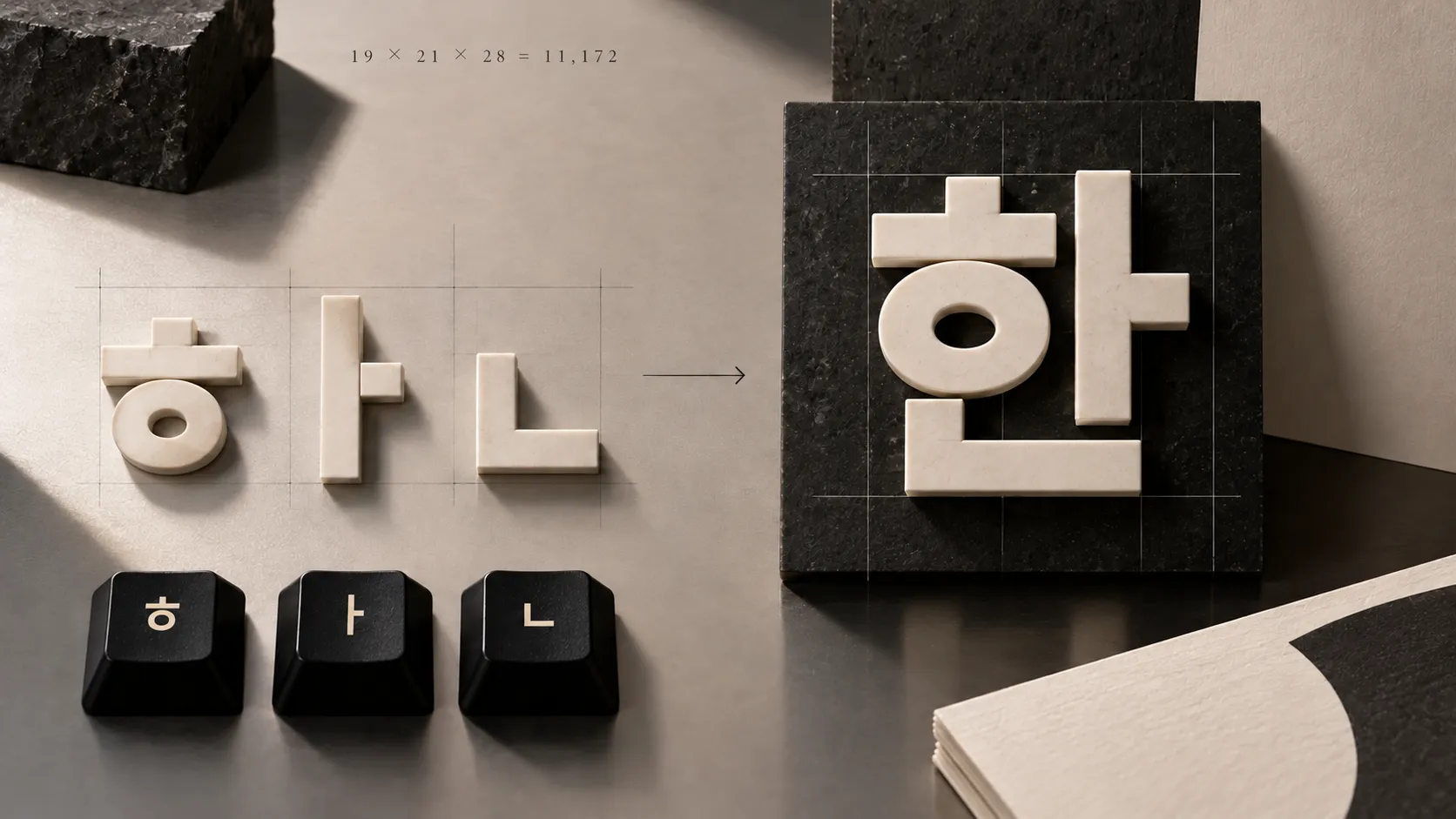
Type ㅎ, ㅏ, and ㄴ to make 한; that syllable can be separated into the same three components. Hangul’s analysis of sounds and systematic combinations still shape keyboard input, character encoding, and search.
Article
When you type 한 on a phone, your fingers enter ㅎ, ㅏ, and ㄴ in sequence. Instead of three separate letters, the screen displays a single syllable. Add ㅏ and it becomes 하나. The input method moves ㄴ from the final position of the first syllable to the beginning of the next.
We usually continue typing without noticing that brief rearrangement. The computer, however, must identify consonants and vowels, decide where they belong, and know when to revise an existing combination. An everyday text field continually processes Hangul’s structure.
What makes Hangul’s design interesting is less the label “scientific” than its specific rules. Following how sounds were analyzed, related sounds given related forms, and letters combined into syllables reveals what the design accomplishes.
Letter shapes drawn from the body producing sound
The Jejahae section of the Hunminjeongeum explains the basic shapes ㄱ, ㄴ, ㅁ, ㅅ, and ㅇ in relation to the speech organs. It describes ㄴ through the shape of the tongue touching the upper gums, and ㅁ through the shape of the mouth. To represent sounds that cannot be seen, the designers observed the body producing them.
Strokes were added for related sounds. Placing ㄱ beside ㅋ, ㄴ beside ㄷ and ㅌ, or ㅁ beside ㅂ and ㅍ makes their resemblance apparent. The forms preserve relationships between sounds rather than presenting only unrelated shapes to memorize.
The Jejahae should not be read as a modern anatomical diagram, and letters such as ㄹ follow a different principle from the addition of strokes. The vowel elements ㆍ, ㅡ, and ㅣ combine the period’s understanding of heaven, earth, and humanity with descriptions of tongue position. Within that historical explanation, we can still trace an effort to analyze sounds and organize letters systematically.
More combinations from familiar elements
가, 각, 간, and 갈 are different syllables, but do not require wholly different ingredients. They share ㄱ and ㅏ, with different final consonants or none at all. 가 and 거 differ in their vowel. Familiar elements are combined to form new syllables.
Modern precomposed Hangul syllables combine 19 initial consonants, 21 medial vowels, and 28 final-position possibilities, including no final consonant. Thus 19 × 21 × 28 = 11,172, the number of modern Hangul syllables encoded in Unicode. This includes combinations uncommon in actual words, but does not encompass every possible Old Hangul expression.
That is why a keyboard does not need 11,172 syllable keys. It accepts individual letters, and an input method combines them. The input method implements the order of entry and any revisions to the combination, drawing on a structure that can be broken down consistently.
A computer can take 한 apart again
Unicode does not place modern Hangul syllables in an arbitrary order. Their arrangement by initial, medial, and final components allows arithmetic composition and decomposition. A single visible syllable corresponds to a systematically assigned code value.
Counting from zero, the initial ㅎ in 한 has index 18, its medial vowel ㅏ has index 0, and its final ㄴ has index 4. Final index 0 means no final consonant. Adding (18 × 21 + 0) × 28 + 4 to the code value of 가 gives the code value of 한. Reversing the calculation recovers the indices of ㅎ, ㅏ, and ㄴ.
Initial-consonant search is a familiar use of this structure. A program can extract ㅎ and ㄱ from 한글 and compare them with ㅎㄱ. Such a search works with the components of the writing without needing to understand the word’s meaning. Unicode does not perform the search itself; software implements it using the structure.
The same visible syllable can have different representations
한 can be stored as one precomposed syllable code point or as a sequence of conjoining initial, medial, and final code points. The visible result can be the same while the underlying representation differs. Programs therefore consider normalization when comparing or searching text.
Standalone letters such as ㄱ and ㄴ must also be distinguished from the conjoining jamo used to construct syllables. Similar-looking shapes do not mean that arbitrary codes will form the same syllable when placed together. Character standards, input methods, and fonts must work together to handle the syllable blocks that people read so naturally.
Hangul connects the analysis of sounds with the combination of letters. Sejong did not design it in anticipation of computers, but present-day technology uses that structure for input and calculation. In the brief act of entering ㅎ, ㅏ, and ㄴ, principles for representing sounds, rules for constructing syllables, and software for processing text work together.
Sources and editorial notes
National Hangeul Museum · Hunminjeongeum Standard Commentary
Unicode Consortium · Korean FAQ, modern Hangul syllables and letter combinations
National Institute of the Korean Language · General rules and commentary on Hangul spelling
Unicode Standard · Algorithms for decomposing and composing Hangul syllables
Machine-translated from Korean. Read the original.