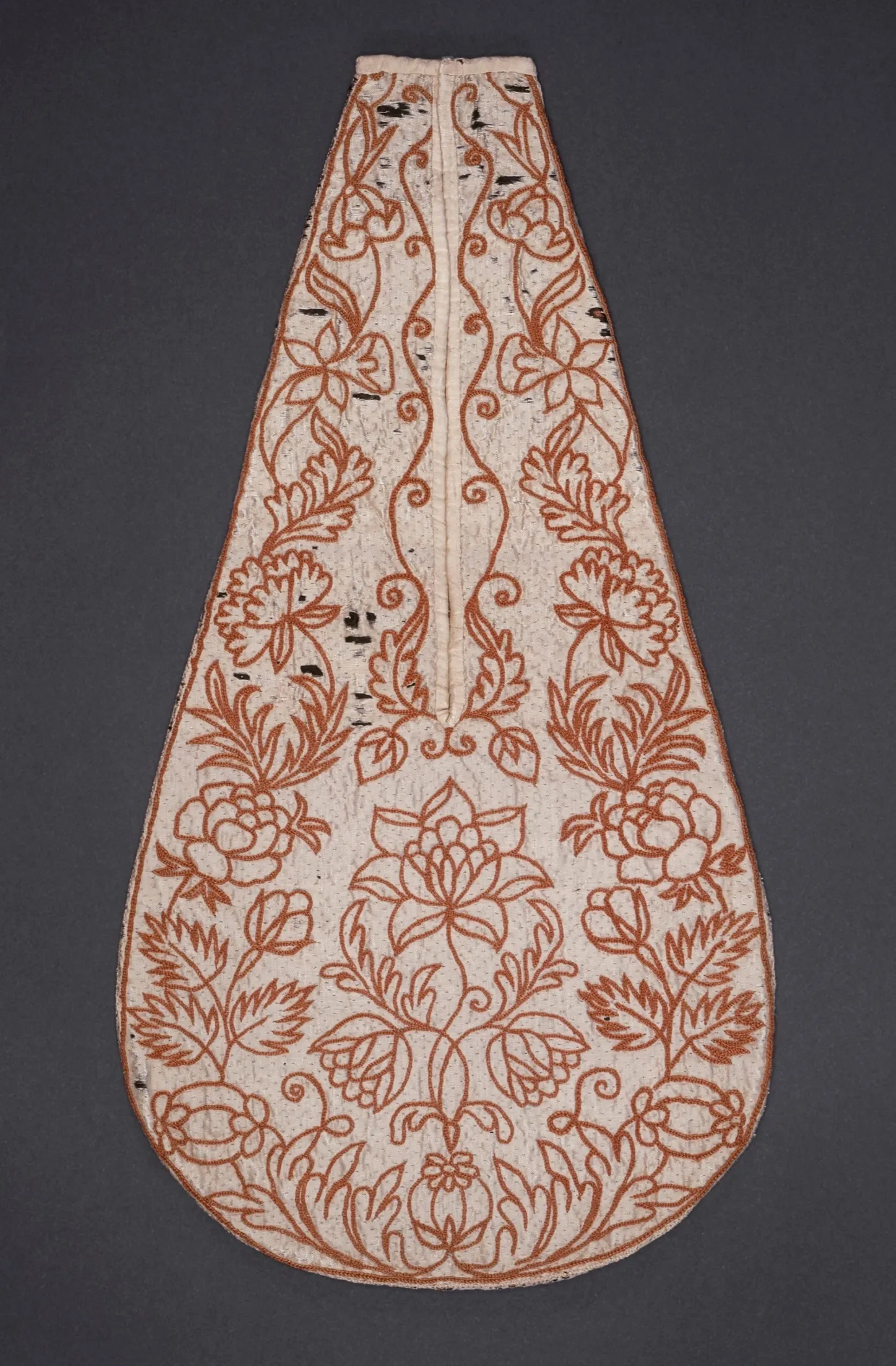
Tie-on pockets sat beneath skirts, carrying keys, money and sewing tools independently of the garment.
Article
Reaching into a skirt did not necessarily mean reaching into a pocket sewn onto it. European tie-on pockets were separate bags fastened around the waist. Openings in outer garments and petticoats provided access.
They could be worn singly or in pairs and larger groups. A widening lower section and vertical opening were common. Some large surviving examples described by the V&A measure about 40 by 30 centimetres.
Contents included keys, money, scissors, thimbles, letters and keepsakes. Needs varied with work and daily life. A pocket could be easily accessible beneath an apron or concealed under clothing when going out.
Lost-property advertisements and theft trials provide unexpected evidence of their contents. Objects rarely worth listing in ordinary life became an inventory after a loss. These records reveal well-used tools alongside valuables.
Tie-on pockets, bags and sewn-in storage were used alongside one another. A separate pocket could move between outfits. Untying its cord let the wearer take it off with the day’s belongings still inside.
Sources and editorial notes
www.vam.ac.uk · 따로 매는 주머니 자료 1
Editorial note: Facts were checked against the linked sources. Interpretations are MUADAILY’s editorial perspective. Image: LACMA · Public domain · A woman’s tie-on pocket in LACMA’s collection.
Machine-translated from Korean. Read the original.