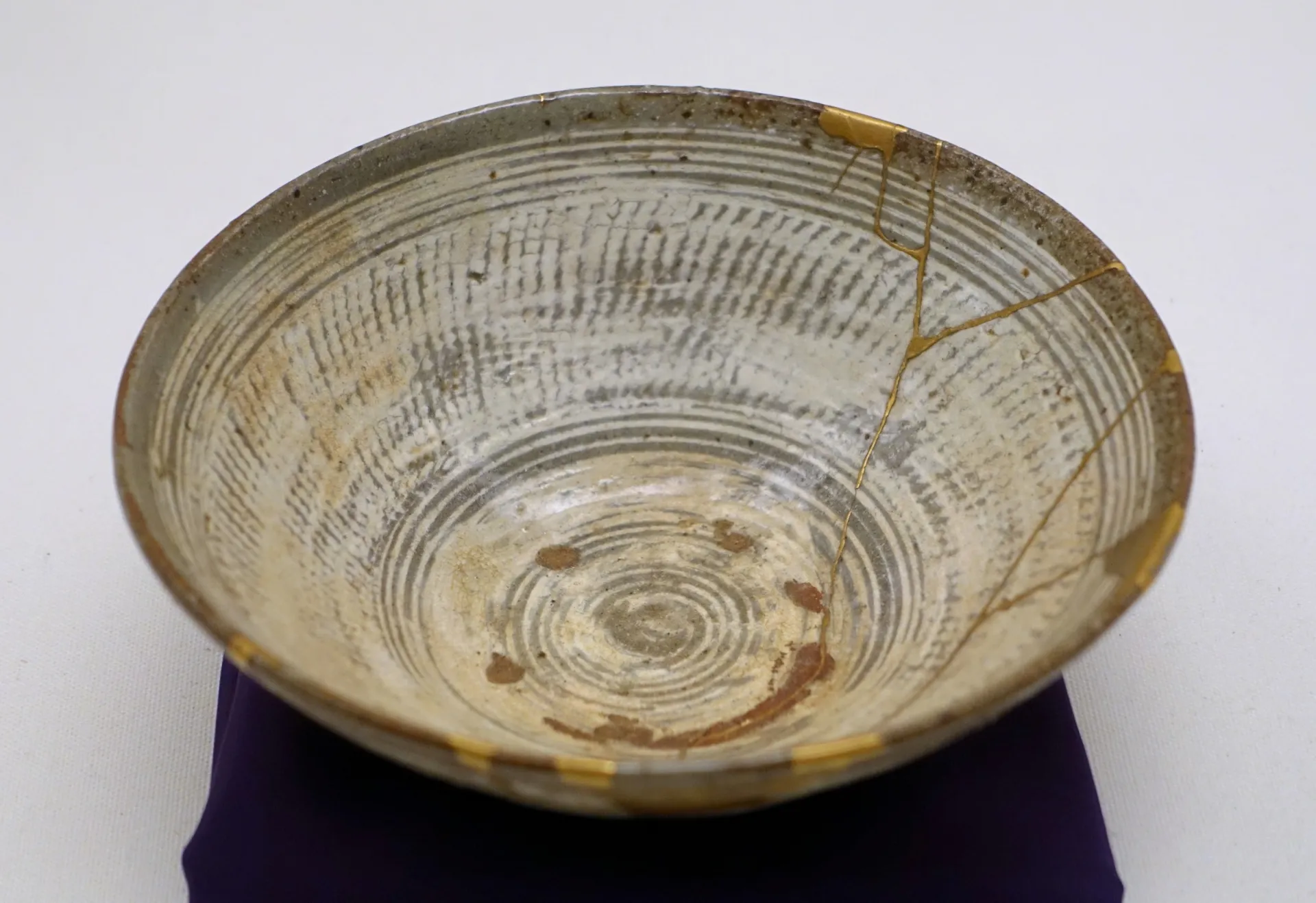
Lacquer joins ceramic fragments, and metallic powder finishes the repair. A gold line follows the boundaries where the vessel broke.
Article
A fine gold line runs across a tea bowl. It was not part of the original decoration: it follows the boundary between broken pieces. Kintsugi repairs ceramics with lacquer and finishes the joins with metallic powder.
Gold catches the eye, but lacquer provides the underlying bond. The broken pieces are joined with lacquer, and gaps and surfaces are prepared. Powder such as gold is then applied to finish the repair.
A tea bowl presented by the Smithsonian’s Freer Gallery preserves such repairs. A vessel may have been made and later repaired in different places. Manufacture, use, breakage and repair can belong to different stages in an object’s life.
Japan House London recounts a tradition about shogun Ashikaga Yoshimasa having a broken tea bowl repaired. Displeased with its metal repairs, he is said to have prompted Japanese craftspeople to seek another method. The story alone, however, cannot establish the technique’s precise origin.
The finished gold lines change direction and branch according to the shapes of the broken fragments. Following the gold around the bowl reveals where pieces separated and were joined again.
Sources and editorial notes
www.japanhouselondon.uk · 킨츠기 금 수선 자료 2
Editorial note: Facts were checked against the linked sources. Interpretations are MUADAILY’s editorial perspective. Image: Daderot · CC0 · A Joseon-period tea bowl with gold repairs, Ethnological Museum, Berlin.
Machine-translated from Korean. Read the original.