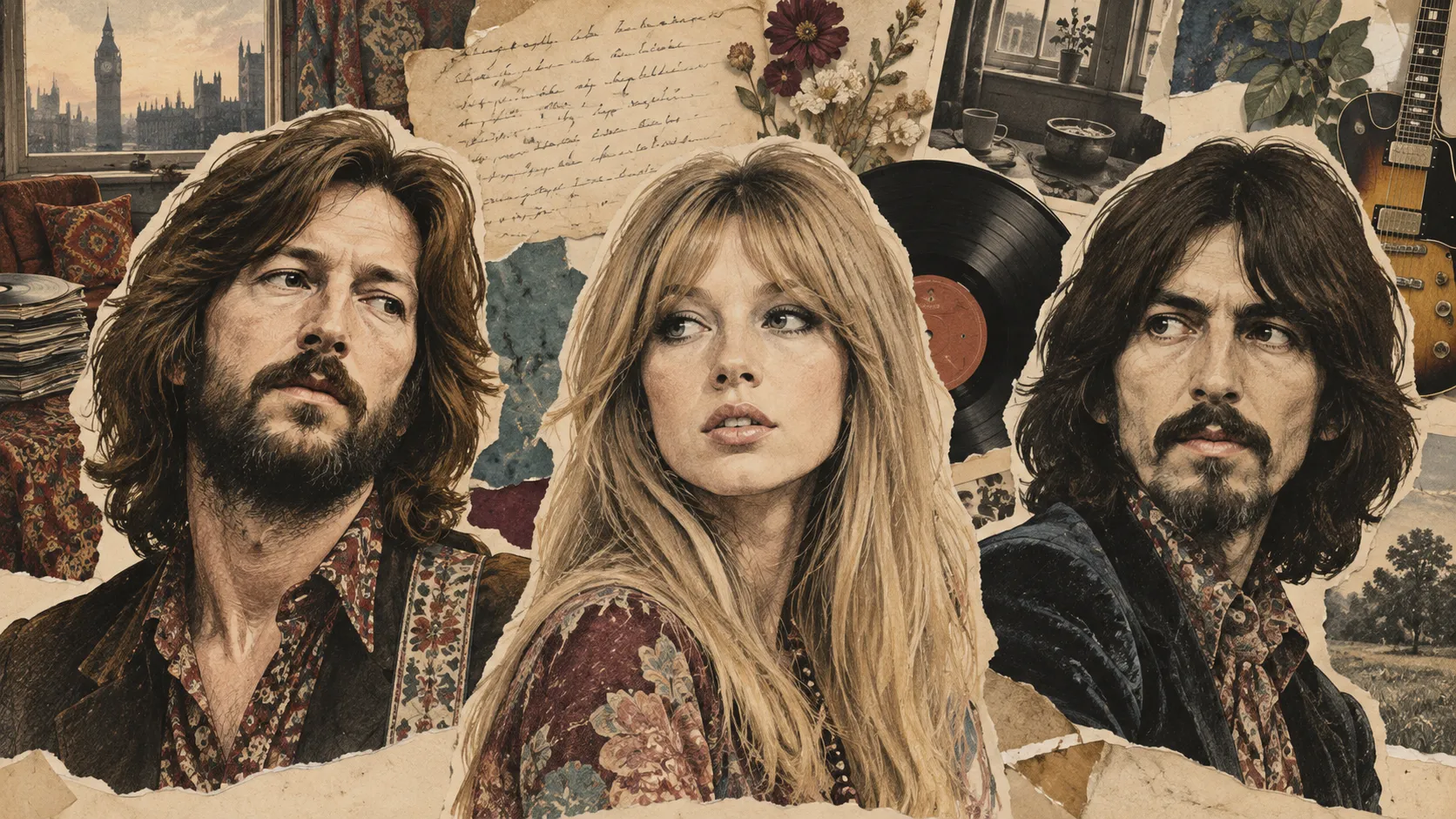
Eric Clapton, George Harrison, and Pattie Boyd. A letter opens the story of three people and invites us to hear familiar songs anew.
Article
In the autumn of 1970, Pattie Boyd received a letter. The envelope was marked “express” and “urgent.” On a small sheet of paper, a few questions appeared in neat handwriting: did she still love her husband, was there another lover, and did she still have feelings for the person writing to her? Pattie assumed it was from an odd fan and even showed it to her husband, George Harrison. That evening, Eric Clapton called. Only when he asked whether she had received his letter did she realize who had sent it. The E at the end stood for Eric. 1
Around the time he wrote that letter, Clapton also put his feelings for Pattie into a song. The letter asked about her feelings in tiny handwriting; the song held nothing back, in either its guitars or its vocals. It was called “Layla.” The name he called out so desperately was different, but Pattie was the person he wanted to hear it.
Eric Clapton — Layla, Royal Albert Hall performance, 1991Playing guitar on a friend's song
Clapton and Harrison were old friends. They had grown close through conversations about guitars and music when Clapton was in the Yardbirds. 2 They admired each other's music and recorded together. On the Beatles' “While My Guitar Gently Weeps,” it is Clapton's lead guitar that weaves around Harrison's singing. Although he was not credited on the album at the time, his playing became an essential part of the song. 3
The Beatles — While My Guitar Gently WeepsListen to Harrison's singing alongside Clapton's lead guitar.Knowing what happened between them later makes listening a little more complicated. The man playing guitar on his friend's song would fall in love with that friend's wife. Yet conflict was not all the three had known. Pattie also remembered Harrison often playing the melody of “Something.” She said that after he recorded it, he told her he had written it for her, and she was delighted. 4
The Beatles — Something, official music video“Something” and “Layla” are often presented together as songs written by two men for the same woman. Seen that way, they can seem like competing declarations of love. In between those songs, though, was a marriage: a couple gradually growing apart, and a friend drawing closer.
Someone who sat beside her and listened
The memories that help explain Pattie's attraction to Clapton are surprisingly ordinary. He would sit beside her and talk, compliment her clothes or the food she had made, and say things that made her laugh. Pattie recalled welcoming that attention. It was the kind she had once received from her husband, but which had become less frequent. 1
Her marriage was growing increasingly strained. At a time like that, being with Clapton may have offered the pleasure of feeling that someone cared about her. Even so, leaving with him was not an easy decision. Pattie was drawn to Clapton but could not bring herself to leave her husband. 5 Clapton's feelings, meanwhile, grew stronger. He later described them as an “obsession.” He knew she was his close friend's wife, but however hard he tried, he could not stop thinking about her. 2
Having feelings for each other did not mean they were ready to make the same choice. Clapton wanted them to live together; Pattie was not yet ready to end her marriage. “Layla” was written during that period.
Why he called Pattie Layla
In a book given to him by a Sufi, Clapton found a story that resembled his own situation: Nizami's “Layla and Majnun.” He recognized his own predicament in the story of a man tormented by his inability to be with the woman he loved. 6 So Pattie became Layla in the song. Clapton explained that using another name made it easier to express his feelings without being so direct. 2 He could say things to Layla that were harder to say using Pattie's name.
Duane Allman also joined the recording sessions. Bobby Whitlock, who worked with them, remembered how well Clapton and Allman's guitars fitted together. Even after a day's recording, the two would play guitar and talk about blues musicians. 7 It is easy to hear “Layla” as one man's desperate declaration, but encounters and performances like these helped turn that declaration into the music we know.
Clapton played the finished album for Pattie. He hoped that hearing the song would make her understand his feelings, and that she would finally leave Harrison to live with him. Pattie was deeply affected, too, though her first reaction was worry: what if everyone realized who the song was about? Even so, she was moved that his feelings for her had become such powerful music. 8 For Clapton, it was a way to declare his love. For Pattie, it also revealed something she wanted to keep private.
When the piano begins, another story emerges
About three minutes and ten seconds into the original recording, piano enters after the rush of guitars and vocals. It feels as though the emotions poured out in the first part are beginning to settle. The transition sounds natural, as if the two parts had always belonged together, but the piano section was added later. 7 And that melody carries another person's story.
Singer and songwriter Rita Coolidge said that she had written “Time” with her then partner, drummer Jim Gordon. According to Coolidge, part of that song was used in “Layla,” but her name was left out of the songwriting credits. Whitlock supported her account, saying he had been present when Coolidge and Gordon were writing “Time.” 910 The credited writers of “Layla” are Clapton and Gordon. Coolidge's account has not been reflected in those credits, but it belongs in the discussion of how the song came to be.
Until then, the song may have brought Clapton and Pattie's relationship to mind. Now the piano melody also brings Coolidge's story into focus. How did she feel hearing a melody so many people loved? The story behind the song extends beyond the love triangle.
Life after he played her the song
Pattie did not leave her husband immediately after hearing “Layla.” She recalled going home with Harrison even after Clapton told him how he felt about her. It was not until 1974, several years later, that Pattie left Harrison for Clapton. 8 Clapton could pour his love into a song lasting just a few minutes, but he could not change the listener's life in an instant.
While waiting for Pattie, Clapton also threatened to start using heroin if she would not leave Harrison for him. He later acknowledged doing so, admitting that he was already dependent on drugs and had used the threat to try to change her mind. He called his own behavior childish. 2 Knowing this makes it harder to hear the song's longing as purely romantic. However much pain he was in, whether to return his love was Pattie's decision.
A song written while she was getting ready
After they began living together, a very different song emerged. One day, Pattie was choosing what to wear to a party at Jimmy Page's house. As she took longer to get ready, she worried that Clapton would be angry at having to wait. When she went downstairs, though, he played her the song he had written while waiting: “Wonderful Tonight.” Pattie remembered the moment as magical. 5
Eric Clapton — Wonderful Tonight, official live performanceRecorded at Madison Square Garden in 1999.The woman Clapton had so desperately wanted to join him in “Layla” was now getting ready to go out from the home they shared. Pattie took her time choosing clothes; Clapton waited. The tenderness of “Wonderful Tonight” grows out of an ordinary scene like this. Hearing the two songs together brings home how much their relationship had changed.
They married in 1979. But living with the person he had waited for did not solve everything. Pattie said this relationship, too, was shaken by drugs, alcohol, and infidelity. She left Clapton in 1987, and they divorced in 1989. 58 Their lives included tender evenings like the one in “Wonderful Tonight,” but also many days that never made it into the song.
When George was in the audience
What became of Harrison and Clapton's friendship through all of this? They kept in touch and still cared about each other, though that did not mean they carried on as if nothing had happened. Clapton recalled that all three had been deeply hurt, and that conversations with Harrison sometimes included sharp words. He also admitted wondering what Harrison was thinking whenever he was in the audience for a performance of “Layla.” 11
To an audience, it was a favorite song. To Harrison, it involved his marriage and his friend. There are stories of Harrison making light of the situation, but even Clapton did not fully know how he felt. Clapton said Harrison did not always reveal what he was thinking, and may have been more hurt than he let on. 2
In 1992, Clapton performed a different arrangement of “Layla” on “MTV Unplugged.” Acoustic guitars replaced the sharp electric sound with an easygoing rhythm. 12 The mood had changed so much that a first-time listener might briefly wonder whether it was the same song.
Eric Clapton — Layla, 1992 MTV Unplugged recordingThe performance cannot tell us that all three people's wounds had healed. Still, there is something worth listening to in the way Clapton returned, years later, to a song he had once sung so desperately, with a different voice and rhythm.
Pattie had a story of her own
Pattie Boyd was long remembered as the woman behind “Something,” “Layla,” and “Wonderful Tonight.” But the life she described held more than the happiness of inspiring famous songs. After separating from Clapton, she began to reconsider who she was, and said that returning to photography helped her through a difficult time. 5 As a model and photographer, she also had things she wanted to see and capture for herself. 13
Listening to “Layla” again, I am still moved by the guitar. I feel I understand a little better why Clapton sang with such longing. But I also think of Pattie hearing it for the first time: moved, yet worried that people would realize who it was about; aware of his feelings, yet unable to leave her husband immediately. After the song ended, all three still had to live with their choices.
Sources and reporting notes
- Christie's — The 1970 letter and excerpts from Pattie Boyd's memoir
- CNN Larry King Live — Eric Clapton interview transcript, rebroadcast October 20, 2007
- The Beatles — Official song page
- ABC News — Interview with Pattie Boyd, August 31, 2007
- Christie's — Interview with Pattie Boyd, 2024
- Musician, May 1982 — Scan of the original Eric Clapton interview
- Guitar Player — An Oral History of Derek and the Dominos' Layla
- Christie's — Provenance of the original Layla cover artwork and memoir excerpts
- Rock Cellar — Interview with Rita Coolidge, 2016
- Where's Eric! — Interview with Bobby Whitlock, 2011
- Fan archive reprint of a Rolling Stone interview with Eric Clapton
- Official artist channel — Metadata for the 1992 Unplugged recording
- Pattie Boyd — Official website
The linked sources document the reporting. Personal recollections reflect the speakers’ memories, and comments on the music are editorial interpretation.
Machine-translated from Korean. Read the original.