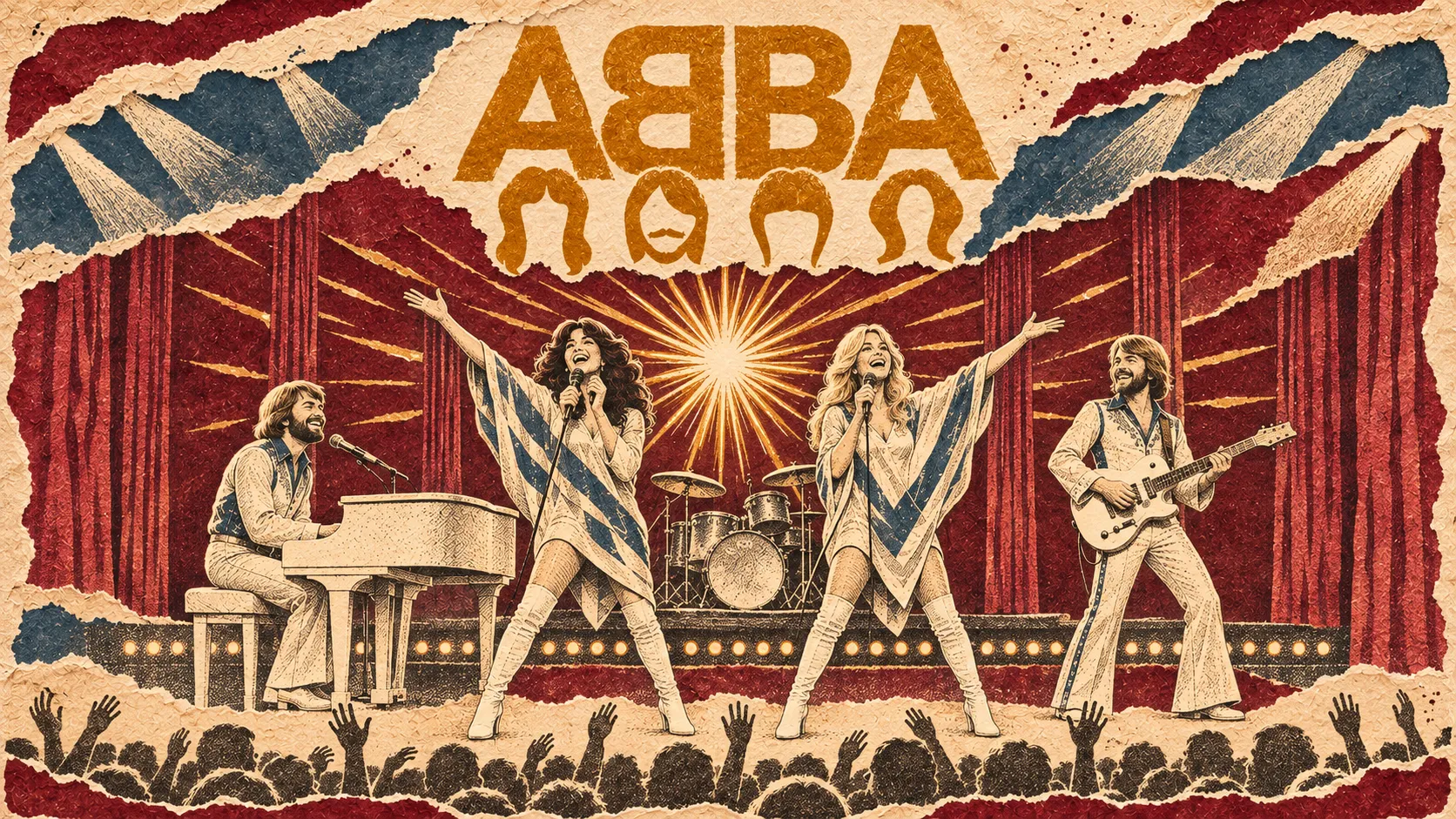
From “Waterloo” and “The Winner Takes It All” to a mother and daughter singing in Mamma Mia!: nearly forty years passed before ABBA made a new album, while their songs kept finding other voices and stages.
Article
In a London theatre in 1999, a daughter about to marry invites three men who might be her father. As her mother looks at her, “Slipping Through My Fingers” begins. A song ABBA released in 1981 has entered the story of two characters who did not exist when it was written. The musical is Mamma Mia! 51112
Slipping Through My FingersABBA · Official audioWhat London heard that day was not news of the four members’ return. It was proof that even someone new to ABBA could follow this mother and daughter through their songs. Nearly forty years passed before the group released another studio album. During that interval, the music found listeners beyond its original audience through dancing, breakups and family stories.
Four performers arrive in Brighton
In 1973, the four entered Sweden’s Eurovision selection with “Ring Ring” and finished third. They did not reach the international final, but the song and album were Swedish hits. The following year they tried again as ABBA, taking the initials of Agnetha, Björn, Benny and Anni-Frid. On April 6, 1974, “Waterloo” won the Eurovision final in Brighton, England. 1113
“Waterloo” borrows Napoleon’s defeat to describe surrendering to love. The words describe losing, but piano and guitar propel an excited beat. When the two singers deliver the title together, they sound as though they have welcomed that surrender. Already there is a technique ABBA would often use: setting the emotion in the words against the rhythm’s physical appeal, allowing both to be felt at once. 513
WaterlooABBA official channel · Eurovision final, Brighton, 1974“Mamma Mia” reaches Australia ahead of the band
Eurovision introduced ABBA’s faces to several countries at once. But with new songs the next year, the four could not visit every country’s television studios. They commissioned promotional films from Lasse Hallström, who had made short pop films for Swedish television. The songs could travel with the members’ faces and gestures even where the band could not go. 18
Australian television aired clips including “Mamma Mia” and “SOS” in 1975. ABBA’s official production history credits local label RCA with strongly advocating a “Mamma Mia” single; it spent ten weeks at No. 1 in Australia. The Eurovision winners no longer had to wait until they could appear in a local studio. A short film from Sweden arrived first, and Australian broadcasters and the record company helped it reach further. 19
Before it became a musical’s title, “Mamma Mia” had brought four Swedes into Australian living rooms.
Mamma MiaABBA · Official music videoWhen the piano sweeps in
“Dancing Queen” begins with a sweep across the piano before the singing enters. The two voices seem to take us somewhere dancing is already under way; even alone, the room can feel different. Yet according to ABBA’s official account, there were no voices or lyrics when Frida first heard it and cried. Benny had brought home an instrumental backing tape after a late-night mixing session. 12
Its working title was “Boogaloo.” Recording began in August 1975 and continued through the September vocals and further work at the end of the year. The official history records that “Fernando,” completed around the same period, became a single first, while “Dancing Queen” was released in August 1976. Some heard it earlier: dressed in Baroque-style costumes, ABBA performed it at celebrations on the eve of the Swedish royal wedding, before it reached record shops. 1
Dancing QueenABBA · Official music videoA breakup on the same album
Continue through Arrival, the album containing “Dancing Queen,” and “Knowing Me, Knowing You” takes those voices into a different room. One song suggests joining a crowd; the other can evoke a room left behind after someone departs. A single voice begins, with others layering into the chorus. The fuller sound somehow makes the absence clearer. 23
The video’s snow-covered setting is memorable too. The four appear in changing pairs, their gazes passing one another even when their faces are close. Official records place filming between late 1976 and early 1977. Its loneliness is created through expressions and framing; knowledge of the members’ private lives is not required for it to work. The images give the breakup a visible form. 3
Agnetha sings the breakup Björn wrote
The first single from 1980’s Super Trouper, “The Winner Takes It All,” treats a broken relationship as a contest with a winner and a loser. Its production history describes several attempts before the backing acquired its eventual flow; the early working title was “The Story Of My Life.” Björn wrote the finished lyrics, and Agnetha sang them after their marriage had ended. The official account acknowledges that the experience partly informed the words. 14
The piano maintains its movement while Agnetha’s voice returns with changing intensity. At first she can sound like someone choosing words carefully in front of another person; in the chorus, the restrained voice rises. The lyricist’s and singer’s lives provide context, but they do not make the narrator’s account a factual record of the couple’s relationship. Her performance can feel close even to listeners who know nothing about them. 1416
The Winner Takes It AllABBA · Official music video“Super Trouper,” on the same album, takes its title from a stage spotlight. Behind the bright chorus is a touring performer worn down by the schedule, sustained by knowing one particular person will be in the audience. A voice accepting separation and a voice seeking someone in the crowd share the record. Such private feelings help the bright songs endure. 515
Super TrouperABBA · Official music videoThe closed door of The Visitors
The sense of space changes from the first track of 1981’s The Visitors. The opening cautiously swells, and the singing begins almost as if addressing someone nearby. In the lyrics published in the official discography, the narrator listens for people outside the door. Agnetha’s voice in the first single, “One Of Us,” hesitates differently: the wish to reverse a breakup becomes clearer against the steady accompaniment. 45
One Of UsABBA · Official music videoThe album arrived in November 1981. Nearly forty years would pass before the next studio album. Knowing that interval may make its closed door feel like a farewell, but it does not establish that this was the intention during recording. The 2021 release changed the earlier record’s place in the catalogue: what had stood at the end now had a successor. 46
While there was no new album, others sang ABBA
In 1992, British synth-pop duo Erasure released Abba-esque, an EP of ABBA covers. Its “Take A Chance On Me” video playfully revisited the original’s clothes and gestures. ABBA Gold, released the same year, gathered hits from different periods onto one compilation. Unlike audiences encountering successive singles in the 1970s, a later buyer could hear “Dancing Queen” and “The Winner Takes It All” for the first time on the same day. 1117
Take A Chance On MeABBA · Official music videoMamma Mia!, which opened in London in 1999, went further. Producer Judy Craymer conceived of placing existing songs within a new story, and Catherine Johnson wove them into the lives of a mother and a daughter preparing to marry. A biographical musical might have centred the band’s lives and release history. Here, fictional characters sing ABBA when their own story calls for it. 12
“Slipping Through My Fingers” makes the distinction clear. On The Visitors, it reflects on time passing as a child grows. In the musical, those years return to a mother facing her daughter’s wedding. Someone entering the theatre without knowing the title can leave with a reason to remember it. The year of the original record does not determine the day a person first meets ABBA. 512
A concert project leads back to the studio
The new album began with a performance project. In their 2021 statement, the members said working on a London show featuring their digital likenesses prompted them to record again. They were creating young versions of themselves for the stage, but the people who returned to the studio were Agnetha, Björn, Benny and Frida with decades more life behind them. 6
The first two new recordings in Stockholm were “I Still Have Faith In You” and “Don’t Shut Me Down.” Voyage, released in November 2021, contains ten tracks including these two. Recognition arrives at different speeds: the opening song moves slowly with Frida’s low voice in front. On “Don’t Shut Me Down,” Agnetha begins quietly, then piano and rhythm enter as if the room’s lights have come on together. 678
I Still Have Faith In YouABBA · Official audioAnyone who loves the piano in “Dancing Queen” may notice a particular moment in “Don’t Shut Me Down”: the piano changes the atmosphere after the conversational opening verse. It feels less like a repetition of the older song than the recognition of a familiar way of playing after many years.
Don’t Shut Me DownABBA · Official lyric videoTheir captured movements, a band playing live
ABBA Voyage opened at London’s ABBA Arena in May 2022. The official show information describes digital versions of Agnetha, Björn, Benny and Frida performing alongside a live band. All four participated in the production, with their movements recorded through motion capture. The Industrial Light & Magic team responsible for the digital performers has also explained how the work combined with choreography by Wayne McGregor, show visuals and lighting. 7910
At an ordinary concert, large side screens let distant spectators see a singer’s expression. At ABBA Voyage, the perspective on the main stage can likewise differ from that on the side screens. The ILM team explains why the digital performers therefore had to work from more than a frontal view. A screen showing another angle still needed to convey the same person standing in the same place. The production had to anticipate the change in perspective as an audience member turned their head. 10
Bringing songs heard at home into one room
Old records summon different scenes for different listeners: a family radio for one, a music video discovered later for another. At a concert, people hear together the songs they learned in separate places. ABBA Voyage provides a place for those songs to sound again, combining movements captured from the four members with musicians playing in the room today.
Someone who watched the Brighton broadcast can sit beside someone who played ABBA Gold from start to finish and someone who first met the group through the mother’s song in Mamma Mia! When the “Dancing Queen” piano enters, their first memories may differ, but they know which voices come next. By the time the four returned, the people ready to sing along were already in the audience.
Sources and reporting notes
- ABBA · Recording and release of Dancing Queen
- ABBA · Making Arrival
- ABBA · Recording and video for Knowing Me, Knowing You
- ABBA · Making The Visitors
- ABBA · Official discography
- ABBA · 2021 Voyage announcement
- ABBA · Recording the new album and opening the London show
- ABBA · Voyage release date and track list
- ABBA Voyage · Official show information
- Industrial Light & Magic · Interview with the production team
- ABBA · Group history and the 1990s revival
- MAMMA MIA! · Official show history
- ABBA · Waterloo and Eurovision in Brighton
- ABBA · Making Super Trouper
- ABBA · Super Trouper reissue notes
- ABBA official channel · The Winner Takes It All video
- ABBA · Take A Chance On Me and Erasure’s reinterpretation
- ABBA · Lasse Hallström and promotional films for overseas television
- ABBA · Making the 1975 album; Australian broadcasts and single release
The linked sources document the reporting. Personal recollections reflect the speakers’ memories, and comments on the music are editorial interpretation.
Machine-translated from Korean. Read the original.