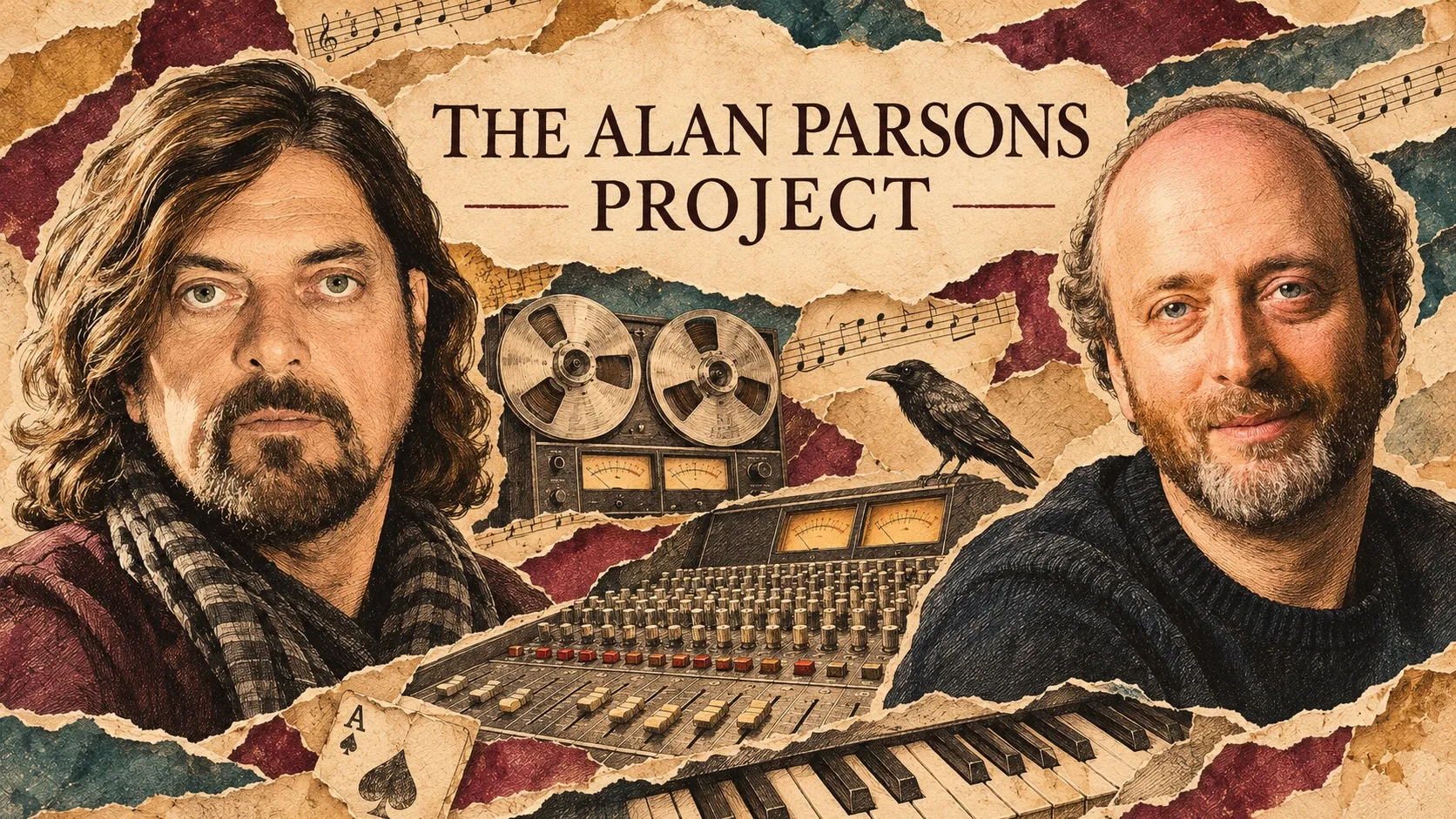
From Eric Woolfson on “Eye in the Sky” to Colin Blunstone on “Old and Wise”: the singers and studio stories behind the Alan Parsons Project.
Article
Eric Woolfson sang “Eye in the Sky”
The voice on “Eye in the Sky” belongs to Eric Woolfson. Although the artist name is the Alan Parsons Project, Woolfson, who wrote the song, stepped up to the microphone himself. He also sings “Time” and “Don’t Answer Me.” Hearing the three together brings the same singer into focus across different albums.12
Woolfson did not sing every Project song. “I Wouldn’t Want to Be Like You” features Lenny Zakatek, while “Old and Wise” is sung by Colin Blunstone. Parsons and Woolfson made their records with different singers for different songs. Even on one album, the voice can change from track to track.23
Eye in the SkyThe Alan Parsons Project · 1982 · Official audioEngineer Parsons meets songwriter Woolfson
Parsons first became known as a recording engineer. He assisted on Beatles recordings and engineered Pink Floyd’s The Dark Side of the Moon, then produced records for artists including Pilot and Steve Harley. He had built a studio career with other musicians before beginning the project that bore his own name.4
Woolfson was a songwriter and pianist who also worked as Parsons’s manager. He had planned an album based on Edgar Allan Poe’s writing and had written and demoed some songs. Unsure he could complete it on the scale he imagined, he had set it aside. Working with Parsons allowed him to return to the plan.5
Woolfson’s idea resembled film production. If viewers chose films by a director despite changing actors, might listeners choose records by their producer despite changing singers? The working name used in presenting the idea to a label was the Alan Parsons Project, and it stayed. Parsons’s production and engineering and Woolfson’s writing and playing formed the centre, with musicians joining according to each song’s needs.15
Their contributions to songwriting and production overlapped. Parsons also wrote and played. In a later interview, he explained that they collaborated more closely on songs early on, then increasingly wrote separately. Records bearing the same two names could involve different ways of working at different stages.6
Laughter interrupts a thunder recording
The first album, Tales of Mystery and Imagination (1976), contains pieces based on Poe’s stories and poems. Parsons sang on “The Raven,” recording his voice through a vocoder, alongside singing by actor Leonard Whiting. The first record by this team of changing vocalists also preserves Parsons’s own voice.7
Even thunder received special attention. Woolfson recalled needing it for “The Fall of the House of Usher” but disliking the available effects. When a storm arrived over London, Parsons took a dummy-head recording microphone into the studio’s back yard. Raindrops hitting the head interfered, so Woolfson and bassist David Paton held up material to shelter it.7
The sight of the two holding up the shelter made them laugh. With the laughter on tape too, they had to try again. Woolfson recalled that they finally obtained usable thunder by avoiding each other’s gaze and suppressing their laughter. In the yard where they were recording the album’s ominous storm, keeping a straight face had become the immediate problem.7
The RavenThe Alan Parsons Project · Recording released in 1976 · Provided by UMGA changing cast of singers on I Robot
The next album, I Robot (1977), began with a plan to adapt Isaac Asimov’s fiction. Relevant rights had already gone elsewhere, preventing that approach. Rather than reproducing a specific plot, the album broadened toward people, machines and artificial intelligence. Its title, without the comma of the book’s title, emerged from that process.3
Lenny Zakatek sings the second track, “I Wouldn’t Want to Be Like You.” Woolfson plays electric piano rather than taking the microphone, joined by Ian Bairnson on guitar, David Paton on bass and Stuart Tosh on drums. For listeners who associate the Project with Woolfson’s voice, this is a chance to hear Zakatek alongside it.3
Peter Straker and Jaki Whitren appear on “Some Other Time,” while Allan Clarke sings “Breakdown.” One track can use two singers, and the next can introduce another voice. The vocal lineup follows the songs rather than organizing the album around one lead singer.3
I Wouldn’t Want to Be Like YouThe Alan Parsons Project · 1977 · Official videoAn album inspired by a Monaco casino
The Turn of a Friendly Card (1980) explores gambling and risk. Woolfson, then living in Monaco, found inspiration in the people and sounds of a casino. The album closes with an extended title piece in five parts, giving the casino-inspired story room to unfold.8
Before that extended story come “Games People Play” and “Time,” sung by Zakatek and Woolfson respectively. The credits for “Time” also list Woolfson’s piano, additional vocals by Parsons and Andrew Powell’s orchestral arrangement. As one track gives way to the next on the same record, the lead voice changes too.8
“Time” suggests passing time and parting rather than directly describing a casino. Within an album about gambling, it can bring to mind time slipping away while someone waits for another round. A listener who began by imagining a glittering casino may find their thoughts turning elsewhere.8
Games People PlayThe Alan Parsons Project · 1980 · Official video TimeThe Alan Parsons Project · 1980 · Official audio“Sirius” becomes a Chicago Bulls introduction
“Sirius” may be remembered through its use before its title. Its association with Chicago Bulls player introductions connected it to basketball arenas. Its original position was at the beginning of Eye in the Sky (1982). The instrumental lasts less than two minutes and leads into the title song sung by Woolfson.29
Parsons wrote the short instrumental as an introduction to “Eye in the Sky,” as he explained in interviews. Music that preceded the singing on the album came to precede the players’ arrival in an arena.69
If an arena was where you first heard it, try the opening two tracks in album order. Instead of a player announcement, “Eye in the Sky” follows. In an interview, Parsons also specified hearing the song with its “Sirius” introduction.9
SiriusThe Alan Parsons Project · 1982 · Official audio · InstrumentalParsons nearly gave up on “Eye in the Sky”
Parsons did not like “Eye in the Sky” from the beginning. He recalled being unconvinced by its early form and nearly giving up on it. Finding the right feel for Woolfson’s song took time.6
Parsons said the track eventually came together with a steady, driving rhythm. He also recalled being repeatedly reminded of his early doubts about it. In the same interview, he added that “Don’t Answer Me” had proved difficult too, taking work before he felt they had something. Neither familiar song had come easily in the studio.6
The animated video for “Don’t Answer Me”
Ammonia Avenue (1984) unexpectedly began at a chemical plant. Invited by ICI’s chairman, Woolfson visited the Billingham works in England and found the title amid long pipes and a street without people or trees. The theme concerned mutual misunderstanding between the public and the worlds of industry and science.10
Woolfson also sang “Don’t Answer Me” on this album. Making a promotional video brought up the absence of a fixed performing lineup again. Rather than filming a band playing together, they chose animation with cartoon characters.110
The video follows cartoon characters instead of showing Woolfson at a microphone. The figures on screen are not the people singing, but the recording brings back the voice heard on “Eye in the Sky” and “Time.”
Don’t Answer MeThe Alan Parsons Project · 1984 · Official animated videoColin Blunstone sings “Old and Wise”
Colin Blunstone of the Zombies sings “Old and Wise,” the final track on Eye in the Sky. Woolfson, who sang the title song, plays piano and organ here; Mel Collins performs the saxophone solo. Within one album, Woolfson moves between lead singer and keyboard player.12
Next time “Eye in the Sky” appears, perhaps open its credits instead of changing the track. The artist still says the Alan Parsons Project. Beside vocals is Eric Woolfson.
Old and WiseThe Alan Parsons Project · 1982 · Audio provided by Arista/LegacySources and reporting notes
- The Alan Parsons Project · 공식 FAQ: 팀 이름, 역할, 참여 음악가
- The Alan Parsons Project · Eye in the Sky (1982): 곡 순서와 참여자 명단
- The Alan Parsons Project · I Robot (1977): 기획 변경과 곡별 보컬·연주자
- Alan Parsons Live · Alan Parsons 공식 약력
- The Alan Parsons Project · Eric Woolfson 공식 약력
- Songwriting Magazine · Alan Parsons 인터뷰: 공동 작곡, Sirius, Eye in the Sky 제작 과정
- The Alan Parsons Project · Tales of Mystery and Imagination (1976): 울프슨의 회고와 참여자 명단
- The Alan Parsons Project · The Turn of a Friendly Card (1980): 주제와 참여자 명단
- Rock Cellar · Alan Parsons 인터뷰: Eye in the Sky와 Sirius
- The Alan Parsons Project · Ammonia Avenue (1984): 공장 방문과 뮤직비디오 제작 배경
The linked sources document the reporting. Personal recollections reflect the speakers’ memories, and comments on the music are editorial interpretation.
Machine-translated from Korean. Read the original.