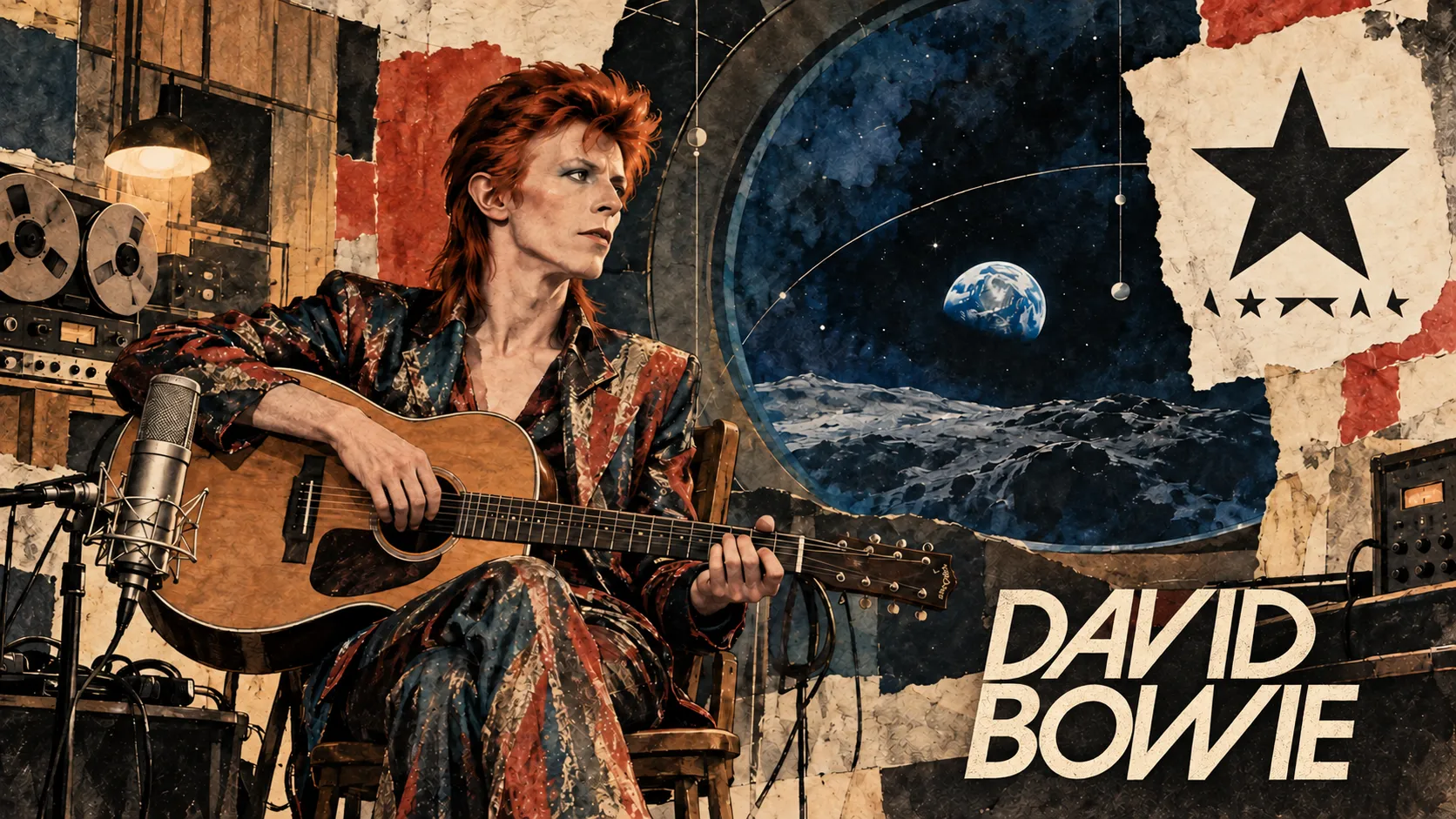
From Major Tom and Ziggy Stardust to Blackstar: behind the images of space and farewell was an artist still making new work.
Article
On January 8, 2016, David Bowie's last studio album, Blackstar, was released. It was his sixty-ninth birthday. Two days later, on January 10, Bowie passed away. There were only two days between the joy of hearing new music and the sadness of losing the person who created it.911
After the news, it became difficult to hear the album as listeners had at first. What might have been unfamiliar new music now sounded like words left by someone departing. Longtime producer Tony Visconti described Blackstar as Bowie’s parting gift to us.12
Yet calling Bowie’s death a return to space too quickly turns a long working life into a legend. He did not really come from another planet. He sang about someone alone in space, played a rock star from the stars, and made different music after leaving those characters behind. To approach the final album, it helps to return to the first person he sent into space.
The character went into space before the singer
Astronaut Major Tom appears in the single "Space Oddity" released on July 11, 1969. He sets off while communicating with ground control, and as the song progresses, he gets further and further away from Earth. The achievement of reaching space does not end the story. A voice calling to him from the ground and no response remain at the end.12
Space here is not the triumphant end of an adventure. It is somewhere from which a person far from home looks back at the place he lived. Earth is still there, but beyond reach. At the heart of the song is the fear that technology can take people farther while the connection between them breaks down.
Major Tom need not be read as Bowie himself. What matters is the choice to send a character far away and sing about his isolation. You do not have to be an astronaut to describe feeling out of place. Someone in a classroom, on a street or at home can feel that they do not belong. Space could be both a remote location and a familiar feeling.
The song’s success did not arrive all at once. Bowie’s official history records a UK singles-chart peak of No. 5 in 1969; it first reached No. 1 there on its 1975 reissue. A song rediscovered at another moment is a more accurate account of this beginning than a story of a genius everyone immediately recognised.1
Space OddityDavid Bowie official video. The song was released in 1969, and the linked video is a version produced by Mick Rock in 1972.A singer from the stars takes the stage
The perspective changed with 1972’s The Rise and Fall of Ziggy Stardust and the Spiders from Mars. Bowie created the rock-star persona Ziggy Stardust. Audiences encountered hair, clothes, movement and onstage relationships alongside the songs. Even the album title’s promise of a rise and fall presented the singer’s career as a story.3
That character entered living rooms through the performance of “Starman” broadcast on BBC’s Top of the Pops on July 6, 1972. Bowie sings to the camera shoulder to shoulder with guitarist Mick Ronson. The official account names Boy George and Spandau Ballet’s Gary Kemp among those watching that day.4
The scene’s force cannot be reduced to flamboyant clothes. Clothes, voice and the closeness of the two musicians appeared in the same frame. It can be read as a performance showing that a singer need not fit an established masculine image to command a song. The audience received more than the premise of a character from space: they could also see the possibility of presenting themselves differently.
Ziggy is not a single key that unlocks every Bowie song. Major Tom is an astronaut within a song; Ziggy is a rock star developed across an album and the stage. Both have connections to space, but they are different characters. Bowie used them to shift the relationship between performer and listener rather than construct one world with a definitive guide.
Starman — Top of the PopsOfficial release video of the performance broadcast on July 6, 1972. This is the stage where Bowie and Mick Ronson appeared together.After retiring Ziggy, Bowie played an alien
At London’s Hammersmith Odeon on July 3, 1973, Bowie surprised the audience as the show drew to a close. He announced that this was not only the tour’s final concert but the last one they would play together. Those who had come to see Ziggy Stardust were also hearing a farewell.5
Anyone who took that to mean Bowie was retiring could see him onstage again the following year, on the Diamond Dogs tour. He had ended the stage incarnation of Ziggy and the Spiders. Instead of repeating a successful persona indefinitely, he left audiences wondering which Bowie they would encounter next.5
In Nicolas Roeg’s 1976 film The Man Who Fell to Earth, Bowie plays an actual alien. His character comes to Earth to save his drought-stricken home planet, planning to use his advanced technology to earn the money he needs. But his stay becomes increasingly tangled. He studies human culture through multiple televisions and becomes caught in earthly habits and desires.6
The alien who came to save his home becomes trapped on someone else’s planet. Bowie, whose strangeness attracted people onstage, plays an outsider caught among them onscreen. Watching him grow closer to television than to a spacecraft, we begin to worry whether he can ever return.
Major Tom returns changed
Major Tom reappears in 1980’s “Ashes to Ashes,” but without a repeat of the first song’s heroic departure. Bowie revisits him through images of addiction and unease. The video, co-directed by Bowie and David Mallet, offers a Pierrot costume and strange landscapes rather than the next chapter of a space adventure.714
The change shows how Bowie chose to revisit an earlier success. Keeping the original Major Tom intact might have revived a familiar nostalgia. Instead, he marked the character with the passage of time, as though meeting an old creation again did not mean being able to recover the same feelings.
Major Tom’s story is not a medical record or a direct account of Bowie’s private life. Characters and metaphors coexist with the singer’s present circumstances. What is clear is that Bowie returned to a name from a song written eleven years earlier. His listeners had aged too. That interval may help explain why the same character sounds different on his return.
Ashes to AshesDavid Bowie official video. This is a song that brought back Major Tom in 1980.The song reaches space itself
In 2013, Canadian astronaut Chris Hadfield released a video of himself performing “Space Oddity” aboard the International Space Station. A person actually orbiting Earth was singing a song that had imagined space. The Canadian Space Agency records the performance in its account of Hadfield’s missions, and Bowie’s official site also featured his version.81315
That does not mean Bowie himself went into space; Hadfield did. But a song can reach somewhere its writer cannot through another person’s voice. A work that imagined an astronaut’s isolation from the ground was now coming back from space to listeners on Earth.
The fictional calls to Major Tom went unanswered. Hadfield’s video reached a real audience on Earth under very different circumstances. Set side by side, the two suggest why Bowie’s space imagery has endured: the song gives us both someone travelling far away and people here listening and waiting.
Space Oddity — Chris HadfieldHadfield's cover video filmed on the International Space Station. The current posting channel notation is Rare Earth.The final album was still a collaborative record
Returning to Blackstar brings us to names that a story of space and farewell can obscure. Tony Visconti was the longtime colleague co-producing it, while the musicians included saxophonist Donny McCaslin, keyboardist Jason Lindner, bassist Tim Lefebvre and drummer Mark Guiliana. These are the names in the official credits. Even on his final album, Bowie was working with other musicians to make something new.9
Treating the album only as a last testament can push that work aside. Looking for predictions of death can mean overlooking who made the sounds together. Bowie was both a person approaching death and a musician working with colleagues. While listeners search for a goodbye, the record still contains their collective performances.
Johan Renck directed the “Lazarus” video, released on January 7, 2016. The album arrived the next day, and Bowie died two days after that. The official announcement said he had died surrounded by family after living with cancer for 18 months. Knowing that sequence inevitably changes the feelings the music brings.1011
Visconti’s description of a parting gift carries the grief of a collaborator, but it cannot account for everything Bowie was thinking near the end. The Victoria and Albert Museum’s archive also records his development of a musical idea called The Spectator in 2015. Alongside the finished final album are traces of another story still in progress.12
BlackstarOfficial video for the title track of Bowie’s final studio album. Its symbols need not be reduced to a single definitive interpretation.Listening to Bowie's songs again
After someone dies, we may want to find a final goodbye in every choice they made. Bowie’s longstanding characters—an astronaut and a singer from the stars—make that temptation especially strong. Saying he left Earth for his own planet may briefly ease the grief. But it also expresses how those left behind want to remember him.
Bowie kept living and making different music after he ended Ziggy. When he brought Major Tom back, he changed the character’s meaning; while making his final album, he was also imagining another stage work. He left a series of attempts to change his familiar image, rather than one space story whose meaning was settled from beginning to end.
Play “Space Oddity” again and Major Tom sets out once more. In “Starman,” Bowie still sings close to Ronson’s shoulder. Blackstar retains the sounds Bowie and his colleagues completed near the end of his life. We cannot meet him again, but we can encounter his characters and songs at different ages. Our experience of listening can keep changing even after his death.
LazarusThe official video, released on January 7, 2016. Listening again brings its proximity to the album’s release and Bowie’s death into view.Sources and reporting notes
- David Bowie Official · Space Oddity 50th Anniversary Record
- David Bowie Official Video Space Oddity
- Library of Congress · Commentary on Ziggy Stardust by Susan E. Booth
- David Bowie Official · Starman, Top of the Pops 50th Anniversary
- David Bowie Official · Ziggy and the Spiders' Last Performance
- BFI · The Man Who Fell to Earth Work Information
- David Bowie Official · Ashes to Ashes video production record
- Canadian Space Agency · Chris Hadfield’s space activity record
- David Bowie Official · Blackstar Release Date · Production Credit
- David Bowie Official · 10th Anniversary of Lazarus Video Release
- David Bowie Official · Obituary January 10, 2016
- V&A · Blackstar and the unfinished creation record of The Spectator
- David Bowie Official · Introduction to Space Oddity by Chris Hadfield
- David Bowie Official Video Ashes to Ashes
- Recording Academy of America · Space Oddity and Hadfield Video
The linked sources document the reporting. Personal recollections reflect the speakers’ memories, and comments on the music are editorial interpretation.
Machine-translated from Korean. Read the original.