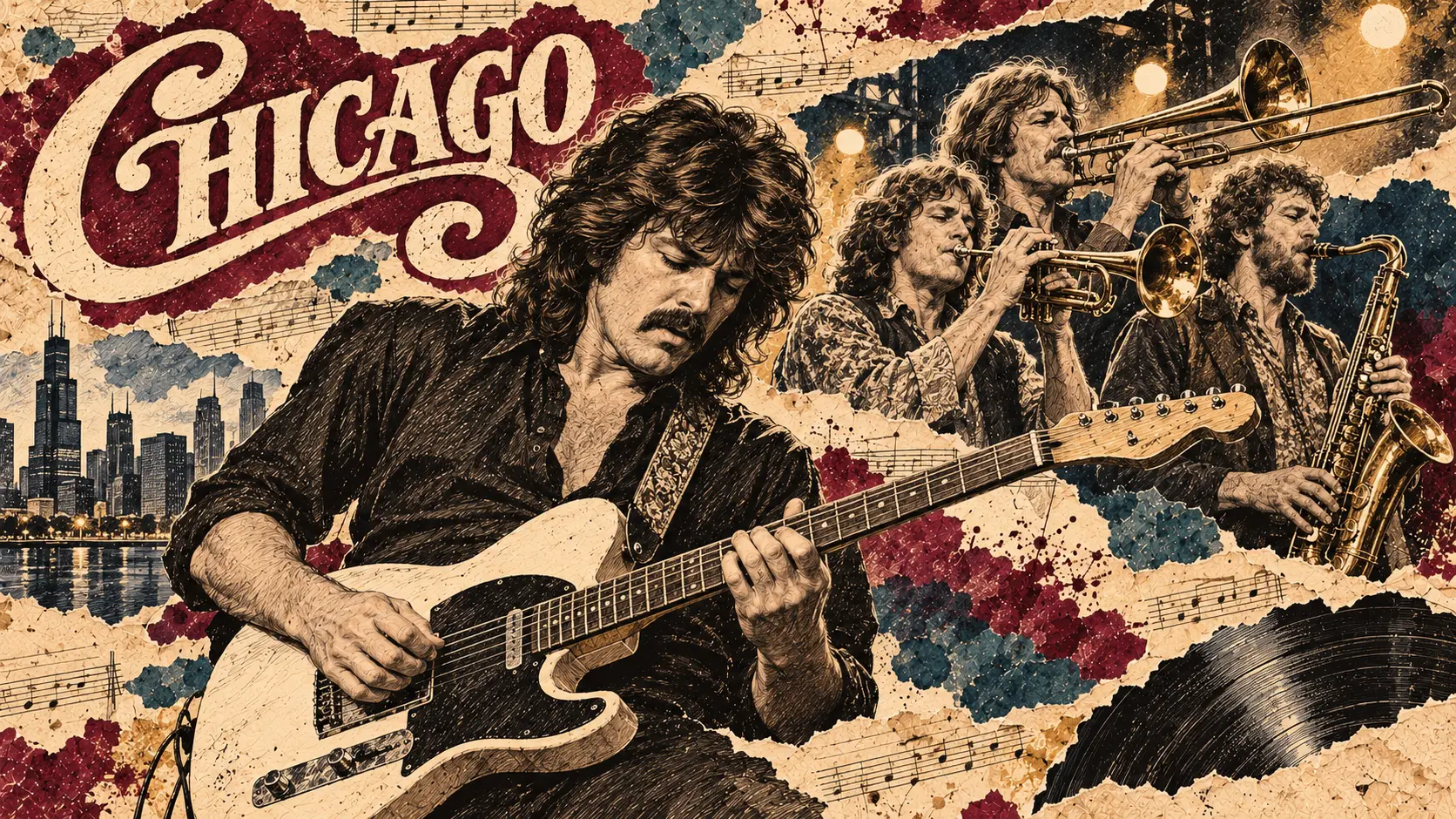
From “Get Away,” which follows “Hard to Say I’m Sorry,” we explore Chicago through eight songs: Terry Kath’s guitar, Peter Cetera’s ballads, and the band’s contrasting voices.
Article
The ballad gives way to “Get Away”
Listen to the full album version of “Hard to Say I’m Sorry” and the mood changes dramatically. The familiar piano, Peter Cetera’s voice, and the swelling chorus belong to the well-known ballad. But “Hard to Say I’m Sorry / Get Away” does not stop there. The drums pick up speed and the horns become more prominent, turning the quiet ballad into an energetic ensemble performance.12
If you know only the ballad, it can sound as though another song has begun. The closing section does have its own title: “Get Away.” Hearing both parts together draws attention to Chicago’s instrumental interplay as well as its ballads. That contrast offers a starting point for exploring the early albums.
A key figure in early Chicago is guitarist Terry Kath, with his long dark hair, deep voice, and forceful playing. His name may be unfamiliar to listeners who discovered Chicago through its 1980s ballads. On the early records, however, he plays a central role: he not only plays guitar but also sings lead on “Make Me Smile” and “Colour My World.”3
Guitars and horns in early Chicago
Chicago formed in 1967 as a seven-piece band combining guitar, bass, drums, and keyboards with trumpet, trombone, and saxophone. Robert Lamm, Peter Cetera, and Terry Kath shared vocal duties. Lee Loughnane played trumpet, James Pankow trombone, Walter Parazaider wind instruments, and Danny Seraphine drums. Different combinations of singers and instruments gave the songs distinct characters.4
The 1969 debut was released as Chicago Transit Authority, the longer name the band used before becoming Chicago. It was a double album, opening with Kath’s “Introduction.” The title fits: horns and rhythm instruments take turns coming to the fore, introducing the range of the band’s playing.5
The horns do more than support the vocals. Instruments reinforce a rhythm together, then exchange phrases and make room for one another. The guitar remains distinct among the horns. The interest lies as much in how the instruments interact as in the singer. It is a striking way to open a debut album.
Introduction (2002 Remaster)1969 Debut album first song · Official audioThe early-morning hour behind “25 or 6 to 4”
On “25 or 6 to 4,” from the band’s second album in 1970, that interplay takes a shorter, more forceful form. A repeating guitar riff and powerful horns underpin Cetera’s high vocal. Beside the gentler “Hard to Say I’m Sorry,” it reveals a different side of the same singer.6
The numbers in “25 or 6 to 4” can seem puzzling. Songwriter Robert Lamm explained that the title came from working on a song late at night: it was twenty-five or twenty-six minutes before four, around 3:34 or 3:35 a.m. The search for something to write about became the subject itself. As Lamm explained, it is a song about writing a song.17
Kath’s guitar rewards close listening here. The repeating riff drives the song, while the instrumental break gives way to an extended solo. The force of the horns and the rough edge of the guitar make the performance more intense. Even if the vocal first draws you in, the guitar soon demands attention.
Chicago - 25 or 6 to 4 (Official Audio)1970 Original song · Official audioTwo songs sung by Terry Kath
Kath sings lead on “Make Me Smile” and “Colour My World,” both from the same second album. Trombonist James Pankow wrote both songs as parts of his seven-part suite “Ballet for a Girl in Buchannon.” Familiar today as individual songs, they originally belonged to a larger work.89
On “Make Me Smile,” sharply accented instruments and Kath’s gritty voice create an energetic performance. Despite the cheerful title, the vocal sounds forceful and rough-edged rather than polished. That contrast gives the song much of its character.
Make Me SmileLead vocals by Terry Kath · Official audio“Colour My World” is much quieter. Over a repeating piano pattern, Kath sustains his notes, and the flute continues at the same unhurried pace. Heard beside “Make Me Smile,” it shows how differently the same singer could perform. Powerful ensemble playing and gentle songs were both part of Chicago from the early years.39
Colour My WorldWritten by James Pankow; sung by Terry Kath · Official audioChicago’s first U.S. No. 1: “If You Leave Me Now”
Written and sung by Cetera, “If You Leave Me Now” appeared on Chicago X in 1976 and became the band’s first U.S. No. 1 single. Kath was still alive when the album was released. Chicago’s early instrumental identity and its success with ballads overlapped; they were not entirely separate eras.10
Here Cetera carries long melodic lines gently rather than singing with the force heard on “25 or 6 to 4.” The same high voice creates a very different effect. Its delicate phrasing against the quiet accompaniment is central to the song’s appeal.
For listeners who discovered Chicago through this hit, Cetera’s voice may seem to define the band. Yet songwriting and vocal duties varied from song to song. Lamm wrote “25 or 6 to 4,” Cetera sang it, and Kath played guitar. The credits reveal how several members contributed to familiar recordings.
Chicago - If You Leave Me Now [Official Audio]From Chicago X (1976) · Official audioMaking Chicago 16 with David Foster
Kath died in an accident in January 1978. Chicago lost a major guitarist and singer. The band continued, but his playing and voice would no longer be part of its new recordings. Its subsequent musical changes cannot be explained by his death alone: new members and producers helped shape the band over several years.1
An important release in that period was Chicago 16 in 1982, the first Chicago album produced by David Foster. On “Hard to Say I’m Sorry,” the arrangement gradually builds around Cetera’s voice. Rhino’s account of the album highlights Foster’s production, the band’s softer sound, and Cetera’s role.2
Now return to the opening track and listen through to the end. As the gentle ballad gives way to “Get Away,” the horns come through clearly. Soft vocals and forceful ensemble playing occupy the same track. Even after the band’s major success with ballads, horn-led playing remained part of Chicago’s music.11
Kath does not play on this recording; it was made after his death. The connection is in the ensemble playing familiar from early Chicago, which continued in later music. Comparing the earlier songs with this brief closing section makes the horns more rewarding to hear. That is why the album version is included here.
Chicago - Hard To Say I'm Sorry/Get Away (Official Audio)Full album version, including the closing Get Away section · Official audioThe two voices in “Hard Habit to Break”
Foster continued as producer on Chicago 17 in 1984, with Cetera again a prominent vocalist. The album includes “You’re the Inspiration” and “Hard Habit to Break” and is identified in the band’s official account as its best-selling release. Piano, keyboards, and layered vocals make its 1980s sound distinctive.12
“You’re the Inspiration” builds in intensity toward the chorus. Even when the song is familiar, the next chorus remains something to anticipate. Its appeal differs from the extended instrumental passages on the early albums: vocals and accompaniment build within a shorter song to draw the listener in.
Chicago - You're the Inspiration (Official Music Video)1984 Chicago 17 · Official music videoBill Champlin also sings on “Hard Habit to Break.” Listen to the passages he and Cetera take in turn to hear the contrast in their voices. Like the earlier combinations of Kath, Lamm, and Cetera, the song shows how different singers continued to shape Chicago’s sound in the 1980s.1314
Chicago - Hard Habit To Break (Official Music Video)1984 Chicago 17 · Official music videoListen again for the guitars and horns
Listening through Chicago’s recordings reveals more than a steady move toward softer music. “Colour My World” was already gentle in 1970, while “Get Away” featured powerful horns in 1982. The albums reveal a wider range than a few signature hits might suggest.
After exploring Kath’s guitar and vocals and Pankow’s suite alongside Cetera’s voice, “Hard to Say I’m Sorry” may sound a little different. This time, keep listening after the ballad ends. “Get Away” follows with Chicago’s energetic ensemble playing.
Sources and reporting notes
- Chicago · Official band history and member reminiscences
- Rhino · Chicago 16
- Rhino official music · Colour My World credits
- Chicago · The original seven members and the Rock and Roll Hall of Fame
- Chicago · The Chicago Transit Authority Album
- Chicago Band · 25 or 6 to 4 official music source
- SongwriterUniverse · Direct interview with Robert Lamm (2017)
- Rhino · Chicago II reissue and song order
- Rhino · Chicago second album and seven-part suite
- Chicago · Chicago X
- Chicago Band · Hard To Say I’m Sorry/Get Away Official album recording
- Chicago · Chicago 17
- Bill Champlin Official · Introduction to voice and representative songs
- RHINO · Hard Habit To Break official music video
- Chicago - Topic · Introduction (2002 Remaster)
- Chicago - Topic · Make Me Smile
- Chicago Band · Chicago - If You Leave Me Now [Official Audio]
- Chicago Band · Chicago - You're the Inspiration (Official Music Video)
The linked sources document the reporting. Personal recollections reflect the speakers’ memories, and comments on the music are editorial interpretation.
Machine-translated from Korean. Read the original.