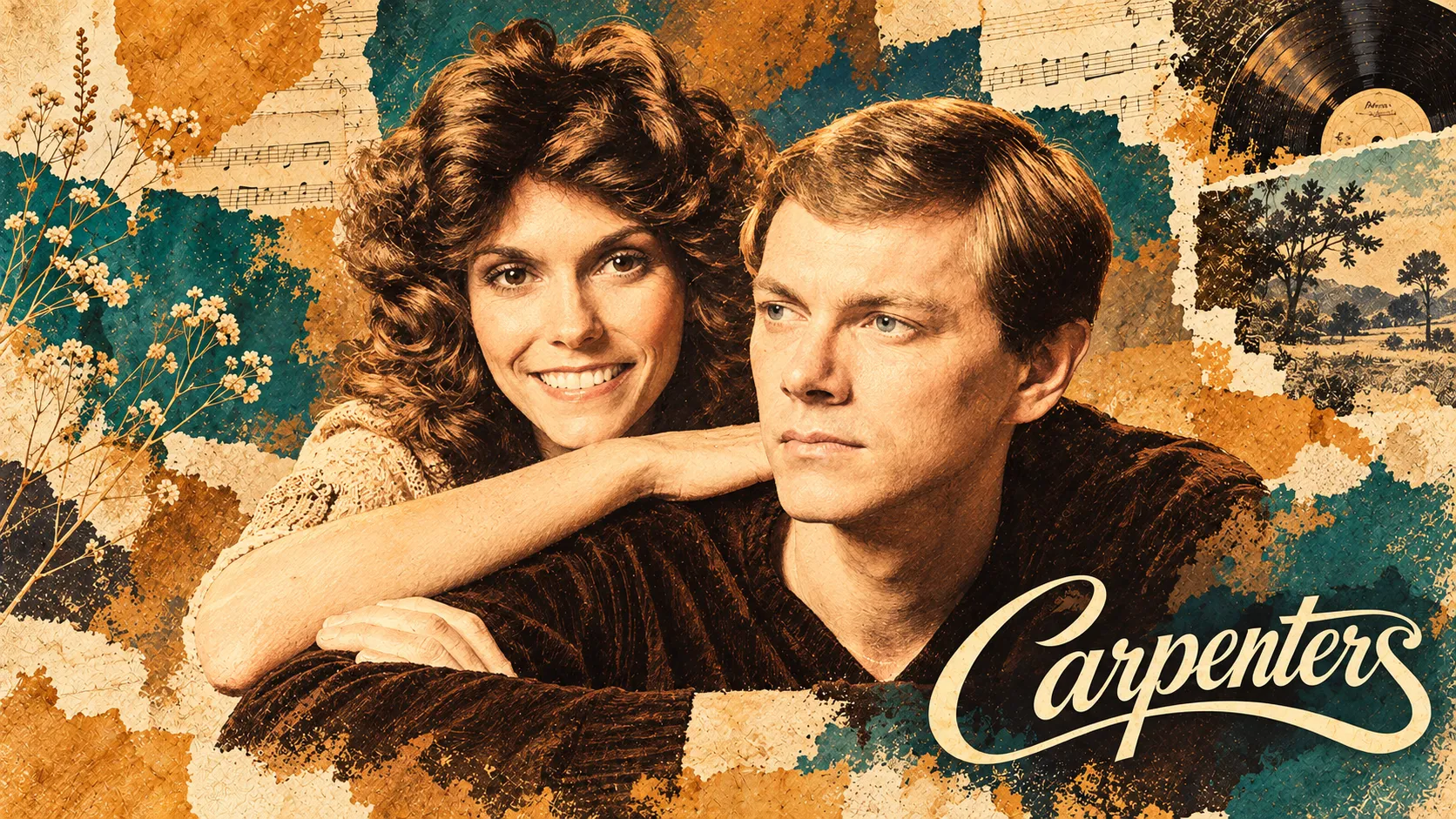
Karen first picked up drumsticks; Richard found a hit in a bank advertisement. Seven songs revisit the siblings and the musicians behind a familiar voice.
Article
The siblings began with a jazz trio
Think of the Carpenters—Karen and her brother Richard—and a voice may come to mind before any instrument. The opening of “Close to You” or the refrain of “Yesterday Once More” can be recognisable even when a title slips your memory. Yet Karen did not begin by dreaming of being a singer at the front of the stage. The instrument that first drew her to making music was the drums.1
The official biography describes Karen being captivated by fellow student Frankie Chavez’s drumming in high school. At home she tapped on chairs with chopsticks along to records; her parents later bought her a drum kit. In 1965 she formed a trio with Richard and bassist and tuba player Wes Jacobs. It was a jazz-oriented group, with Richard on piano and Karen on drums.12
That beginning changes how we see their roles. The future world-famous singer was keeping time, while her brother at the piano selected the music and shaped its sound. Richard recalls that the pieces they played to win the 1966 Hollywood Bowl competition were instrumentals. The Carpenters as we remember them did not arrive fully formed.2
Rediscovering Karen as a drummer does not mean assuming that she played drums on every recording. Hal Blaine played on “Close to You” and “Superstar,” while Karen is credited on “Yesterday Once More.” Looking at the other musicians alongside the siblings reveals how many people contributed to a familiar song.368
〈Close to You〉 and the birth of the Carpenters sound
Signing with A&M in 1969 did not bring immediate major success. Their first album included a reworking of the Beatles’ “Ticket to Ride.” Richard recalls that it caught Burt Bacharach’s attention, leading to preparations for a performance of Bacharach’s songs. An opportunity came not only from writing new material, but from someone hearing how they interpreted another writer’s work.23
While Richard was choosing the repertoire, A&M’s Herb Alpert gave him the sheet music for “(They Long to Be) Close to You,” written by Bacharach and Hal David. Richard arranged it but initially left it out of the concert medley. With Alpert’s encouragement, they decided to record it separately, making several attempts before everyone was satisfied. The recording released in 1970 became a turning point.3
The credits list Richard on arrangement and keyboards, Karen on lead vocals, and both on backing vocals. Piano, other instruments and overdubbed voices make room around the lead singer. Describing their sound solely in terms of Karen’s voice leaves out Richard’s decisions about the song and the sounds surrounding her. Those choices shaped what the listener heard.3
At the 1971 Grammys, they won Best New Artist and a vocal-performance award for “Close to You.” It may sound like a longstanding standard now, but then it introduced the sound of a new act. Next time, follow Karen’s voice and then notice where the piano and backing vocals enter. New things to hear in a familiar song need not be hidden.4
(They Long to Be) Close to YouA track from the 1970 album. Official Carpenters audio provided by Universal Music Group.〈We’ve Only Just Begun〉 was born from a bank advertisement
Richard found the next hit in a television commercial. A Crocker Bank advertisement showed a young couple marrying and driving towards the sunset, accompanied by “We’ve Only Just Begun.” Roger Nichols and Paul Williams had written it for the advertisement, not for a Carpenters album.5
Richard already knew both writers. He recognised Williams’s voice, met him at A&M and asked about the song. Since the advertisement used only a portion, he also asked whether there was a middle section and more verses. In his account, hearing the demo convinced him it could be a hit, and he began arranging it.5
The newlyweds are not the only interesting people in this scene. While other viewers might have been remembering the bank or waiting for the next programme, Richard heard the potential for a complete recording. He could imagine the song beyond the advertisement, with a different voice and different instruments. Finding their repertoire also meant noticing music already being used elsewhere.
Knowing the finished recording makes its advertising origins unexpected. The music found another life after the short commercial. The credit belongs to more than the arranger: Nichols’s melody, Williams’s lyrics, Richard’s arrangement and Karen’s singing gave the song a form that would be heard for years.5
We’ve Only Just BegunOfficial audio of the 1970 release: a song found in an advertisement became one of the duo’s best known.〈Superstar〉 reborn with Karen’s voice
Richard also discovered “Superstar” through someone else’s performance. While the Carpenters were making their third album, he saw Bette Midler sing it on The Tonight Show. He thought the right arrangement could make it a hit and that it would suit Karen. Leon Russell wrote the music and Bonnie Bramlett the lyrics.6
Recording it did not settle the choice of single. Richard recalled weighing “Superstar” against “Let Me Be the One,” concerned that the former’s lyrics might feel unusual on a Carpenters record. A&M’s Jerry Moss gave him confidence in the choice; Richard’s account ends by thanking him.6
There is no need to explain Richard’s concern through the siblings’ private relationship or later tragedy. He was considering how the song fitted their record. Once an act establishes a sound, listeners develop expectations. Selecting the next song involves deciding whether to repeat a strength or introduce a different feeling.
Here it helps to distinguish the song’s narrator from the singer. Karen gives voice to a story written by others. The closer that voice feels, the more tempting it is to make every sadness her own. But making another person’s story feel personal to a listener is part of a singer’s work. “Superstar” is an opportunity to hear that ability.
SuperstarOfficial video from CarpentersVEVO. Listen without immediately equating the song’s story with Karen’s life.〈Goodbye to Love〉, a meeting of ballad and fuzz guitar
“Goodbye to Love” brings us to Richard’s own writing and a new musical choice. He wrote most of the melody while in London in 1971, with lyrics by John Bettis. Richard praised Karen’s singing, explaining that the long phrases and chromatic passages make it difficult to sing accurately. A song that sounds effortless is not necessarily easy to perform.7
While arranging it, Richard imagined a fuzz-guitar solo with a rough, distorted tone. He also knew whom he wanted: Tony Peluso, whose band had backed Mark Lindsay when Lindsay opened for the Carpenters. For listeners used to piano and gentle voices, the guitar introduces a strikingly different sound. Richard had wanted that contrast from the beginning.7
Not everyone approved. Richard recalled receiving complaints that they had turned to hard rock. That was the response of some listeners, not a wholesale rejection by their fans. Still, it complicates the idea that the Carpenters always offered the same kind of softness. They made room for a new sound, and it surprised people.7
Keep listening after the voice falls silent. The guitar takes over and gives the same song a different expression. That moment depends both on the arranger imagining the sound and on the musician producing it. Following Karen into Peluso’s solo also brings Richard’s arrangement into focus.
Goodbye to LoveOfficial audio of the 1972 release. Stay with it through Tony Peluso’s guitar solo.The oldies nostalgia in “Yesterday Once More”
“Yesterday Once More” did not have to age before becoming a song about nostalgia. Richard and John Bettis wrote it in 1973 about the feeling of hearing old songs again. Richard explains that earlier hits were enjoying renewed popularity, a development he and Karen welcomed. Even then, there was older music they wanted to revisit.8
Richard planned to place the song before and after the oldies medley on side two of Now & Then. Heard within the album, the familiar single also introduces other songs and brings the listener back from them. The subject and the album’s structure work together: after describing the longing, the record actually returns to the older music.8
That brings us back to the drumsticks. Richard’s published credits list Karen as the drummer on this recording. The voice we recognise was also helping make the rhythm. There is no need to claim that a particular stroke reveals her personality; knowing the credit simply gives us another part to listen for.8
For today’s listeners, the Carpenters themselves are older music. A song recorded by the young siblings as they looked back at earlier music is now heard by people looking back at the siblings. The recording is unchanged, but the object of the nostalgia can differ: a parent’s record collection for one person, a chance playlist discovery for another. An old song does not take everyone to the same past.
Yesterday Once MoreOfficial audio of the 1973 release. On the original album, the song bookends an oldies medley.A voice waiting for a letter, 〈Please Mr. Postman〉
They also went beyond remembering old songs and recorded favourites themselves. “Please Mr. Postman” was a 1961 hit for the Marvelettes and was later recorded by the Beatles. Richard wrote that both he and Karen loved it and had long considered recording it. Their single came out in autumn 1974 and appeared on Horizon the following year.15
Even in the studio, the choice was not universally welcomed. Richard recalled engineer Ray Gerhardt’s dislike of the basic four-chord backing track; adding the rest of the arrangement did not change his taste. The siblings felt differently. They believed the simple song they loved could be a hit.15
Listen to the beat as well as Karen’s voice. The official credits name her on drums as well as lead vocals. Richard handled keyboards and arrangement, and the two built the backing vocals together. The drummer and arranger from the opening of this story were still working together inside a song listeners hummed.15
Please Mr. PostmanOfficial Carpenters audio provided by Universal Music Group. The single was released in 1974 and included on an album in 1975.The Carpenters' music continues across generations
Karen died on February 4, 1983, aged 32. Richard continued assembling unreleased recordings and compilations. In his writing, he described both the joy and the sorrow of that work, which he felt he owed to Karen and to the music they had made. Returning to recordings without the person who helped create them must have been very different from simply playing a record again.2
Later listeners did not all live through the duo’s active years. The official biography notes how the 1995 Japanese drama Miseinen introduced their songs to younger viewers. Music first heard on records and radio moved through television and now plays on phones. Each new route brings someone to a song for the first time.9
Knowing Karen’s life may make the sadness in her songs more immediately audible. But reading every recording as a confession foreshadowing her death narrows the life of a musician who played an instrument and reinterpreted other writers’ songs. She was a drummer and singer at the centre of recordings made with Richard and other musicians. Not every story she sang was a page from her diary.
The final selection is 1971’s “Rainy Days and Mondays,” also written by Roger Nichols and Paul Williams and arranged by Richard. Listen to the low spirits in the song, the voice conveying them, and the sounds chosen around that voice. What remains is more than one singer: it is the music of the people who helped make the recording.10
Rainy Days and MondaysOfficial audio of the 1971 song. This final selection brings Karen’s singing and Richard’s arrangement together.Sources and reporting notes
- Richard Carpenter Official · Karen’s drum/trio activity from 1964 to 1966
- Richard Carpenter · Gold 35th Anniversary Direct Retrospective
- Richard Carpenter · Close to You song commentary and performance credits
- Recording Academy · Carpenters Award Records
- Richard Carpenter · We’ve Only Just Begun song commentary
- Richard Carpenter · Superstar song commentary and performance credits
- Richard Carpenter · Goodbye to Love song commentary and performance credits
- Richard Carpenter · Yesterday Once More song commentary and performance credits
- Richard Carpenter Official Biography · Later listeners and Japanese television drama
- Universal Music Group · Rainy Days and Mondays official release music credit
- Carpenters official artist · Current introduction and official channel connection
- Carpenters - Topic · Official Music Channel
- CarpentersVEVO · Official Music Channel
- Carpenters Official Artist Channel · Official Music Channel
- Richard Carpenter · Please Mr. Postman song commentary and performance credits
The linked sources document the reporting. Personal recollections reflect the speakers’ memories, and comments on the music are editorial interpretation.
Machine-translated from Korean. Read the original.